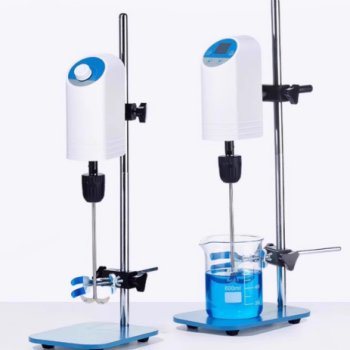
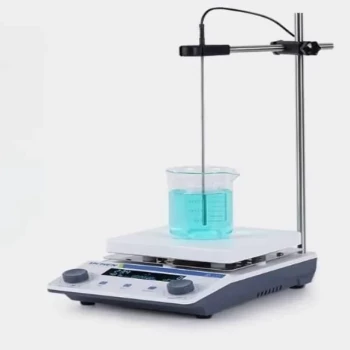
An overhead stirrer acts as the critical kinetic engine in a high-pressure reactor, enabling the conversion of cellulose by maintaining a uniform suspension of water-insoluble reactants. By operating at high speeds, typically around 1000 rpm, it prevents the sedimentation of cellulose powder and heterogeneous catalyst particles, ensuring consistent interaction within the aqueous solution.
By solving the physical problem of solid deposition, the overhead stirrer directly drives chemical efficiency. It maximizes mass transfer between phases, which is the primary factor in achieving high conversion rates and the selective production of sorbitol.
Overcoming Phase Incompatibility
Managing Insoluble Solids
In cellulose hydrogenolysis, neither the cellulose powder nor the heterogeneous catalyst dissolves in the aqueous medium.
Without active intervention, these solids naturally settle to the bottom of the reactor.
The overhead stirrer uses high-speed kinetic energy to force these particles to remain suspended, creating a homogeneous mixture out of a naturally heterogeneous system.
Enhancing Mass Transfer
For the chemical reaction to occur, the cellulose, catalyst, and hydrogen must make physical contact.
A static or poorly mixed system limits these interactions to the surface of the settled solids.
The stirrer facilitates rapid, chaotic movement throughout the reactor, significantly increasing the frequency of collisions between reactants and enhancing mass transfer efficiency.
Driving Reaction Quality
Preventing Localized Reactions
When solids are allowed to deposit or settle, the reaction environment becomes inconsistent.
This leads to "hot spots" or zones of inactivity, resulting in uneven reaction rates across the batch.
Continuous suspension ensures that every particle experiences the same conditions, preventing the localized variations that degrade product quality.
Increasing Selectivity and Conversion
The ultimate metric for reactor performance is the yield of the desired product—in this case, sorbitol.
Inefficient mixing often leads to incomplete conversion or the formation of unwanted byproducts.
By optimizing mass transfer and consistency, the overhead stirrer directly increases both the conversion rate of the cellulose and the selectivity toward sorbitol.
Operational Criticality: The Cost of Low Kinetics
The Dependency on Speed
The system relies entirely on adequate kinetic energy to function; this is not a passive process.
If the stirring speed drops below the necessary threshold (e.g., significantly lower than 1000 rpm), the suspension collapses immediately.
The Consequence of Deposition
Once solid deposition occurs, the surface area available for reaction plummets.
This halts the efficiency of the process almost instantly.
Therefore, the mechanical capability to maintain high RPM is not optional but a fundamental requirement for the reaction to proceed.
Making the Right Choice for Your Process
To optimize your cellulose conversion process, view the stirrer not just as a mixer, but as a reaction controller.
- If your primary focus is maximizing Yield: Prioritize high-torque, high-RPM stirring capabilities to ensure total suspension of all solid mass.
- If your primary focus is Product Purity (Selectivity): Focus on maintaining consistent agitation speeds to prevent localized gradients that lead to byproducts.
The success of cellulose hydrogenolysis relies less on the chemistry of the solution and more on the physics of the suspension.
Summary Table:
| Feature | Benefit for Cellulose Conversion | Impact on Results |
|---|---|---|
| High-Speed Kinetics | Prevents sedimentation of insoluble cellulose and catalysts | Maintains consistent reaction surface |
| Suspension Control | Eliminates "hot spots" and localized zones of inactivity | Ensures uniform product quality |
| Mass Transfer Efficiency | Increases collision frequency between cellulose, H2, and catalyst | Boosts conversion rates and yield |
| High Torque/RPM | Overcomes phase incompatibility in aqueous mediums | Maximizes selectivity toward sorbitol |
Elevate Your Chemical Processing with KINTEK Expertise
At KINTEK, we understand that the success of cellulose hydrogenolysis depends on the physics of suspension. Our high-performance high-temperature high-pressure reactors and autoclaves are engineered with precision overhead stirring systems to handle the most demanding kinetic requirements.
Whether you are focusing on maximizing yield or ensuring product purity, KINTEK provides the advanced laboratory equipment you need—from crushing and milling systems for feedstock preparation to temperature control solutions and specialized consumables like PTFE and ceramics.
Ready to optimize your reaction efficiency? Contact our technical specialists today to find the perfect reactor configuration for your research and production goals.
References
- Bashir Ahmad Dar, Mazahar Farooqui. Ceria-Based Mixed Oxide Supported CuO: An Efficient Heterogeneous Catalyst for Conversion of Cellulose to Sorbitol. DOI: 10.4236/gsc.2015.51003
This article is also based on technical information from Kintek Solution Knowledge Base .
Related Products
- High Performance Laboratory Stirrers for Diverse Applications
- High Pressure Laboratory Autoclave Reactor for Hydrothermal Synthesis
- Stainless High Pressure Autoclave Reactor Laboratory Pressure Reactor
- Customizable High Pressure Reactors for Advanced Scientific and Industrial Applications
- Customizable Laboratory High Temperature High Pressure Reactors for Diverse Scientific Applications
People Also Ask
- How does a laboratory stirrer influence MOF product quality? Master Precision in Non-Solvothermal Synthesis
- What critical role does a Laboratory Stirrer play during leaching? Enhance Titanium-Magnesium Waste Recovery
- What is the primary function of laboratory stirring equipment in the preparation of compost leachate? Optimize Extraction
- What is a laboratory mixer? A Guide to Achieving Perfect Sample Homogeneity
- What is a laboratory mixer used for? Choose the Right Tool for Liquids or Solids