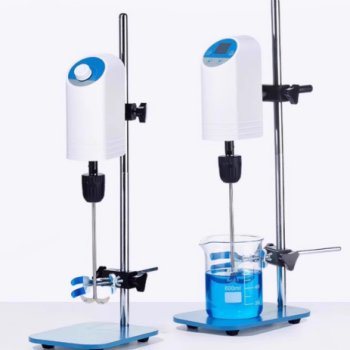
To handle the unique rheology of ionic liquid and biomass mixtures effectively, your pressure reactor requires a customized, high-torque stirring system. When processing these materials at significant scales (such as 40 kg) with solid loads around 15 wt%, the system must be equipped with a powerful impeller capable of overcoming extreme torque burdens. This driving force is the only way to ensure the slurry maintains flow for efficient mixing and uniform heat transfer.
Processing biomass in ionic liquids creates a highly viscous environment, particularly when solid loads reach 15 wt%. The stirring system’s primary role shifts from simple agitation to generating the massive torque required to physically move the heavy slurry, preventing thermal gradients and ensuring reaction homogeneity.
The Challenge of High-Viscosity Processing
The Impact of Solid Loading
When you introduce biomass into ionic liquids, the physical properties of the mixture change drastically.
At a 15 wt% solid load, the mixture transitions from a fluid into a thick, resistant slurry.
This increase in viscosity is not linear; it creates a substantial mechanical hurdle that standard agitation systems often fail to overcome.
Overcoming Torque Burdens
The defining requirement for your reactor is sufficient driving force.
As the viscosity climbs, the resistance against the impeller blades increases, creating a high torque burden on the motor.
A standard motor may stall or overheat under these conditions; therefore, a powerful, customized impeller system is non-negotiable to maintain rotation.
Critical Functions of the Stirring System
Achieving Efficient Mixing
In high-viscosity applications, turbulence does not occur naturally.
The stirring system must mechanically force the movement of the material to ensure the biomass is evenly distributed within the ionic liquid.
Without this "powerful impeller" action, the solids will stagnate, leading to incomplete reactions and poor yields.
Ensuring Uniform Heating
Heat transfer is severely compromised in thick slurries because convection currents are minimized.
The stirring system must circulate the material vigorously to move heated fluid away from the reactor walls and into the bulk of the mixture.
If the stirring lacks the power to move the slurry, you will experience hot spots near the walls and cold zones in the center, compromising process safety and quality.
Understanding the Trade-offs
Power vs. Complexity
Implementing a high-torque system often requires a more robust drivetrain and potentially a larger reactor footprint.
While this increases the initial engineering complexity and cost, it is a necessary investment to prevent process failure.
Energy Consumption
A system designed to overcome high torque burdens will naturally consume more energy than a standard agitator.
However, attempting to save energy by under-powering the stirrer is a false economy.
Inadequate stirring leads to longer reaction times and lower quality products, which are far more costly than the electricity required to drive a proper motor.
Making the Right Choice for Your Goal
When specifying your customized pressure reactor, prioritize the mechanical capability of the drive system.
- If your primary focus is Process Stability: Ensure the motor and impeller are rated for torque loads significantly higher than the theoretical baseline to prevent stalling during viscosity spikes.
- If your primary focus is Product Consistency: Prioritize impeller designs that maximize axial flow to ensure the biomass slurry is uniformly heated throughout the entire 40 kg batch.
A powerful, customized stirring system is not just a component; it is the engine that drives the viability of your entire biomass processing operation.
Summary Table:
| Requirement | Specification for High Viscosity | Impact on Process |
|---|---|---|
| Impeller Type | High-torque, customized impeller | Overcomes mechanical resistance; ensures slurry flow |
| Motor Power | High-driving force / Robust drivetrain | Prevents stalling and overheating under 15 wt% solid loads |
| Mixing Action | Forced mechanical movement | Ensures reaction homogeneity and prevents solid stagnation |
| Heat Transfer | Continuous material circulation | Eliminates hot spots and ensures uniform thermal distribution |
| Process Focus | Enhanced axial flow design | Maximizes product consistency and batch stability |
Optimize Your Biomass Processing with KINTEK Precision
Handling high-viscosity ionic liquids and complex biomass mixtures requires more than just standard equipment—it demands engineered reliability. KINTEK specializes in advanced laboratory solutions, including customized high-temperature high-pressure reactors and autoclaves specifically designed to handle extreme torque burdens and maintain uniform heat transfer.
Whether you are scaling to 40 kg batches or conducting specialized battery research, our comprehensive portfolio—from crushing and milling systems to PTFE consumables and ceramic crucibles—is built to withstand the rigors of modern material science.
Ready to overcome your viscosity challenges? Contact our engineering experts today to design a reactor system tailored to your specific process requirements and achieve unparalleled consistency in your research.
References
- Ling Liang, Ning Sun. Scale-up of biomass conversion using 1-ethyl-3-methylimidazolium acetate as the solvent. DOI: 10.1016/j.gee.2018.07.002
This article is also based on technical information from Kintek Solution Knowledge Base .
Related Products
- High Performance Laboratory Stirrers for Diverse Applications
- Customizable High Pressure Reactors for Advanced Scientific and Industrial Applications
- Mini SS High Pressure Autoclave Reactor for Laboratory Use
- Customizable Laboratory High Temperature High Pressure Reactors for Diverse Scientific Applications
- High Pressure Laboratory Autoclave Reactor for Hydrothermal Synthesis
People Also Ask
- How does a laboratory stirrer influence MOF product quality? Master Precision in Non-Solvothermal Synthesis
- What critical role does a Laboratory Stirrer play during leaching? Enhance Titanium-Magnesium Waste Recovery
- What is the primary function of laboratory stirring equipment in the preparation of compost leachate? Optimize Extraction
- What is a laboratory mixer? A Guide to Achieving Perfect Sample Homogeneity
- What is a laboratory mixer used for? Choose the Right Tool for Liquids or Solids