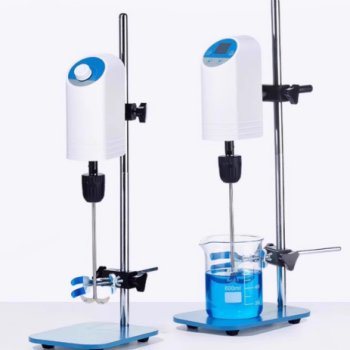
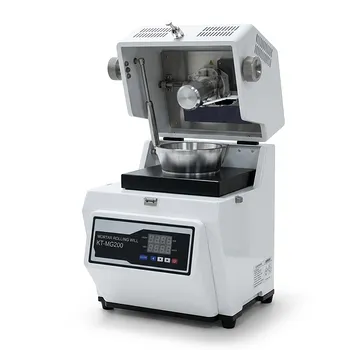
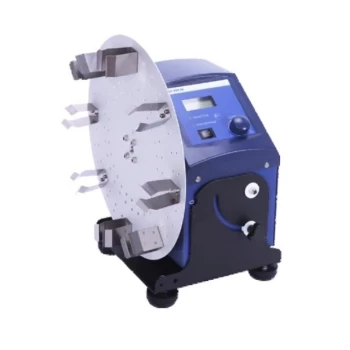
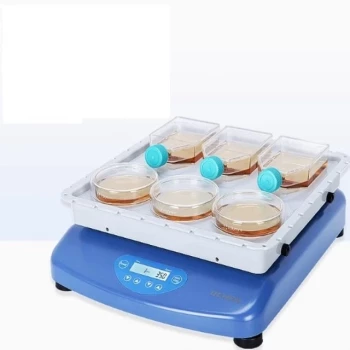
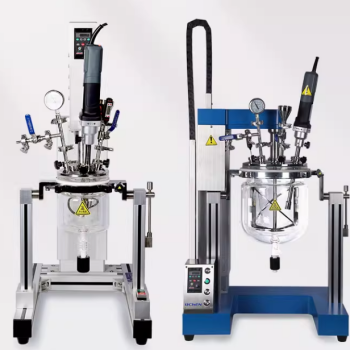
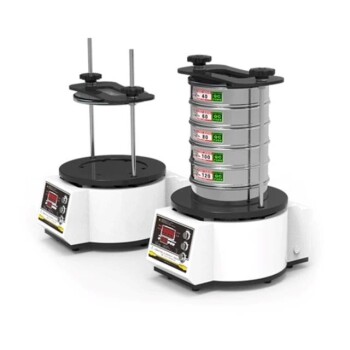
Laboratory stirring equipment serves as the primary stabilization mechanism in the preparation of Nano Zero-Valent Iron (nZVI) slurries. Its fundamental function is to generate high-speed mechanical agitation that forces iron nanoparticles to remain uniformly dispersed in deionized water, preventing the physical separation that naturally occurs with dense, magnetic metals.
The core challenge in nZVI preparation is that nanoparticles will instinctively clump together due to magnetic attraction or sink due to gravity. Stirring equipment acts as the counter-force to these physical laws, ensuring the slurry remains a homogeneous mixture capable of delivering precise chemical dosages.
The Mechanics of nZVI Dispersion
Counteracting Magnetic Agglomeration
Nano Zero-Valent Iron particles possess inherent magnetic properties. Without significant kinetic energy input, these particles naturally attract one another, forming larger clusters or "agglomerates."
High-speed mixing provides the shear force necessary to disrupt these magnetic bonds. By keeping the particles physically separated, the equipment maintains the high surface-area-to-volume ratio that makes nanoparticles effective.
Preventing Gravitational Settling
Despite their small size, iron particles are dense and prone to rapid sedimentation in water. If left static, the solids will separate from the liquid phase.
Continuous agitation combats gravitational settling by imparting constant upward and lateral momentum to the particles. This ensures the iron remains suspended in the deionized water carrier rather than accumulating at the bottom of the container.
Operational Impact on Treatment Efficiency
Ensuring Precise Dosage Control
For wastewater treatment applications, the concentration of the slurry must be consistent from the first drop to the last. Variations in concentration lead to erratic dosing.
Proper stirring guarantees that every volume of slurry introduced to the reactor contains the exact calculated mass of nZVI. This uniformity is non-negotiable for reproducible experimental results or reliable industrial treatment.
Stabilizing Reduction Potential (Eh)
The chemical effectiveness of nZVI is often monitored via the oxidation-reduction potential (ORP or Eh) within the reactor.
A uniform slurry ensures a stable reduction potential. When dispersion is poor, the reactivity fluctuates, leading to unstable treatment conditions and unpredictable degradation of contaminants.
Understanding the Trade-offs
The Limits of Mechanical Mixing
While stirring is effective for suspension, it differs from techniques like ultrasonic dispersion which uses cavitation to break down particles, or grinding which alters particle size.
Stirring equipment is strictly for maintaining the state of the slurry. It prevents re-agglomeration but does not fundamentally alter the particle size or morphology once the slurry is formed.
Managing Mass Transfer Resistance
As seen in broader ZVI applications, the interface between the solid particle and the liquid is where the reaction occurs. Static fluid creates a "boundary layer" that slows down chemistry.
Insufficient mixing speed can lead to mass transfer resistance. The equipment must provide enough turbulence to constantly refresh the liquid in contact with the iron surface, ensuring the reaction rate remains high.
Making the Right Choice for Your Goal
To maximize the effectiveness of your nZVI slurry, select your mixing parameters based on your specific stability requirements:
- If your primary focus is dosage accuracy: Prioritize high-speed, continuous agitation that strictly prevents gravitational settling to ensure the concentration entering the reactor is constant.
- If your primary focus is chemical reactivity: Ensure the stirring intensity is sufficient to overcome magnetic attraction, keeping particle surface area maximized for the reduction reaction.
The success of nZVI applications relies less on the chemistry of the iron itself and more on the mechanical ability to keep that iron accessible and evenly distributed.
Summary Table:
| Feature | Role in nZVI Preparation | Impact on Research/Treatment |
|---|---|---|
| High-Shear Mixing | Disrupts magnetic agglomeration | Maintains high particle surface area and reactivity |
| Continuous Agitation | Counteracts gravitational settling | Ensures uniform slurry concentration for precise dosing |
| Kinetic Energy Input | Overcomes mass transfer resistance | Accelerates reaction rates by refreshing particle interfaces |
| Homogenization | Stabilizes reduction potential (Eh) | Provides reproducible results and stable treatment conditions |
Optimize Your Nano-Material Preparation with KINTEK
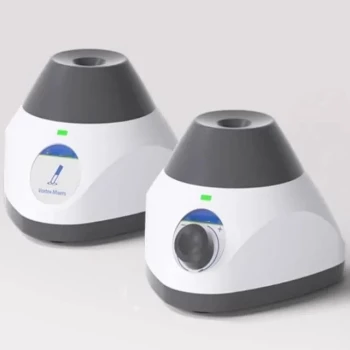
Precision in Nano Zero-Valent Iron (nZVI) applications depends entirely on the stability and uniformity of your slurry. At KINTEK, we provide high-performance laboratory stirring equipment, homogenizers, and shakers designed to overcome magnetic attraction and gravitational settling in even the most demanding chemical environments.
Beyond mixing, KINTEK offers a comprehensive suite of laboratory solutions, including:
- Advanced Thermal Processing: Muffle, tube, and vacuum furnaces for precise material synthesis.
- Sample Preparation: High-pressure hydraulic presses, crushing systems, and milling equipment.
- Specialized Reactors: High-temperature high-pressure reactors and autoclaves for complex chemical reactions.
- Electrochemical Tools: Electrolytic cells, electrodes, and battery research consumables.
Ready to elevate your lab's efficiency and ensure reproducible results? Contact our technical experts today to find the perfect equipment tailored to your research or industrial treatment goals.
References
- Thobeka Pearl Makhathini, Babatunde Femi Bakare. Enriched Co-Treatment of Pharmaceutical and Acidic Metal-Containing Wastewater with Nano Zero-Valent Iron. DOI: 10.3390/min11020220
This article is also based on technical information from Kintek Solution Knowledge Base .
Related Products
- High Performance Laboratory Stirrers for Diverse Applications
- Laboratory Small Constant Temperature Heated Magnetic Stirrer Heater and Stirrer
- Laboratory Vortex Mixer Orbital Shaker Multifunctional Rotation Oscillation Mixer
- Laboratory Vibratory Sieve Shaker Machine for Dry and Wet Three-Dimensional Sieving
- Mini Planetary Ball Mill Machine for Laboratory Milling
People Also Ask
- How does a laboratory stirrer influence MOF product quality? Master Precision in Non-Solvothermal Synthesis
- What critical role does a Laboratory Stirrer play during leaching? Enhance Titanium-Magnesium Waste Recovery
- What is the primary function of laboratory stirring equipment in the preparation of compost leachate? Optimize Extraction
- What is a laboratory mixer? A Guide to Achieving Perfect Sample Homogeneity
- What is a laboratory mixer used for? Choose the Right Tool for Liquids or Solids