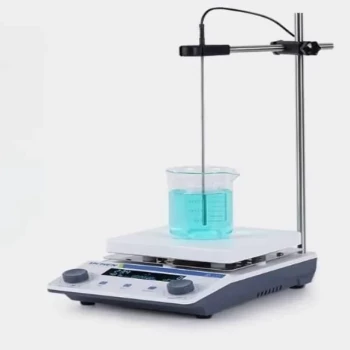
A laboratory magnetic stirrer is critical for maintaining high rotation speeds, typically around 1000 rpm, to ensure the homogenous integration of all reaction components. This intense mechanical agitation is necessary to mix reactants, products, and specialized catalysts—such as deep eutectic solvents or ion exchange resins—effectively.
High-speed stirring acts as a fundamental driver of process efficiency by eliminating physical barriers within the reaction vessel. It creates a uniform environment that maximizes contact between components, directly accelerating the reaction rate and optimizing catalytic performance.
The Physics of Reaction Efficiency
Eliminating Concentration Gradients
In a static or poorly mixed system, reactants and products can separate, creating localized pockets of differing concentrations.
High-speed rotation forces the continuous movement of the fluid, preventing this stratification. This ensures that the concentration of reactants remains uniform throughout the vessel, allowing the reaction to proceed consistently in all areas.
Removing Thermal Gradients
Temperature control is vital for esterification, but heat sources can create hot and cold spots within a mixture.
Vigorous stirring distributes thermal energy evenly across the entire system. By eliminating thermal gradients, the stirrer ensures the reaction temperature is maintained precisely where it needs to be for optimal kinetics.
Optimizing Catalytic Interaction
Enhancing Component Contact
For a reaction to occur, the reactants must physically contact the catalyst. This is particularly challenging when using complex systems involving deep eutectic solvents or ion exchange resins.
High rotation speeds generate the turbulence required to bring these distinct phases into sufficient contact. This mechanical forcing functions to overcome diffusion limitations that would otherwise slow down the process.
Accelerating Reaction Rates
The ultimate goal of using high speeds is to shorten the reaction time.
By ensuring uniform mixing and maximizing component contact, the system achieves a higher frequency of effective molecular collisions. This directly accelerates the overall reaction rate and enhances the efficiency of the catalyst.
The Risks of Inadequate Agitation
The Formation of "Dead Zones"
While high speed is beneficial, the primary operational risk is failing to maintain that speed throughout the process.
If the rotation drops below the optimal threshold (e.g., significantly under 1000 rpm), the system creates "dead zones" where mixing is insufficient. In these stagnant areas, catalysts may settle or heat may not transfer, leading to incomplete reactions and lower yields.
Making the Right Choice for Your Goal
To ensure successful preparation of benzoic acid esters, you must align your equipment settings with your specific chemical needs.
- If your primary focus is Speed of Reaction: Maintain high RPM to maximize molecular collisions and eliminate diffusion barriers immediately.
- If your primary focus is Consistency of Yield: Ensure the stirring speed is sufficient to completely banish thermal and concentration gradients that cause batch variations.
High-speed mixing is not merely a mechanical step; it is a kinetic necessity for driving complex esterification reactions to completion.
Summary Table:
| Feature | Impact on Esterification | Benefit to Laboratory Process |
|---|---|---|
| High Rotation Speed (1000 RPM) | Eliminates concentration & thermal gradients | Ensures uniform reaction conditions and prevents hotspots |
| Intense Mechanical Agitation | Maximizes contact between reactants & catalysts | Overcomes diffusion limitations of deep eutectic solvents |
| Turbulent Fluid Dynamics | Increases molecular collision frequency | Significantly accelerates overall reaction rates |
| Homogenous Mixing | Prevents the formation of "dead zones" | Ensures high yields and consistent batch quality |
Elevate Your Chemical Synthesis with KINTEK Precision
Achieve flawless homogeneity and peak reaction efficiency in your esterification processes. KINTEK specializes in high-performance laboratory equipment designed for rigorous chemical research. Whether you need advanced magnetic stirrers, precision high-temperature high-pressure reactors, or durable PTFE and ceramic consumables, we provide the tools to eliminate process variables.
From crushing and milling systems to sophisticated cooling solutions and battery research tools, KINTEK is your partner in laboratory excellence. Contact us today to optimize your lab setup!
References
- Emine Sert, Ferhan Sami Atalay. Application of Green Catalysts for the Esterification of Benzoic Acid with Different Alcohols. DOI: 10.18466/cbayarfbe.370364
This article is also based on technical information from Kintek Solution Knowledge Base .
Related Products
- Laboratory Small Constant Temperature Heated Magnetic Stirrer Heater and Stirrer
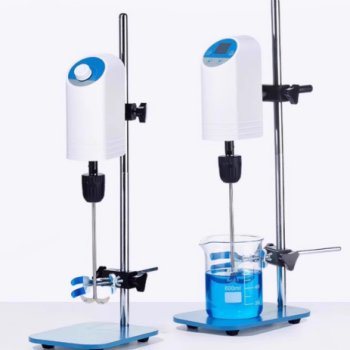
- High Performance Laboratory Stirrers for Diverse Applications
- Custom PTFE Teflon Parts Manufacturer for Magnetic Stirring Bar
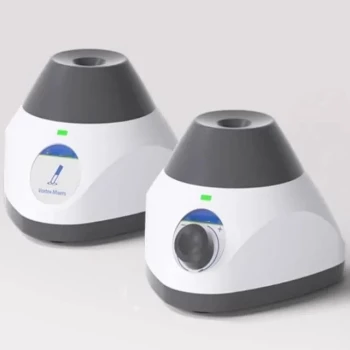
- Laboratory Vortex Mixer Orbital Shaker Multifunctional Rotation Oscillation Mixer
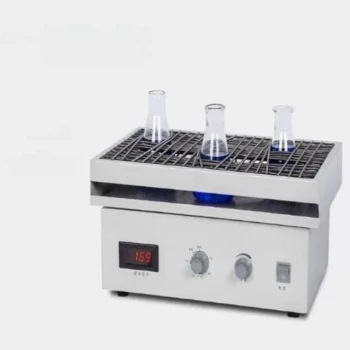
- Laboratory Multifunctional Small Speed-Adjustable Horizontal Mechanical Shaker for Lab
People Also Ask
- What role does a magnetic stirrer with heating play in ZnO nanoparticle synthesis? Precision Control for Quality Results
- What role does a constant temperature heating magnetic stirrer play in MFC-HAp synthesis? Achieve Material Homogeneity
- What is the function of a laboratory magnetic stirrer in Ni–Cr–P electrodeposition? Optimize Ion Transport & Coating
- What role does a laboratory magnetic stirrer play in TiO2 and TiO2-Ag sol preparation? Master Chemical Kinetics
- What role does a laboratory magnetic stirrer play in the acidification pretreatment of aluminum sludge? Speed Recovery