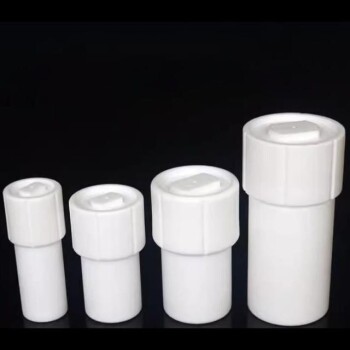
The high-pressure digestion tank with a PTFE liner serves as the essential reactor for the hydrothermal synthesis of Manganese-doped Sodium Vanadium Fluorophosphate (NVPF). It creates a hermetically sealed environment that maintains high temperatures (typically 200 °C) and autogenous pressures, which are necessary to facilitate uniform nucleation and crystal growth of precursor components at the molecular level.
Core Takeaway: This equipment provides the critical hydrothermal conditions required to construct a stable NVPF crystal structure, ensuring uniform manganese doping and high chemical purity by utilizing an inert liner to prevent metallic contamination and corrosion.
Creating the Hydrothermal Reaction Environment
Achieving Subcritical States
The digestion tank allows solvents to reach a subcritical state, significantly enhancing the solubility and reactivity of the manganese, sodium, and vanadium precursors. This environment is inaccessible at standard atmospheric pressure, making the sealed tank indispensable for the reaction.
Maintaining Autogenous Pressure
As the temperature rises within the sealed vessel, autogenous pressure is generated. This pressure forces the precursors to interact at the molecular level, ensuring that the manganese dopants are integrated evenly into the NVPF crystal lattice.
Facilitating Controlled Crystal Growth
Molecular-Level Nucleation
The high-pressure environment facilitates uniform nucleation, where the initial "seeds" of the NVPF crystal form simultaneously throughout the solution. This uniformity is vital for creating a final product with consistent electrochemical properties.
Structural Stability
By providing a controlled, high-energy environment, the tank allows for the construction of a stable NVPF crystal structure. This structural integrity is critical for the material’s performance as an electrode, as it must withstand repeated cycling in battery applications.
The Critical Role of the PTFE Liner
Corrosion Resistance
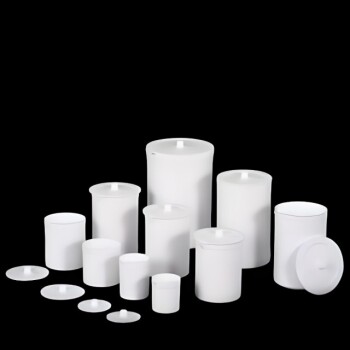
The Polytetrafluoroethylene (PTFE) liner is used because it is highly resistant to the aggressive chemical precursors and acidic environments often found in NVPF synthesis. It acts as a protective barrier, preventing the precursor solution from corroding the stainless steel outer shell of the digestion tank.
Ensuring Chemical Purity
By isolating the reaction from the metal vessel, the PTFE liner prevents metal ion contamination. This ensures the high purity of the synthesized Manganese-doped NVPF, which is essential for maintaining predictable performance in high-performance energy storage.
Understanding the Trade-offs
Temperature Limitations
While PTFE is highly inert, it has a physical limit; it generally cannot be used for reactions exceeding 250 °C. For NVPF synthesis requiring higher thermal energy, different liner materials like PPL (polyphenylene polymers) must be considered to avoid liner deformation.
Pressure Management and Safety
High-pressure digestion tanks are "black box" reactors, meaning the internal state cannot be monitored in real-time during the reaction. Overfilling the liner or using volatile solvents can lead to excessive pressure buildup, posing a safety risk if the rupture disk or safety valves fail.
How to Apply This to Your Synthesis Project
When selecting or operating a digestion tank for Manganese-doped NVPF synthesis, consider your specific material requirements:
- If your primary focus is Phase Purity: Ensure the PTFE liner is thoroughly cleaned with acid between runs to prevent "memory effects" or cross-contamination from previous batches.
- If your primary focus is Crystal Morphology: Precisely control the filling degree (typically 60-80%) of the PTFE liner to manage the headspace and the resulting autogenous pressure.
- If your primary focus is Scale-up Potential: Evaluate the heat transfer lag of the PTFE liner, as thicker walls in larger tanks can cause a delay between the oven temperature and the actual reaction temperature.
By mastering the hydrothermal environment provided by the PTFE-lined tank, you can achieve the precise molecular architecture necessary for high-performance Manganese-doped NVPF.
Summary Table:
| Component/Feature | Role in NVPF Synthesis |
|---|---|
| PTFE Liner | Prevents metal ion contamination and resists corrosive precursors. |
| High-Pressure Shell | Maintains autogenous pressure for molecular-level precursor interaction. |
| Hydrothermal State | Enables subcritical solvent conditions to enhance solubility and reactivity. |
| Nucleation Control | Facilitates uniform crystal growth for consistent electrochemical performance. |
| Temp. Threshold | Supports reactions up to 250°C; ensures structural stability of the lattice. |
Elevate Your Battery Research with KINTEK Precision
Achieving the perfect molecular architecture for Manganese-doped NVPF requires equipment that guarantees purity and stability. KINTEK specializes in high-performance laboratory solutions, offering a robust range of high-temperature high-pressure reactors and autoclaves designed specifically for demanding hydrothermal synthesis.
Beyond reactors, we provide the complete ecosystem for energy research, including:
- High-Temperature Furnaces: Muffle, tube, and atmosphere furnaces for precise calcination.
- Material Processing: Advanced crushing, milling, and sieving systems for uniform precursors.
- Electrochemical Tools: Electrolytic cells, electrodes, and high-precision battery research consumables.
- Lab Essentials: Specialized PTFE products, ceramics, and high-durability crucibles.
Don't let contamination or equipment failure compromise your results. Contact our technical experts today to find the ideal hydrothermal solutions tailored to your synthesis goals.
References
- Renyuan Su, Yurong Ren. Mnx+ Substitution to Improve Na3V2(PO4)2F3-Based Electrodes for Sodium-Ion Battery Cathode. DOI: 10.3390/molecules28031409
This article is also based on technical information from Kintek Solution Knowledge Base .
Related Products
- Custom PTFE Teflon Parts Manufacturer for Microwave Digestion Tank
- Custom PTFE Teflon Parts Manufacturer for PTFE Containers
- Custom PTFE Teflon Parts Manufacturer for Centrifuge Tube Racks
- Custom PTFE Teflon Parts Manufacturer for Hydrothermal Synthesis Reactor Polytetrafluoroethylene Carbon Paper and Carbon Cloth Nano-growth
- Custom PTFE Teflon Parts Manufacturer PTFE Beaker and Lids
People Also Ask
- Why are PTFE containers required for PCT leaching tests? Ensure Chemical Inertness and Analytical Precision
- Why use high-quality PTFE containers for CO2 reduction electrolytes? Eliminate silicon contamination and ensure data.
- Why is PTFE Mandatory for Hydrofluoric Acid (HF) Handling? Ensure Safety and Data Integrity in Corrosion Testing
- Why is a PTFE container required for acid leaching of silicon nanosheets? Ensure High Purity and Safety
- Why are polytetrafluoroethylene (PTFE) containers essential for assessing the corrosion resistance of glassified waste?