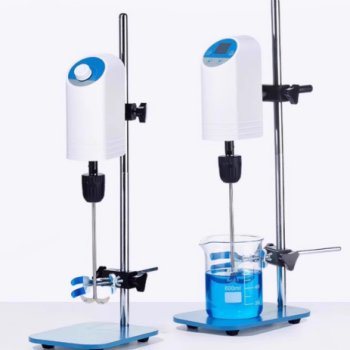
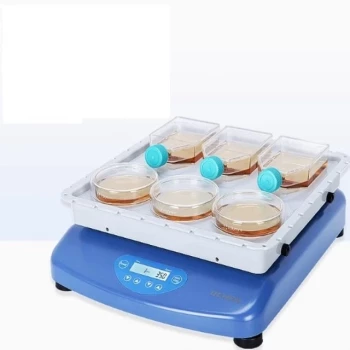
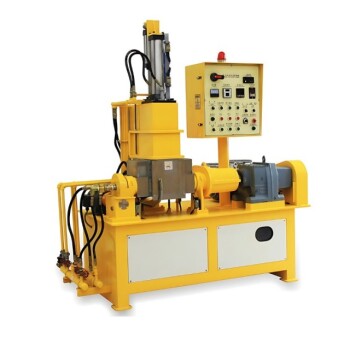
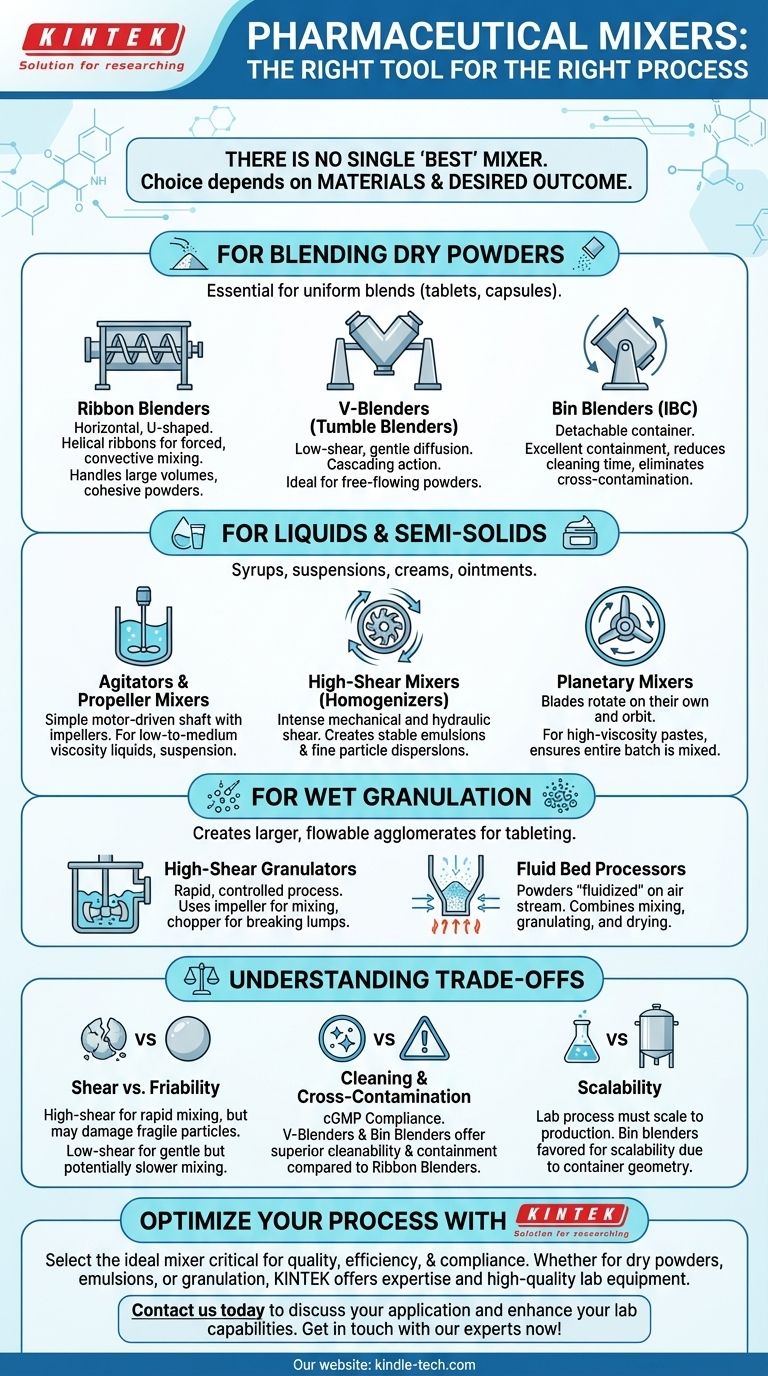
In the pharmaceutical industry, there is no single type of mixer. Instead, a range of specialized equipment is used, with the choice depending entirely on the specific materials and the desired outcome. For blending dry powders, a Ribbon Blender is a common and effective choice due to its ability to handle large volumes and mix materials with different densities.
The most critical insight is not to ask "what mixer is used," but "what is my mixing objective?" The right equipment is determined by the properties of your materials—solid, liquid, or semi-solid—and the specific process goal, whether it's simple blending, high-shear emulsification, or granulation.
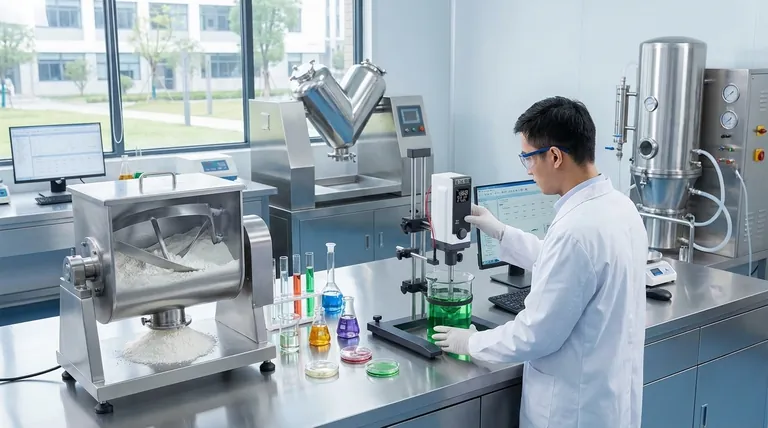
Why a Single "Best" Mixer Doesn't Exist
The term "mixing" in pharmaceuticals covers a wide array of processes, from gently tumbling powders to violently shearing liquids to form an emulsion. Each process requires a distinct mechanical action to achieve a uniform, validated result.
The Material Dictates the Method
Pharmaceutical ingredients can be dry powders, cohesive solids, low-viscosity liquids, or thick pastes and creams. A mixer designed for gentle powder blending would be entirely ineffective for creating a stable ointment.
The Process Defines the Goal
Simple blending aims to achieve content uniformity. Granulation aims to bind particles together. Emulsification aims to disperse one liquid within another. Each of these goals requires a different type of energy input and mechanical design.
Common Pharmaceutical Mixers by Application
To select the right equipment, it's best to categorize mixers by their primary function.
For Blending Dry Powders
This is the most common mixing application, essential for creating uniform blends for tablets and capsules.
- Ribbon Blenders: These use a horizontal, U-shaped trough with a central agitator shaft. Helical ribbons move the material both radially and axially, creating a forced, convective mixing action. This is effective for cohesive powders or when incorporating minor liquid components.
- V-Blenders (Tumble Blenders): These consist of two joined cylinders that tumble, causing the powder to cascade and intermix. This is a very low-shear, gentle process driven by diffusion. It is ideal for free-flowing powders with similar particle sizes and densities to prevent segregation.
- Bin Blenders (IBC Blenders): This modern approach uses a detachable container (Intermediate Bulk Container or IBC) that is clamped and rotated. The primary advantage is containment; the material never leaves the bin, which drastically reduces cleaning time and eliminates cross-contamination risk between batches.
For Liquids and Semi-Solids
This category covers the manufacturing of syrups, suspensions, creams, and ointments.
- Agitators & Propeller Mixers: These are used in tanks to mix low-to-medium viscosity liquids, keep solids in suspension, or ensure thermal uniformity. The design is simple, involving a motor-driven shaft with one or more impellers.
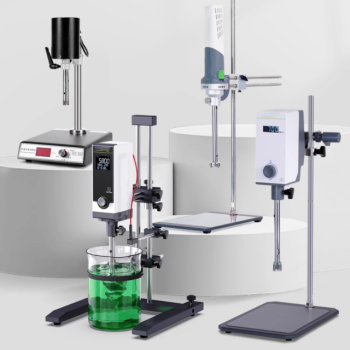
- High-Shear Mixers (Homogenizers): These are essential for creating stable emulsions and dispersions. They use a rotor-stator head that spins at high speed, subjecting the material to intense mechanical and hydraulic shear. This force breaks down droplets and particles to a microscopic size.
- Planetary & Double Planetary Mixers: For high-viscosity materials like thick creams and ointments, these mixers use blades that rotate on their own axes while also orbiting a central axis. This ensures that the entire batch is contacted, leaving no unmixed "dead zones."
For Wet Granulation
Granulation is the process of creating larger, more flowable agglomerates from fine powder, a key step before tablet compression.
- High-Shear Granulators: These use a main impeller to mix the dry powders and a chopper blade to break up wet lumps after a binding liquid is added. This provides a rapid and highly controlled granulation process.
- Fluid Bed Processors: In this technology, powders are suspended or "fluidized" on a stream of heated air. A binding solution is then sprayed into the fluidized bed, causing the particles to agglomerate into granules. This equipment can often combine mixing, granulating, and drying in a single step.
Understanding the Trade-offs
Every mixer design comes with inherent compromises. Understanding these is critical for process development and validation.
Shear vs. Friability
High-shear mixers provide rapid, intense mixing but can damage fragile or friable particles, altering the blend's properties. Conversely, low-shear tumble blenders are gentle but may be too slow or ineffective for cohesive powders that tend to form lumps.
Cleaning and Cross-Contamination
In the highly regulated pharmaceutical environment (cGMP), equipment must be easily and validatably cleanable. Ribbon blenders, with their fixed agitators and sharp corners, can have "dead spots" that are difficult to clean. V-Blenders and, especially, Bin Blenders offer superior cleanability and containment.
Scalability
A process developed on a 1 kg lab-scale mixer must be scalable to a 500 kg production-scale unit. The mixing dynamics of some designs do not scale linearly. Bin blenders are often favored for scalability, as the process is less dependent on the machine and more on the geometry of the container itself.
Selecting the Right Mixer for Your Process
Your final decision must be guided by your specific objective and material characteristics.
- If your primary focus is gentle blending of free-flowing, non-friable powders: A V-Blender or Bin Blender provides low-shear, diffusive mixing with excellent cleaning properties.
- If your primary focus is mixing cohesive powders or adding small amounts of liquid: A Ribbon Blender's forced convective action is effective at breaking up clumps and ensuring distribution.
- If your primary focus is creating stable emulsions or fine particle dispersions: A High-Shear Mixer or Homogenizer is non-negotiable to provide the required energy input.
- If your primary focus is producing granules for tableting: A dedicated High-Shear Granulator or Fluid Bed Processor is the correct choice for this specialized, multi-phase process.
Ultimately, choosing the right mixer is a foundational decision that directly impacts product quality, process efficiency, and regulatory compliance.
Summary Table:
| Application | Mixer Type | Key Features |
|---|---|---|
| Dry Powder Blending | Ribbon Blender, V-Blender, Bin Blender | Handles large volumes, gentle tumbling, excellent containment |
| Liquids & Semi-Solids | Agitators, High-Shear Mixers, Planetary Mixers | Creates emulsions, mixes high-viscosity pastes, no dead zones |
| Wet Granulation | High-Shear Granulators, Fluid Bed Processors | Forms granules, combines mixing and drying in one step |
Optimize Your Pharmaceutical Blending Process with KINTEK
Choosing the right mixer is critical for your product's quality, efficiency, and compliance. Whether you are blending dry powders, creating stable emulsions, or developing a granulation process, KINTEK has the expertise and equipment to meet your specific needs.
We specialize in providing high-quality lab equipment and consumables for the pharmaceutical industry. Our team can help you select the ideal mixer—from Ribbon Blenders to High-Shear Granulators—ensuring it aligns perfectly with your materials and process goals.
Contact us today to discuss your application and discover how KINTEK can enhance your laboratory's capabilities.
Get in touch with our experts now!
Visual Guide
Related Products
- High Shear Homogenizer for Pharmaceutical and Cosmetic Applications
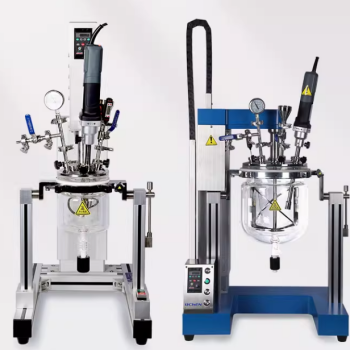
- High Performance Lab Homogenizer for Pharma Cosmetics and Food R&D
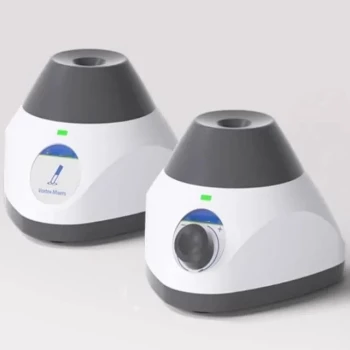
- Laboratory Vortex Mixer Orbital Shaker Multifunctional Rotation Oscillation Mixer
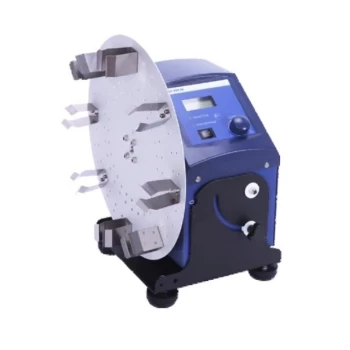
- Laboratory Disc Rotary Mixer for Efficient Sample Mixing and Homogenization
- High Performance Laboratory Stirrers for Diverse Applications
People Also Ask
- What is the necessity of high-shear emulsifiers in silver nanoparticle coatings? Achieve Perfect Dispersion Today
- What is the necessity of using an industrial-grade high-shear homogenizer for biomass washing? Ensure Process Efficiency
- What functions do laboratory centrifuges and high-shear homogenizers perform? Optimize Your Nano-Modified Composites
- Why is a high-shear laboratory mixer essential in cement-based material prep? Achieve Uniform Nanoparticle Dispersion
- What role does a high-shear homogenizer play in ODC catalyst suspensions? Unlock Superior Electrochemical Efficiency