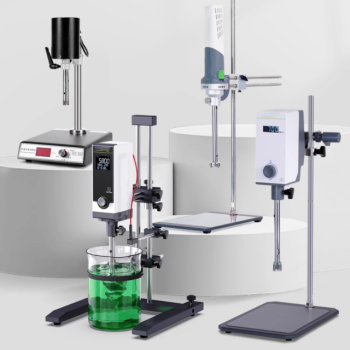
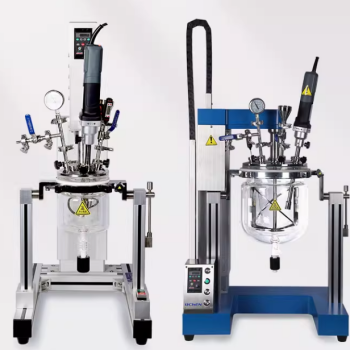
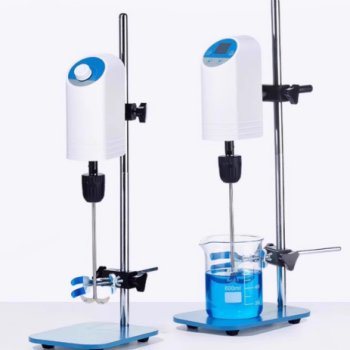
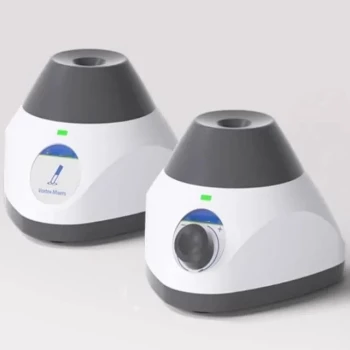
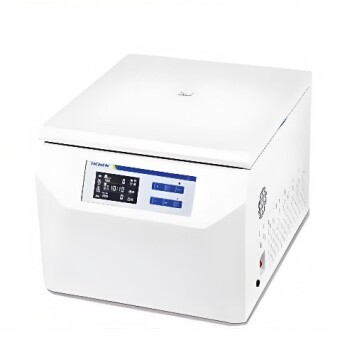
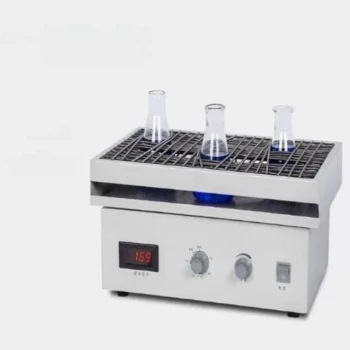
High-shear laboratory mixing is the definitive method for overcoming nanoparticle agglomeration. In experimental cement preparation, nanoparticles such as nano-SiO2 and nano-Fe2O3 possess a strong natural tendency to stick together. A high-shear mixer provides the intense mechanical force required to break these clusters apart, ensuring the particles are distributed evenly throughout the cement slurry.
Without high-shear intervention, nanoparticles self-agglomerate and fail to integrate with the cement matrix. Uniform dispersion is the prerequisite for these particles to act as nucleation centers, directly driving improvements in material density and early strength.
The Challenge: Overcoming Self-Agglomeration
The Nature of Nanoparticles
Nanoparticles used in cement modification, specifically nano-SiO2 and nano-Fe2O3, differ significantly from standard cement additives.
Due to their surface properties, these particles exhibit strong self-agglomeration tendencies. Left to their own devices, they form clumps rather than distinct, individual units.
The Failure of Low-Energy Mixing
Standard mixing methods often lack the mechanical energy to break these inter-particle bonds.
If the particles remain clumped, they exist as voids or weak points within the mixture. They cannot interact chemically or physically with the cement in the intended manner.
The Solution: High-Shear Mechanics
Generating Intense Mechanical Force
A high-shear laboratory mixer is designed to deliver concentrated energy into the slurry.
This intense mechanical force shears the agglomerates apart. It physically forces the nanoparticles to separate and disperse into the surrounding liquid medium.
Creating Nucleation Centers
The primary goal of dispersion is not just visual uniformity; it is functional activation.
When uniformly dispersed, individual nanoparticles serve as nucleation centers. These centers provide a surface for cement hydrates to grow, accelerating the hydration process.
Enhancing Material Properties
The direct result of effective nucleation is a tangible improvement in the hardened material.
Because the hydration products form more densely around these dispersed centers, the cement exhibits significantly improved early strength and higher overall density.
Common Pitfalls to Avoid
The Risk of Incomplete Dispersion
The most common error in experimental preparation is underestimating the shear force required.
If the mixer does not provide sufficient energy, the material will effectively contain "clumps" of expensive filler rather than active modifiers. This negates the benefits of using nanoparticles entirely.
Misinterpreting Strength Data
If strength results are lower than expected, look at the mixing process first.
Poor dispersion often leads to inconsistent data. The presence of agglomerates can act as stress concentrators, actually weakening the cement rather than strengthening it.
Making the Right Choice for Your Goal
To maximize the effectiveness of nanoparticle-modified cement, match your mixing protocol to your specific experimental objectives:
- If your primary focus is Early Strength: rigorous high-shear mixing is required to create the maximum number of nucleation centers immediately.
- If your primary focus is Material Density: use high-shear mixing to ensure particles fill microscopic voids rather than creating new ones through clumping.
High-shear mixing is not merely an optional step; it is the fundamental enabler of nanotechnology in cementitious materials.
Summary Table:
| Feature | High-Shear Mixing | Standard Mixing |
|---|---|---|
| Particle State | Individual particles (dispersed) | Large clusters (agglomerated) |
| Mechanism | Intense mechanical shear force | Low-energy agitation |
| Hydration Role | Active nucleation centers | Inactive filler/voids |
| Material Impact | High density & early strength | Potential weak points & inconsistent data |
Elevate Your Research with KINTEK Precision Equipment
Maximize the potential of your nanoparticle-modified materials with KINTEK’s high-performance laboratory equipment. Whether you are developing advanced cementitious composites or researching next-generation energy storage, our specialized homogenizers, crushing and milling systems, and high-pressure reactors ensure the precision and repeatability your experiments demand.
Why partner with KINTEK?
- Superior Dispersion: Our homogenizers and milling systems provide the intense energy required to eliminate nanoparticle agglomeration.
- Comprehensive Solutions: From ultrasonic cleaners and shakers to PTFE consumables and ceramics, we provide everything needed for a controlled lab environment.
- Industry Expertise: We specialize in supporting researchers with high-quality battery research tools, dental furnaces, and hydraulic presses tailored for material science.
Don't let poor dispersion compromise your data. Contact KINTEK today to find the perfect mixing and preparation solution for your lab!
References
- Xu Chen. Nanoscale Construction Biotechnology for Cementitious Materials: A Prospectus. DOI: 10.3389/fmats.2020.594989
This article is also based on technical information from Kintek Solution Knowledge Base .
Related Products
- High Shear Homogenizer for Pharmaceutical and Cosmetic Applications
- High Performance Lab Homogenizer for Pharma Cosmetics and Food R&D
- High Performance Laboratory Stirrers for Diverse Applications
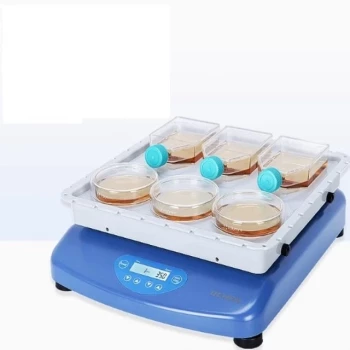
- Laboratory Vortex Mixer Orbital Shaker Multifunctional Rotation Oscillation Mixer
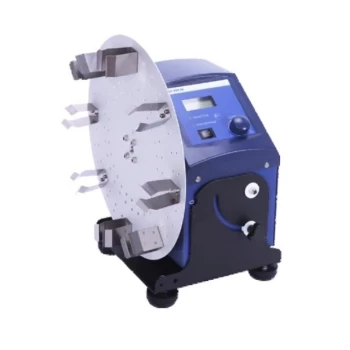
- Laboratory Disc Rotary Mixer for Efficient Sample Mixing and Homogenization
People Also Ask
- Why Use a High Shear Homogenizer for Cathode Slurries? Optimize Double-Layer Solid-State Battery Production
- What is the function of high-shear dispersion equipment in corona-resistant nanocomposites? Elevate Your Insulation
- What is the necessity of using an industrial-grade high-shear homogenizer for biomass washing? Ensure Process Efficiency
- What are the advantages of using a high-shear homogenizer for BED/GMA coatings? Achieve Superior Nano-Dispersion
- What role does a high-shear homogenizer play in ODC catalyst suspensions? Unlock Superior Electrochemical Efficiency