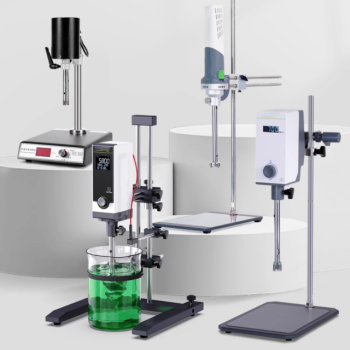
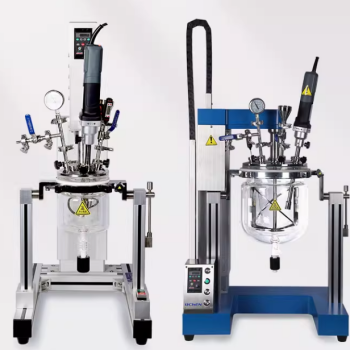
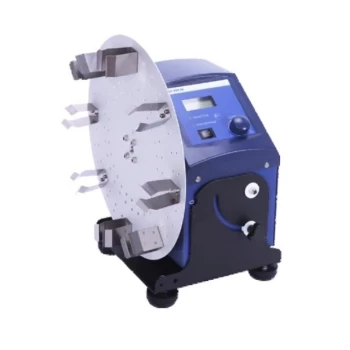
Ultrasonic homogenization equipment serves as a critical catalyst in the green synthesis of carbon nanomaterials by leveraging the power of acoustic cavitation. This process generates localized high temperatures, pressures, and shock waves to physically disrupt the tough, fibrous structures of agricultural waste like bagasse or fruit peels. By doing so, it significantly aids in the dispersion and exfoliation of biomass within a solvent, enhancing the overall efficiency of the conversion process.
The core advantage of this technology lies in its ability to mechanically break down complex biomass structures, facilitating deeper chemical penetration and resulting in finer, higher-quality carbon nanomaterials.
The Mechanics of Ultrasonic Cavitation
Generating Extreme Localized Conditions
The equipment operates by inducing the cavitation effect within a liquid medium. This phenomenon creates microscopic bubbles that collapse violently, generating intense localized heat, high pressure, and strong shock waves.
Physical Breakdown of Biomass
These mechanical forces are uniquely suited for processing agricultural waste. They effectively attack the complex fibrous structures inherent in biomass, such as fruit peels and bagasse, which are typically resistant to standard processing.
Dispersion and Exfoliation
Beyond simple mixing, the shock waves assist in the active dispersion of the material. This leads to the exfoliation (peeling apart) of the biomass layers, increasing the surface area available for reaction.
Enhancing the Synthesis Process
Facilitating Chemical Penetration
A major barrier in processing agricultural waste is getting chemical agents into the dense fiber matrix. Ultrasonic homogenization breaks down these physical barriers, allowing oxidants and activators to penetrate deeply into the material.
Improving Carbonization Efficiency
Because chemical agents can reach the core of the biomass more effectively, the carbonization process becomes more efficient. The reaction is not limited to the surface, allowing for a more complete transformation of the waste material.
Impact on Final Material Quality
Reduction of Physical Dimensions
The ultimate goal of this synthesis is to create materials at the nanoscale. The intense mechanical force applied during homogenization directly reduces the physical dimensions of the final carbon product, ensuring true nanomaterial characteristics.
Understanding the Trade-offs
Dependence on Solvent Interaction
While highly effective, the cavitation process relies on the presence of a solvent to transmit shock waves. The efficiency of the dispersion is strictly tied to how well the chosen solvent interacts with the specific type of agricultural waste being processed.
Making the Right Choice for Your Project
To determine if ultrasonic homogenization is the right step for your green synthesis workflow, consider your specific end goals:
- If your primary focus is process speed: This method accelerates the synthesis by forcing oxidants and activators into the biomass structure faster than passive soaking.
- If your primary focus is particle size: The mechanical exfoliation provided by cavitation is essential for reducing the final physical dimensions of the carbon nanomaterials.
Ultrasonic homogenization effectively bridges the gap between raw, fibrous agricultural waste and high-value carbon nanomaterials through precise mechanical force.
Summary Table:
| Feature | Benefit in Green Synthesis |
|---|---|
| Acoustic Cavitation | Generates localized high temperature and pressure to break fibrous biomass. |
| Structural Disruption | Physically exfoliates agricultural waste like bagasse for deeper chemical penetration. |
| Dispersion Efficiency | Ensures uniform distribution of oxidants and activators within the solvent. |
| Material Quality | Directly reduces particle dimensions to achieve true nanoscale characteristics. |
| Process Speed | Accelerates the conversion of waste into high-value carbon products. |
Elevate Your Nanomaterial Synthesis with KINTEK Precision
Maximize the potential of your green synthesis research by integrating KINTEK’s high-performance ultrasonic homogenization equipment. Whether you are converting agricultural waste into carbon nanomaterials or developing advanced battery research tools, our solutions provide the mechanical force needed for superior exfoliation and dispersion.
From high-temperature furnaces and ball milling systems to high-pressure reactors and PTFE consumables, KINTEK specializes in laboratory equipment designed for the most demanding material science applications. Our team is dedicated to providing researchers with the durability and precision required to achieve breakthroughs in sustainability and energy storage.
Ready to optimize your lab's efficiency and material quality? Contact KINTEK today to find the perfect solution for your workflow!
References
- Gaurav Tatrari, Nanda Gopal Sahoo. Solid waste-derived carbon nanomaterials for supercapacitor applications: a recent overview. DOI: 10.1039/d0ma00871k
This article is also based on technical information from Kintek Solution Knowledge Base .
Related Products
- High Shear Homogenizer for Pharmaceutical and Cosmetic Applications
- High Performance Lab Homogenizer for Pharma Cosmetics and Food R&D
- Lab Sterile Slapping Type Homogenizer for Tissue Mashing and Dispersing
- Laboratory High Throughput Tissue Grinding Mill Grinder
- Laboratory Disc Rotary Mixer for Efficient Sample Mixing and Homogenization
People Also Ask
- Why Use a High Shear Homogenizer for Cathode Slurries? Optimize Double-Layer Solid-State Battery Production
- What is the function of high-shear dispersion equipment in corona-resistant nanocomposites? Elevate Your Insulation
- What is the necessity of using an industrial-grade high-shear homogenizer for biomass washing? Ensure Process Efficiency
- What are the advantages of using a high-shear homogenizer for BED/GMA coatings? Achieve Superior Nano-Dispersion
- What role does a high-shear homogenizer play in ODC catalyst suspensions? Unlock Superior Electrochemical Efficiency