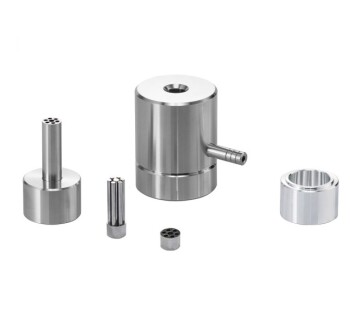
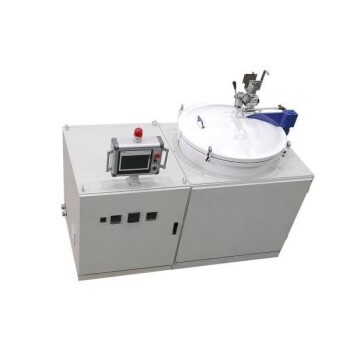
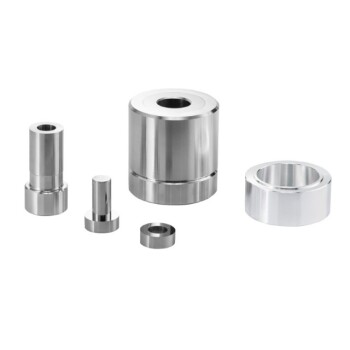
High-temperature molds, specifically graphite variants, function primarily as dual-purpose vessels for geometric containment and uniform pressure transmission during the vacuum hot pressing of WC-10Co. Their critical role is to withstand the mechanical stress of hydraulic loading (typically around 10 MPa) while maintaining structural integrity at sintering temperatures, ensuring the applied force is transferred evenly to the powder to achieve the required material density.
Core Takeaway The success of sintering WC-10Co relies not just on heat, but on the mold's ability to act as a rigid pressure conduit. It must translate external hydraulic force into uniform internal compression, directly dictating the final dimensional accuracy and density distribution of the cemented carbide.
The Mechanics of Shaping and Containment
Defining Final Geometry
The most immediate function of the mold is to serve as a precision container.
It confines the loose WC-10Co powder, establishing the macroscopic shape of the final cemented carbide product. The mold must maintain its dimensions rigidly, preventing the powder from shifting or deforming during the initial stages of the process.
Withstanding Extreme Environments
To function effectively, the mold material must offer exceptional high-temperature mechanical strength.
The sintering process subjects the mold to intense heat (often ranging from 650°C to 1500°C) combined with significant physical stress. A failure in the mold's structural integrity under these conditions would result in immediate defects or the total loss of the billet.
The Critical Role of Pressure Transmission
Uniform Force Distribution
The primary reference highlights that uniform pressure distribution is the decisive factor in the quality of the sintered body.
The mold acts as the medium that transfers the uniaxial load from the hydraulic rams to the powder. If the mold deforms unevenly, the pressure gradient within the powder becomes inconsistent, leading to density variations in the final product.
Achieving High Density
The application of mechanical pressure (e.g., 10 MPa or higher) forces particle contact within the WC-10Co mixture.
This pressure promotes densification by mechanically reducing porosity and driving the rearrangement of particles. This is essential for achieving the high hardness and toughness characteristics associated with cemented carbides.
Facilitating Gas Expulsion
While the vacuum environment manages the atmosphere, the pressure applied by the mold assists in the physical expulsion of entrapped gases.
By compressing the powder lattice, the mold helps force out pockets of air or volatiles that would otherwise form voids, ensuring a non-porous microstructure.
Thermal Functions and Efficiency
Acting as a Heating Element
In induction-heated systems, graphite molds often serve as susceptors or induction receptors.
They convert electromagnetic energy into heat, which is then transferred to the WC-10Co powder. This allows for rapid and efficient heating compared to purely radiative methods.
Thermal Conductivity and Uniformity
Graphite's high thermal conductivity ensures that heat is distributed evenly throughout the powder specimen.
This prevents thermal gradients that could lead to uneven sintering or residual stresses within the carbide, facilitating a strong metallurgical bond between the tungsten carbide and the cobalt binder.
Understanding the Trade-offs
Mechanical Limits vs. Density Goals
While higher pressures generally yield better density, every mold has a mechanical yield point.
Pushing a graphite mold beyond its rated pressure (e.g., significantly exceeding 10-30 MPa depending on the grade) can cause fracture. You must balance the desire for maximum density against the structural limits of the specific mold grade you are using.
Chemical Interactions
Although graphite is largely inert, risks exist at extreme temperatures.
While the vacuum environment minimizes oxidation, direct contact between the mold and certain reactive elements in complex alloys can occasionally lead to carbon diffusion or surface contamination. Proper release agents or specific mold grades are required to ensure easy demolding and surface purity.
Making the Right Choice for Your Goal
To optimize your WC-10Co sintering process, select your mold strategy based on your specific engineering priorities:
- If your primary focus is Dimensional Accuracy: Prioritize high-strength graphite grades with minimal thermal expansion to ensure the mold retains precise geometry under 10 MPa loads.
- If your primary focus is Material Density: Focus on the mold's ability to withstand higher hydraulic pressures without deformation to maximize particle compaction.
- If your primary focus is Process Efficiency: Utilize graphite molds with optimized electrical properties to act as effective induction receptors for faster heating cycles.
Ultimately, the mold is not just a container; it is an active mechanical component that defines the structural integrity of your final product.
Summary Table:
| Core Function | Description | Impact on WC-10Co |
|---|---|---|
| Geometric Containment | Confines powder to precise macroscopic shapes | Ensures dimensional accuracy and near-net shapes |
| Pressure Transmission | Transfers hydraulic force (10+ MPa) to powder | Eliminates porosity and achieves high material density |
| Thermal Induction | Acts as a susceptor to convert EM energy to heat | Enables rapid, uniform heating and process efficiency |
| Gas Expulsion | Compresses powder lattice to drive out volatiles | Creates a non-porous, high-strength microstructure |
| Structural Integrity | Resists mechanical stress at 650°C - 1500°C | Prevents billet deformation and mold failure |
Elevate Your Material Research with KINTEK Precision Engineering
Achieving the perfect density and microstructure in cemented carbides requires equipment that stands up to the most demanding thermal and mechanical stresses. KINTEK specializes in providing high-performance laboratory solutions, including high-temperature molds, vacuum hot pressing systems, and advanced muffle or vacuum furnaces designed for precision sintering.
Our comprehensive portfolio supports your entire workflow—from hydraulic pellet presses for initial shaping to crushing and milling systems for powder preparation. Whether you need specialized graphite consumables, ceramics, or high-pressure reactors, KINTEK delivers the reliability your research demands.
Ready to optimize your sintering process? Contact our technical experts today to find the ideal equipment for your laboratory.
Related Products
- 2200 ℃ Graphite Vacuum Heat Treat Furnace
- Ultra-High Temperature Graphite Vacuum Graphitization Furnace
- Horizontal High Temperature Graphite Vacuum Graphitization Furnace
- Ball Press Mold for Lab
- Anti-Cracking Press Mold for Lab Use
People Also Ask
- What is the process of vacuum heat treating? Achieve Superior Hardening with a Clean, Bright Finish
- How does heat transmit in a vacuum? Mastering Thermal Radiation for Purity & Precision
- Why do you heat treat in a vacuum? Achieve Perfect Surface Finish and Material Integrity
- How does a vacuum heat treat furnace work? Achieve Pristine, Oxide-Free Metal Parts
- What is graphite heating? A Guide to Durable, High-Temp Industrial Furnace Solutions