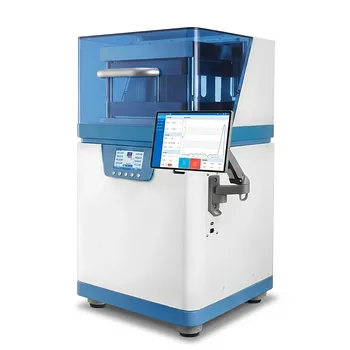
The high-pressure solvothermal reactor acts as a critical "structural primer" that dictates the final crystalline architecture of niobium pentoxide. Specifically, it provides a sealed, high-temperature (260 °C) environment using ethanol to modify the physicochemical state of niobium pentoxide hydrate precursors. This specialized pretreatment is the essential step that enables the precursor to transform into a distinct mixed-phase structure, consisting of coexisting H and M phases, during the final high-temperature calcination process.
The core role of the reactor is to facilitate a high-pressure chemical reorganization of the precursor that cannot be achieved at ambient pressure. This pretreatment effectively "programs" the material to develop the specific H and M crystalline phases required for high-performance applications.
The Mechanics of Solvothermal Pretreatment
Superheating Beyond the Boiling Point
The reactor allows ethanol to reach temperatures of 260 °C, which is far above its standard boiling point. By maintaining a sealed environment, the reactor generates autogenous pressure, keeping the solvent in a liquid or supercritical state where its reactivity and diffusion capabilities are significantly enhanced.
Physicochemical Modification of the Precursor
Under these extreme conditions, the niobium pentoxide hydrate precursor undergoes a transformation in its chemical and physical state. This environment facilitates the deep penetration of the solvent into the precursor's molecular structure, reorganizing its bonds and preparing it for phase transitions that would otherwise be inaccessible.
Ensuring Uniformity and Stability
The isothermal and pressurized conditions within the reactor ensure that the entire batch of precursor is treated uniformly. This consistency is vital for preventing the formation of unwanted single-phase impurities and ensuring that the final material exhibits a stable, structurally intact framework.
Enabling the Mixed-Phase Transition
Setting the Stage for Calcination
The solvothermal process does not complete the phase transformation but acts as a mandatory pretreatment. By altering the precursor's state in the reactor, the material is primed so that it naturally transitions into the mixed H and M phases when it is later subjected to high-temperature calcination.
The Limitation of Conventional Methods
Standard heating or low-pressure methods often result in the formation of a single, stable phase rather than the desired dual-phase (d-H,M-Nb2O5) structure. The high-pressure reactor overcomes these thermodynamic barriers by providing the energy and pressure required to stabilize the transition intermediates.
Parallels in Advanced Synthesis
Similar to how high-pressure reactors facilitate the oriented growth of nanorods or the ordered coordination of metal-organic frameworks (MOFs), the solvothermal treatment of niobium ensures that the growth of the H and M phases is controlled and predictable.
Understanding the Trade-offs
Equipment Complexity and Safety
The use of high-pressure reactors requires specialized corrosion-resistant materials, such as PTFE liners, and rigorous safety protocols. Working with ethanol at 260 °C under pressure introduces significant safety risks compared to open-air calcination or standard hydrothermal processes.
Scalability vs. Precision
While solvothermal reactors provide unmatched precision in phase control, they are often limited by batch size and reaction time. Balancing the need for high-pressure pretreatment with the requirements of mass production is a common challenge in materials science.
Energy Demands
The two-step process—pressurized solvothermal pretreatment followed by high-temperature calcination—is more energy-intensive than direct synthesis. However, this energy investment is necessary to achieve the specific catalytic or electronic properties provided by the mixed-phase structure.
Making the Right Choice for Your Goal
- If your primary focus is Phase Specificity: Utilize the solvothermal reactor at exactly 260 °C to ensure the precursor is correctly primed for the H and M phase transition.
- If your primary focus is Structural Integrity: Ensure the reactor remains sealed and isothermal to facilitate uniform recrystallization and avoid defects in the crystalline framework.
- If your primary focus is Process Safety: Employ reactors with integrated pressure-relief systems and high-grade liners to manage the risks of superheated organic solvents.
By mastering the high-pressure environment of the solvothermal reactor, researchers can precisely engineer the complex crystalline phases of niobium pentoxide required for next-generation technology.
Summary Table:
| Feature | Impact on Mixed-Phase (d-H,M-Nb2O5) Synthesis |
|---|---|
| Core Function | Acts as a "structural primer" to program the crystalline architecture |
| Critical Conditions | Reaches 260°C in ethanol via autogenous pressure (supercritical state) |
| Precursor Change | Reorganizes molecular bonds in niobium pentoxide hydrate |
| Final Benefit | Enables transition to stable, dual-phase H and M structures during calcination |
Elevate Your Material Research with KINTEK Precision
Achieving the perfect mixed-phase crystalline structure requires equipment that can handle extreme thermodynamic conditions with absolute reliability. KINTEK specializes in advanced laboratory solutions, offering premium high-temperature high-pressure reactors and autoclaves designed for complex solvothermal synthesis.
Whether you are engineering next-generation catalysts or advanced electronic materials, our reactors provide the isothermal stability and corrosion resistance (including high-grade PTFE liners) necessary for safe and uniform results. Beyond reactors, we support your entire workflow with crushing systems, high-temperature furnaces, and essential ceramics.
Ready to optimize your synthesis process? Contact our experts today to find the ideal high-pressure solution for your laboratory’s specific needs.
References
- Yoojin Ahn, Meilin Liu. Mixed‐Phase Niobium Oxide as a Durable and Ultra‐Fast Charging Anode for High‐Power Lithium‐Ion Batteries. DOI: 10.1002/adfm.202310853
This article is also based on technical information from Kintek Solution Knowledge Base .
Related Products
- Customizable Laboratory High Temperature High Pressure Reactors for Diverse Scientific Applications
- Customizable High Pressure Reactors for Advanced Scientific and Industrial Applications
- High Pressure Laboratory Autoclave Reactor for Hydrothermal Synthesis
- Stainless High Pressure Autoclave Reactor Laboratory Pressure Reactor
- Mini SS High Pressure Autoclave Reactor for Laboratory Use
People Also Ask
- How do high-pressure and high-temperature reactors ensure the effective treatment of lignocellulosic wastewater in WAO?
- What equipment is required for high-pressure high-temperature reactions? Master Extreme Chemistry Safely
- How do you control high pressure in a reactor? A Guide to Safe & Stable Operation
- Why is argon better than nitrogen for inert atmosphere? Ensure Absolute Reactivity & Stability
- How does initial oxygen pressure affect the wet oxidation of pharmaceutical sludge? Master Your Oxidation Depth