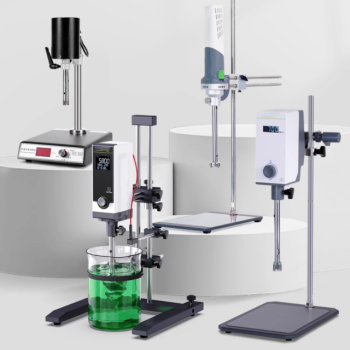
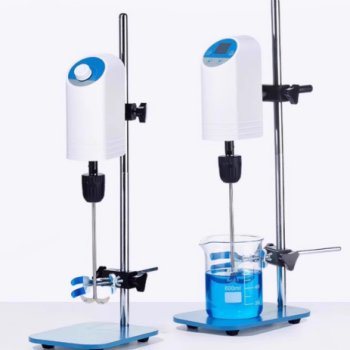
The use of high-shear dispersion is technically essential for breaking down nanoparticle agglomerates that naturally form in high-viscosity mediums like epoxy resin. By applying intense physical forces, this equipment ensures a uniform distribution of $A_xWO_3$ nanopowders, which is the foundational requirement for achieving consistent anti-corrosion performance and coating density. Without this level of mechanical intervention, the nanoparticles remain clumped, rendering their specialized photoelectric properties ineffective.
High-shear dispersion transforms $A_xWO_3$ from a collection of inactive clusters into a functional network within the epoxy. This process is the critical link between raw material properties and the final coating’s ability to provide photoelectric synergistic anti-corrosion protection.
Overcoming Molecular Cohesion in High-Viscosity Resins
Breaking Nanoparticle Agglomerates
Nanoparticles like $A_xWO_3$ have a high surface-area-to-volume ratio, leading to strong attractive forces that cause them to "clump" or agglomerate. High-shear equipment generates the mechanical energy necessary to overcome these inter-particle forces, separating them into individual units.
Navigating High Viscosity
Epoxy resins are inherently viscous, which resists the movement and distribution of powders through conventional stirring. High-shear dispersion introduces localized turbulence and velocity gradients that force the resin and nanoparticles to integrate thoroughly.
Ensuring Functional Performance and Consistency
Activating Photoelectric Synergistic Effects
$A_xWO_3$ nanopowders provide anti-corrosion benefits through a photoelectric synergistic effect when exposed to near-infrared (NIR) light. A uniform distribution ensures that this effect is active across the entire surface of the coating, rather than being concentrated in a few "hot spots."
Optimizing Coating Density
When nanoparticles are perfectly dispersed, they fill the microscopic voids within the epoxy polymer matrix. This increased density creates a more formidable physical barrier against moisture, oxygen, and corrosive ions.
Enhancing Global Corrosion Resistance
Uniformity is the key to longevity; a single poorly dispersed area acts as a weak point where corrosion can begin. High-shear mixing ensures that the protective properties are homogenous, preventing localized coating failure.
Understanding the Trade-offs and Limitations
Heat Generation During Processing
High-shear mixing converts mechanical energy into heat, which can prematurely trigger the curing process in some epoxy systems. Temperature monitoring and cooling jackets are often required to maintain the resin's integrity during the dispersion phase.
Equipment and Energy Costs
Industrial high-shear dispersers represent a higher capital investment and greater energy consumption compared to standard paddle mixers. The technical necessity must be weighed against the performance requirements of the specific application.
Risk of "Over-Shearing"
While rare with inorganic nanopowders, excessive shear can theoretically degrade certain organic additives or the resin chains themselves. Precision timing and speed control are required to reach the "de-agglomeration point" without damaging the base material.
How to Apply This to Your Project
To achieve the best results with $A_xWO_3$ and epoxy systems, your processing strategy should align with your ultimate performance metrics.
- If your primary focus is Maximum Corrosion Resistance: Prioritize longer high-shear cycles at controlled temperatures to ensure the highest possible coating density and void-filling.
- If your primary focus is NIR-Responsive Functionality: Ensure your dispersion speed is high enough to reach the primary particle size, as the photoelectric effect is highly dependent on the surface area of the individual nanoparticles.
- If your primary focus is Production Scalability: Implement a multi-stage mixing process, starting with low-speed wetting followed by a high-shear "milling" phase to optimize energy usage.
The effectiveness of $A_xWO_3$ nanopowders is entirely dependent on the quality of their dispersion within the epoxy matrix.
Summary Table:
| Technical Factor | Impact of High-Shear Dispersion | Resulting Coating Benefit |
|---|---|---|
| Agglomeration | Breaks down nanoparticle clusters into individual units | Consistent photoelectric activity |
| Viscosity | Overcomes resin resistance via localized turbulence | Uniform material distribution |
| Matrix Density | Ensures nanoparticles fill microscopic polymer voids | Enhanced physical barrier for ions |
| Surface Area | Maximizes particle surface exposure | Optimized NIR-responsive functionality |
| Longevity | Eliminates weak points and localized failure | Global, long-term corrosion resistance |
Maximize Your Material Performance with KINTEK Precision
Achieving superior $A_xWO_3$ dispersion requires more than basic mixing—it demands the right mechanical energy to unlock the full potential of your coatings. KINTEK provides the specialized laboratory equipment you need to ensure every nanoparticle is perfectly integrated.
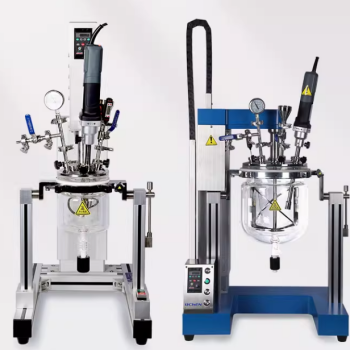
From advanced crushing and milling systems and high-shear dispersers to high-temperature high-pressure reactors and ultrasonic homogenizers, our portfolio is designed to meet the rigorous demands of battery research, advanced coatings, and material science.
Ready to eliminate agglomeration and enhance your coating density?
Contact KINTEK today for expert guidance on selecting the ideal equipment for your specific research or production requirements.
References
- Zi-Xiang Liu, Jin‐Ku Liu. Rapid Synthesis of A<sub><i>x</i></sub>WO<sub>3</sub> (A = H, Na, K) Tungsten Bronze Materials with Strong Near‐Infrared Absorption and Enhanced Photoelectric Anticorrosion Properties. DOI: 10.1002/adem.202301003
This article is also based on technical information from Kintek Solution Knowledge Base .
Related Products
- High Shear Homogenizer for Pharmaceutical and Cosmetic Applications
- High Performance Lab Homogenizer for Pharma Cosmetics and Food R&D
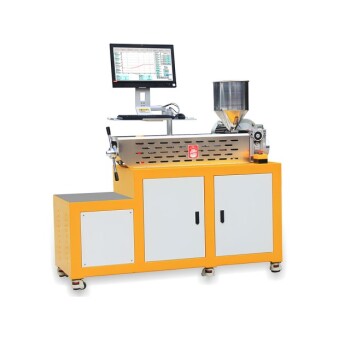
- Filter Testing Machine FPV for Dispersion Properties of Polymers and Pigments
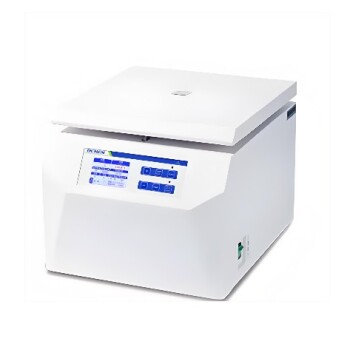
- Benchtop High Speed Small Lab Centrifuge for Serum Separation and Low Temperature Dehydration
- Laboratory Benchtop High Speed Small Centrifuge for Low Temp Serum Separation Dehydration Research
People Also Ask
- Why Use a High Shear Homogenizer for Cathode Slurries? Optimize Double-Layer Solid-State Battery Production
- What is the function of high-shear dispersion equipment in corona-resistant nanocomposites? Elevate Your Insulation
- What is the necessity of using an industrial-grade high-shear homogenizer for biomass washing? Ensure Process Efficiency
- What are the advantages of using a high-shear homogenizer for BED/GMA coatings? Achieve Superior Nano-Dispersion
- What role does a high-shear homogenizer play in ODC catalyst suspensions? Unlock Superior Electrochemical Efficiency