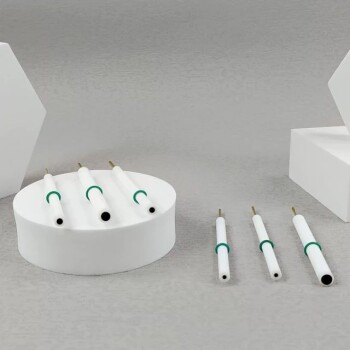
The selection of a 3mm glassy carbon electrode (GCE) as a substrate is driven by its rare combination of electrochemical inertness, high conductivity, and a wide potential window. These properties ensure that the substrate provides a stable, non-reactive physical platform that does not interfere with the redox signals of the materials being tested. By offering an extremely low background current and a dense, polishable surface, the 3mm GCE allows for the formation of uniform thin films that maximize detection sensitivity and electron transfer rates.
Core Takeaway: The 3mm GCE serves as the "gold standard" substrate because it functions as a pure medium for electron transmission without contributing its own catalytic activity or capacitance. This ensures that any measured electrochemical signal is solely attributable to the active modification material, providing an accurate characterization of the sensor's performance.
Superior Electrochemical Characteristics
A Wide Potential Window
The GCE offers a wide electrochemical potential window, which allows researchers to investigate a broad range of redox reactions without the substrate itself decomposing. This versatility makes it suitable for detecting diverse analytes, from biomolecules to industrial pollutants, across various voltage ranges.
Exceptional Chemical Inertness
Glassy carbon is highly resistant to chemical attack and remains inert in acidic electrolytes and harsh environments. This stability ensures that the substrate does not participate in the electrochemical reactions, acting purely as a support for the active catalyst or sensing material.
High Electrical Conductivity
Despite its carbonaceous nature, the GCE provides excellent electrical conductivity, establishing efficient electron transport channels between the electrode surface and the modified layer. This efficiency is critical for maintaining high-speed electron exchange during quantitative analysis and signal tracking.
Physical Advantages for Sensor Modification
Dense and Non-Porous Surface
The surface of a GCE is flat and non-porous, preventing the absorption of analytes into the substrate body. This ensures that the electrochemical signals measured are strictly surface-level phenomena, leading to more accurate data during Oxygen Reduction Reaction (ORR) or methanol oxidation tests.
Ideal Platform for Uniform Thin Films
The 3mm diameter provides a standardized surface area that is easily polished to a mirror-like finish. This smooth topography facilitates the attachment of nanomaterials—such as Nb2O5/rGO or nickel-cobalt nanorods—to form uniform, stable modified films that enhance sensitivity.
Low Background Interference
One of the most critical features of the GCE is its extremely low background current. By minimizing noise, the electrode allows for a high signal-to-noise ratio, enabling the detection of trace amounts of substances like catechol (CC) or hydroquinone (HQ) with distinct redox peaks.
Understanding the Trade-offs
Maintenance and Surface Prep
While the GCE is durable, it requires meticulous polishing between every use to remove contaminants and ensure reproducibility. Failure to achieve a perfectly clean surface can lead to sluggish electron transfer and inconsistent sensor readings.
Thermal and Mechanical Sensitivity
Glassy carbon is susceptible to thermal shock and can be brittle compared to metallic electrodes like gold or platinum. Rapid changes in temperature or excessive mechanical pressure during the mounting process can lead to micro-cracking of the substrate.
Limitations in Surface Area
The 3mm diameter is a standardized size optimized for small-volume laboratory testing but may not be suitable for large-scale industrial applications. For processes requiring high throughput, the physical size of the GCE can become a limiting factor in total current output.
How to Apply This to Your Project
Choosing the Right Strategy for Your Goal
- If your primary focus is high-sensitivity quantitative analysis: Leverage the low background current of the GCE to isolate weak signals from trace biomolecules or pollutants.
- If your primary focus is testing new catalyst materials: Use the GCE's inertness to ensure that the measured catalytic activity is derived entirely from your material and not the substrate.
- If your primary focus is achieving uniform film deposition: Ensure the GCE surface is polished to a mirror finish using alumina slurries to promote tight contact between the substrate and your active slurry.
- If your primary focus is long-term stability in acidic media: Rely on the GCE’s chemical resistance to conduct extended cycling tests without fear of substrate degradation.
By selecting the 3mm GCE, you are establishing a standardized, reliable foundation that ensures your electrochemical data is both accurate and reproducible.
Summary Table:
| Feature | Key Characteristic | Benefit to Electrochemical Sensing |
|---|---|---|
| Potential Window | Wide and stable | Allows detection across diverse voltage ranges without substrate interference. |
| Surface Texture | Dense and non-porous | Facilitates uniform thin-film formation and prevents analyte absorption. |
| Chemical Stability | Inert in acidic media | Ensures measured signals come solely from the catalyst, not the electrode. |
| Conductivity | High electrical efficiency | Provides rapid electron transfer for sensitive quantitative analysis. |
| Background Noise | Extremely low current | Increases signal-to-noise ratio for detecting trace-level substances. |
Elevate Your Electrochemical Research with KINTEK
Precision in sensing starts with a reliable foundation. KINTEK provides high-quality electrolytic cells and electrodes, including the industry-standard 3mm glassy carbon electrode, to ensure your data is accurate and reproducible. Whether you are developing biosensors or exploring battery materials, our comprehensive portfolio—ranging from high-temperature furnaces and hydraulic presses to battery research tools and PTFE consumables—is designed to meet the rigorous demands of modern laboratories.
Ready to optimize your sensor performance? Contact our experts today to find the perfect equipment and consumables for your specific application!
References
- Chenggong Gui. Prediction of food additives based on grey prediction model and electrochemical analysis of gallic acid. DOI: 10.54097/hset.v33i.5328
This article is also based on technical information from Kintek Solution Knowledge Base .
Related Products
People Also Ask
- How do the glassy carbon electrode, SCE, and graphite rod work together in an enzymatic fuel cell? Optimize EFC Testing
- Why is glassy carbon selected for mediator-assisted indirect oxidation of glycerol? The Key to Unbiased Research
- What are the functions of a glassy carbon electrode in CV testing of antioxidants? Enhance Your Redox Analysis Accuracy
- What characteristics make glassy carbon electrodes suitable as anodes? Ideal for Pure Molten Salt Electrolysis
- What are the primary physicochemical reasons for selecting a carbon electrode as the anode in aluminum recovery? 5 Keys