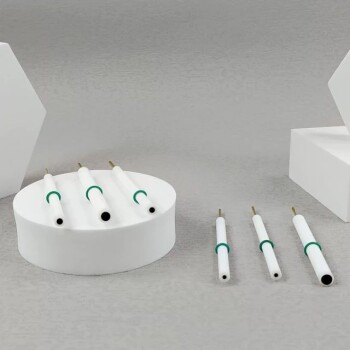
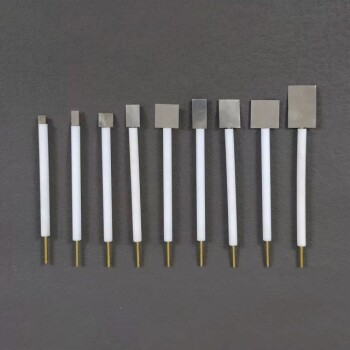
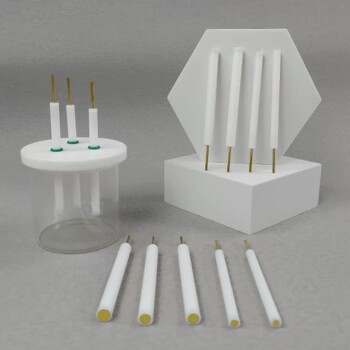
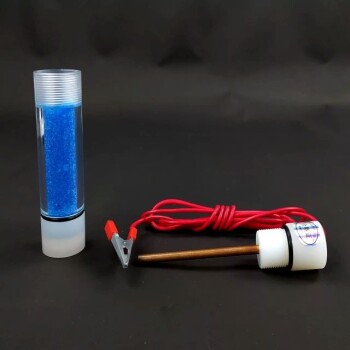
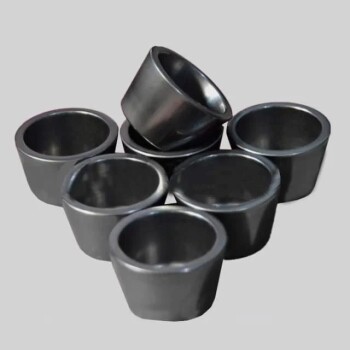
In a three-electrode Cyclic Voltammetry (CV) system, the glassy carbon electrode serves as the primary sensing interface. Its specific function is to facilitate and measure electron transfer between the antioxidant molecules and the circuit. This allows researchers to capture the redox currents necessary for quantifying antioxidant activity accurately.
Glassy carbon allows for the sensitive capture of redox currents due to its wide electrochemical window and high conductivity. Its primary utility lies in determining the Anodic Peak Potential (Epa), which provides a direct quantitative measure of an antioxidant's free-radical scavenging strength.
Core Properties Enabling Function
To understand the specific function of the glassy carbon electrode (GCE), one must look at the physical properties that make it the standard for these tests.
Wide Electrochemical Window
The GCE possesses a wide electrochemical window. This means it remains stable over a broad range of voltages without reacting with the solvent or electrolyte itself.
This stability ensures that the current measured is generated solely by the antioxidant molecules, not by background reactions.
Chemical Inertness
Glassy carbon is highly chemically inert. It does not easily degrade or form unwanted chemical bonds with the species being tested.
This property is vital for repeatability, ensuring the electrode acts as a neutral platform for electron transfer rather than a reactant.
Excellent Electrical Conductivity
The electrode functions as a high-efficiency conductor. It permits the rapid flow of electrons between the antioxidant and the potentiostat.
This high conductivity allows the system to "sensitively capture" even small redox currents produced by low concentrations of antioxidants.
Quantifying Antioxidant Strength
The ultimate function of the GCE in this context is to provide the data needed to evaluate how well an antioxidant works.
Measuring Anodic Peak Potential (Epa)
The GCE enables the precise identification of the Anodic Peak Potential (Epa). This is the specific voltage point where the antioxidant molecule undergoes oxidation (loses electrons) most rapidly.
Correlating Potential to Activity
The recorded Epa serves as a quantitative metric for scavenging ability.
A specific potential level indicates the ease with which the antioxidant can donate electrons to neutralize free radicals. Generally, a lower oxidation potential suggests a stronger ability to scavenge radicals.
Critical Considerations for Accuracy
While the glassy carbon electrode is robust, relying on its properties requires careful attention to experimental conditions.
Surface Sensitivity
The "excellent electrical conductivity" and "inertness" mentioned in the reference are properties of the electrode's surface.
If the surface becomes fouled or modified by reaction byproducts, the electrode loses its sensitivity.
The Necessity of Controlled Potential
The ability to capture redox currents is entirely dependent on the application of a "controlled potential."
Without precise voltage regulation, the high conductivity of the GCE cannot be leveraged to produce comparable quantitative data regarding the Epa.
Making the Right Choice for Your Goal
To maximize the utility of a glassy carbon electrode in your antioxidant research, focus on the specific metric that aligns with your objective.
- If your primary focus is Equipment Setup: Ensure the electrode surface is polished and clean to maintain the high electrical conductivity required for sensitive current capture.
- If your primary focus is Data Analysis: Prioritize the accurate measurement of the Anodic Peak Potential (Epa), as this is your direct indicator of free-radical scavenging efficiency.
The glassy carbon electrode is not just a conductor; it is the critical translation layer that turns chemical antioxidant activity into measurable electrical data.
Summary Table:
| Property | Role in CV Testing | Benefit for Antioxidant Analysis |
|---|---|---|
| Wide Electrochemical Window | Minimizes background noise | Ensures signal is purely from antioxidant redox |
| Chemical Inertness | Prevents electrode-reactant bonding | Maintains data repeatability and electrode longevity |
| High Conductivity | Facilitates rapid electron transfer | Captures sensitive currents from low concentrations |
| Epa Identification | Marks oxidation peak voltage | Provides quantitative metric for radical scavenging |
| Surface Sensitivity | Acts as the sensing interface | Allows for precise detection of molecular interactions |
Elevate Your Electrochemical Research with KINTEK
Precision starts at the electrode interface. KINTEK specializes in high-performance laboratory equipment, providing the advanced electrolytic cells and electrodes—including premium glassy carbon electrodes—required for accurate Cyclic Voltammetry and antioxidant characterization.
Whether you are setting up a comprehensive battery research lab or conducting sensitive biochemical assays, our portfolio of high-temperature furnaces, hydraulic presses, and specialized consumables ensures your results are both repeatable and reliable.
Ready to optimize your lab’s sensing capabilities? Contact us today to explore our full range of solutions!
References
- Faez S. Al-Shibli, Khansa Abdul Razzaq Alassdi. Synthesis of the Antioxidant Compounds from the Eugenol to the Lubricating Oils. DOI: 10.36329/jkcm/2022/v2.i9.13318
This article is also based on technical information from Kintek Solution Knowledge Base .
Related Products
- Glassy Carbon Electrochemical Electrode
- Glassy Carbon Sheet RVC for Electrochemical Experiments
- Conductive Carbon Cloth Carbon Paper Carbon Felt for Electrodes and Batteries
- Platinum Sheet Electrode for Laboratory and Industrial Applications
- Gold Disc Electrode
People Also Ask
- How do the glassy carbon electrode, SCE, and graphite rod work together in an enzymatic fuel cell? Optimize EFC Testing
- Why is glassy carbon selected for mediator-assisted indirect oxidation of glycerol? The Key to Unbiased Research
- What characteristics make glassy carbon electrodes suitable as anodes? Ideal for Pure Molten Salt Electrolysis
- What are the primary physicochemical reasons for selecting a carbon electrode as the anode in aluminum recovery? 5 Keys
- Why is a glassy carbon electrode (GCE) considered an ideal substrate for HER? Key Benefits for Catalyst Research