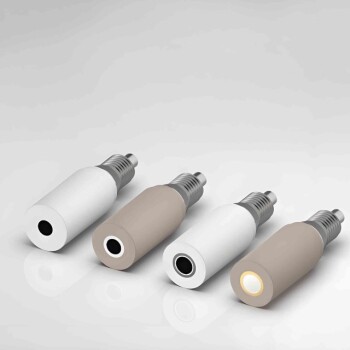
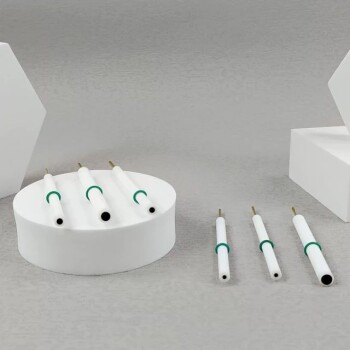
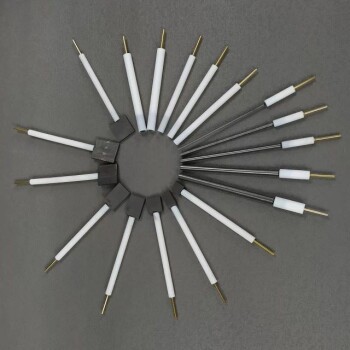
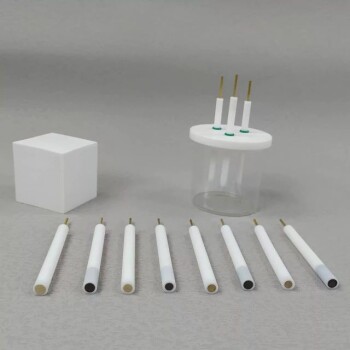
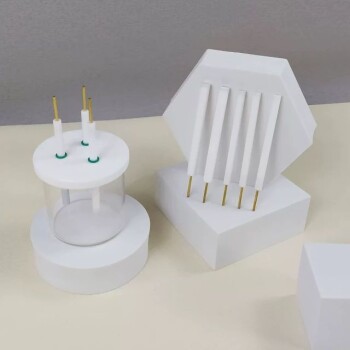
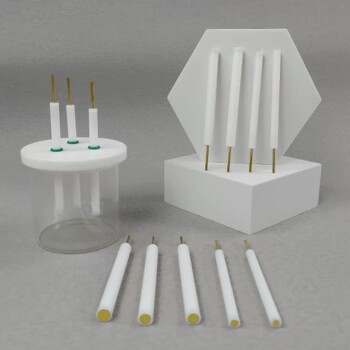
A glassy carbon disc electrode is the foundational tool for reliable catalyst evaluation because it acts as a highly conductive, chemically neutral stage for performance testing. It combines excellent electrical conductivity with a wide potential window and chemical inertness, allowing researchers to measure the specific activity of a catalyst without background interference from the electrode itself.
To accurately evaluate a powder catalyst, you must transform it into a cohesive part of the electrical circuit. The glassy carbon disc solves this by accepting a "catalyst ink" coating to form a uniform thin-layer electrode, ensuring efficient electron transfer and data that truly reflects the catalyst's characteristics.
The Physical Properties of Reliability
Superior Electrical Conductivity
For an electrochemical test to be valid, electrons must move freely between the circuit and the reaction site.
Glassy carbon offers excellent electrical conductivity, serving as a low-resistance bridge. This ensures that any resistance measured is inherent to the electrochemical reaction or the catalyst, not the underlying disc.
Chemical Inertness
A substrate must never participate in the reaction it is meant to measure.
Glassy carbon is chemically inert, meaning it resists reacting with electrolytes or reaction intermediates. This guarantees that the current you observe is generated solely by your supported catalyst, keeping the baseline data pure.
Wide Potential Window
Catalyst evaluation often requires sweeping through a broad range of voltages.
Glassy carbon maintains stability across a wide potential window. This allows you to push the system to the necessary limits to trigger oxidation or reduction reactions without degrading the electrode surface.
The Mechanism of Testing: The Thin-Layer Approach
Creating the Catalyst Ink
Powder catalysts cannot be connected to a wire directly; they must be immobilized.
Researchers mix the powder into a "catalyst ink" solution. This ink is then coated onto the polished surface of the glassy carbon disc.
The Uniform Thin-Layer Electrode
Once the ink dries, it forms a uniform thin-layer electrode.
This configuration is critical because it exposes the maximum amount of catalyst surface area to the electrolyte. It ensures efficient electron transfer between the catalyst layer and the glassy carbon substrate, resulting in data that accurately reflects electrocatalytic characteristics.
Critical Operational Factors
The Necessity of a Polished Surface
The primary reference explicitly notes the importance of the polished surface.
If the glassy carbon is scratched or rough, the catalyst ink will not form a uniform layer. This leads to uneven electron transfer and "noisy" data that misrepresents the catalyst's true efficiency.
Handling the Catalyst Ink
The indispensable nature of this electrode relies on the user's ability to apply the coating correctly.
If the ink is too thick or unevenly distributed, it introduces diffusion limitations. The glassy carbon disc can only function as an ideal substrate if the thin-layer principle is strictly maintained.
Applying This to Your Research
If your primary focus is obtaining pure kinetic data:
- Ensure the glassy carbon surface is mirror-polished before every use to guarantee a uniform thin layer and eliminate substrate noise.
If your primary focus is comparing multiple catalyst powders:
- Standardize your ink formulation and drying process on the glassy carbon to ensure that differences in data reflect the catalyst chemistry, not coating variations.
The glassy carbon disc is not just a holder; it is the silent partner that makes accurate electrochemical measurement possible.
Summary Table:
| Feature | Benefit for Catalyst Evaluation |
|---|---|
| Electrical Conductivity | Low-resistance bridge ensuring efficient electron transfer and accurate data. |
| Chemical Inertness | Prevents substrate interference; ensures measured current comes solely from the catalyst. |
| Potential Window | Wide stability range allows for diverse oxidation and reduction testing without degradation. |
| Surface Quality | Mirror-polished surface enables uniform catalyst ink coating for precise kinetic measurements. |
Elevate Your Electrochemical Research with KINTEK Precision
To achieve publishable, high-fidelity kinetic data, your substrate must be as reliable as your science. KINTEK specializes in high-performance laboratory equipment and consumables, providing the essential tools researchers need for rigorous material characterization.
From our premium glassy carbon disc electrodes and specialized electrolytic cells to our comprehensive range of battery research tools, high-temperature furnaces, and hydraulic presses, we empower your lab with the precision required for groundbreaking discoveries.
Ready to optimize your catalyst evaluation? Contact KINTEK today to explore our full portfolio of electrochemical consumables and laboratory solutions tailored to your specific research goals.
References
- Hsuan-Ming KUNG, Chung‐Kwei Lin. Anode Catalyst of Hybrid AuPd and Rare Earth Doped Cerium Oxide/Multi-Walled Carbon Nanotubes for Direct Formic Acid Fuel Cells. DOI: 10.2497/jjspm.63.706
This article is also based on technical information from Kintek Solution Knowledge Base .
Related Products
- RRDE rotating disk (ring disk) electrode / compatible with PINE, Japanese ALS, Swiss Metrohm glassy carbon platinum
- Glassy Carbon Electrochemical Electrode
- Glassy Carbon Sheet RVC for Electrochemical Experiments
- Graphite Disc Rod and Sheet Electrode Electrochemical Graphite Electrode
- Metal Disc Electrode Electrochemical Electrode
People Also Ask
- What is the rotating ring disk electrode method? Unlock Real-Time Reaction Analysis
- Role of RRDE & Workstations in Aerogel Catalysis: Master Precise Kinetic Analysis & Electron Transfer Pathways
- What role does the RRDE play in catalyst evaluation for H2O2 synthesis? Enhance Selectivity and Kinetic Precision
- What is the RRDE in electrochemistry? Unlock Detailed Reaction Pathways with Dual-Electrode Analysis
- What is the application of RRDE? Unlock Quantitative Catalyst and Reaction Insights