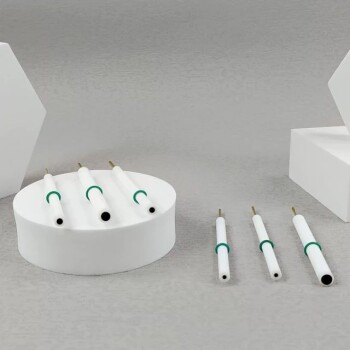
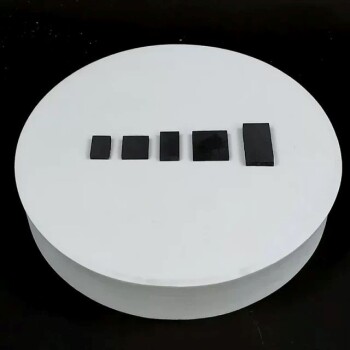
Glassy carbon acts as the definitive substrate for stability testing because it provides a chemically inert and electrically conductive foundation that does not interfere with electrochemical measurements. Its high density and purity allow it to physically support catalyst inks, while its wide potential window ensures that background currents remain negligible. This capability allows researchers to isolate the specific activity of the platinum electrocatalyst, ensuring that all detected signals originate solely from the reaction of interest.
By offering an exceptionally wide potential window and chemical inertness, glassy carbon guarantees that electrochemical signals originate entirely from the catalyst surface. This elimination of background noise is the prerequisite for generating high-precision stability data.
The Critical Role of Chemical Inertness
Eliminating Substrate Interference
To accurately test the stability of platinum, the underlying support must be invisible to the experiment. Glassy carbon is chosen because it is chemically inert, acting as a passive stage rather than an active participant.
Isolating Catalyst Reactions
Because the substrate does not react, researchers can be certain that any degradation or change in current observed during testing is due to the platinum catalyst itself. This isolation is vital for validating the true lifespan and performance of the electrocatalyst.
Ensuring Data Precision
Wide Potential Window in Acidic Media
Glassy carbon possesses a wide potential window, particularly in the acidic electrolytes commonly used for platinum testing. This window represents the voltage range where the electrode material itself does not undergo oxidation or reduction.
Achieving Low Background Current
Within this wide window, the background current is extremely low. This signifies that there is minimal "electrical noise" generated by the substrate. Consequently, the signal-to-noise ratio is maximized, allowing for the precise detection of even subtle electrochemical changes on the catalyst surface.
Physical Support Characteristics
High Purity and Density
The material is distinctively dense and high-purity. These physical properties provide a robust surface for the application of catalyst inks.
Structural Integrity
The density ensures that the catalyst layer sits uniformly on the surface without absorbing into the electrode. This provides a consistent geometric area for the reaction, which is essential for calculating accurate current densities.
The Risk of Signal Contamination
Understanding the "Background" Pitfall
The most significant risk in electrochemical testing is attributing a signal to the catalyst when it actually comes from the substrate. If a substrate lacks the wide potential window of glassy carbon, it generates a high background current.
Compromising Stability Data
A high background current obscures the true behavior of the platinum. Without the specific properties of glassy carbon, stability data becomes unreliable because it is impossible to distinguish between the degradation of the catalyst and the electrochemical noise of the support.
Making the Right Choice for Your Goal
To ensure your stability testing yields publication-grade data, apply these principles:
- If your primary focus is signal clarity: Prioritize the use of glassy carbon to maintain the lowest possible background current, ensuring the signal reflects only the catalyst's activity.
- If your primary focus is rigorous stability tracking: Rely on the inert nature of the substrate to confirm that any performance loss over time is strictly a function of the platinum electrocatalyst, not the electrode holder.
Using glassy carbon transforms the substrate from a potential variable into a reliable constant, securing the foundation of your experimental analysis.
Summary Table:
| Feature | Benefit for Stability Testing |
|---|---|
| Chemical Inertness | Eliminates substrate interference; ensures signals originate only from the catalyst. |
| Wide Potential Window | Allows testing across a broad voltage range without substrate oxidation or reduction. |
| Low Background Current | Minimizes electrical noise, maximizing the signal-to-noise ratio for precise data. |
| High Density & Purity | Provides a robust, uniform surface for catalyst ink application and structural integrity. |
Elevate Your Electrochemical Research with KINTEK
Precision in stability testing starts with the right materials. KINTEK provides high-quality laboratory solutions, including specialized electrolytic cells and electrodes designed to meet the rigorous demands of battery research and electrocatalysis.
Whether you require high-density glassy carbon substrates, high-temperature furnaces (muffle, vacuum, or CVD) for material synthesis, or advanced high-pressure reactors, our comprehensive portfolio supports every stage of your workflow.
Ensure publication-grade data and reliable experimental results. Contact KINTEK today to discuss your specific laboratory equipment and consumable needs with our experts!
References
- Ilgar Ayyubov, András Tompos. Preparation of Pt electrocatalyst supported by novel, Ti(1−x)MoxO2-C type of composites containing multi-layer graphene. DOI: 10.1007/s11144-021-02138-x
This article is also based on technical information from Kintek Solution Knowledge Base .
Related Products
- Glassy Carbon Electrochemical Electrode
- Glassy Carbon Sheet RVC for Electrochemical Experiments
- Conductive Carbon Cloth Carbon Paper Carbon Felt for Electrodes and Batteries
- Copper Sulfate Reference Electrode for Laboratory Use
- Graphite Disc Rod and Sheet Electrode Electrochemical Graphite Electrode
People Also Ask
- How do the glassy carbon electrode, SCE, and graphite rod work together in an enzymatic fuel cell? Optimize EFC Testing
- Why is glassy carbon selected for mediator-assisted indirect oxidation of glycerol? The Key to Unbiased Research
- What are the functions of a glassy carbon electrode in CV testing of antioxidants? Enhance Your Redox Analysis Accuracy
- What characteristics make glassy carbon electrodes suitable as anodes? Ideal for Pure Molten Salt Electrolysis
- What are the primary physicochemical reasons for selecting a carbon electrode as the anode in aluminum recovery? 5 Keys