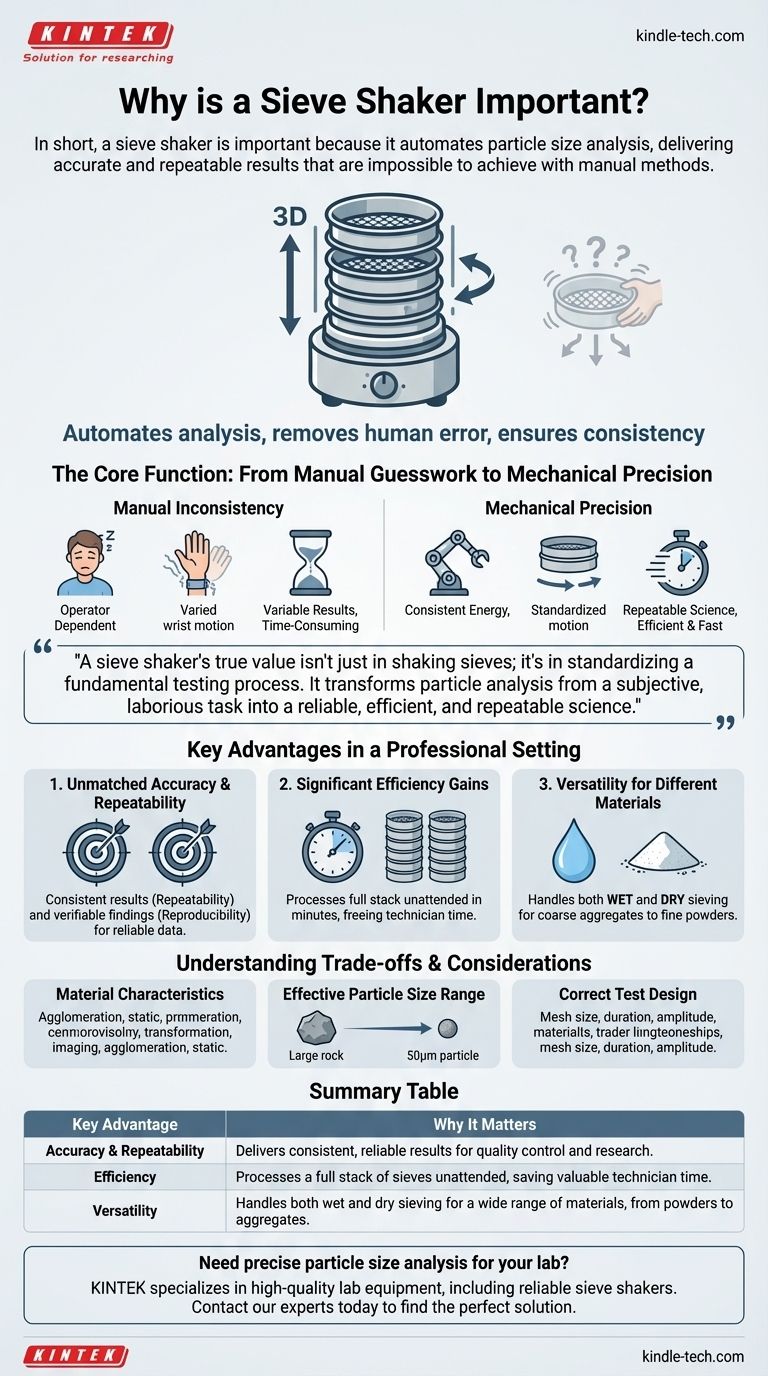
In short, a sieve shaker is important because it automates particle size analysis, delivering accurate and repeatable results that are impossible to achieve with manual methods. This mechanical precision removes human error and inconsistency, making it an essential tool for quality control, research, and any process where particle size distribution is a critical variable.
A sieve shaker's true value isn't just in shaking sieves; it's in standardizing a fundamental testing process. It transforms particle analysis from a subjective, laborious task into a reliable, efficient, and repeatable science, ensuring that data is trustworthy enough for critical decision-making.
The Core Function: From Manual Guesswork to Mechanical Precision
To understand the importance of a sieve shaker, we must first contrast it with the alternative: hand sieving. While simple, manual methods are plagued by inconsistencies that are unacceptable in a professional setting.
How a Sieve Shaker Works
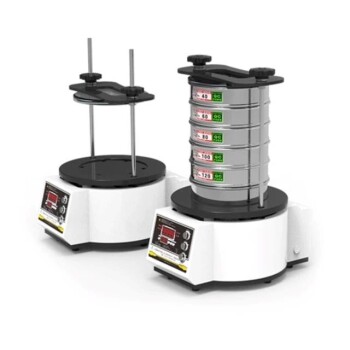
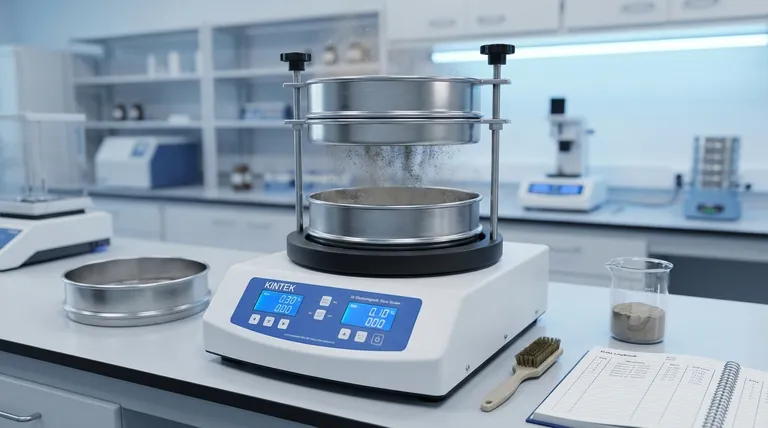
A sieve shaker applies a standardized, uniform motion to a stack of test sieves. Most modern shakers use a 3D throwing motion, which combines a vertical tapping action with a horizontal circular movement.
This complex agitation ensures that all particles are constantly moving and are repeatedly presented to the sieve openings in various orientations, maximizing the opportunity for them to pass through.
Replacing Manual Inconsistency
When a person sieves a sample by hand, the results are highly dependent on the operator. Factors like the vigor of shaking, the duration, and the specific wrist motion are unique to each individual and even vary for the same person over time.
A sieve shaker eliminates this variability. By using a consistent and measurable energy input for a set duration, it guarantees that a sample is processed the same way every single time.
Key Advantages in a Professional Setting
The move from manual to mechanical sieving provides clear, tangible benefits that are critical for scientific integrity and industrial quality control.
Unmatched Accuracy and Repeatability
This is the primary reason sieve shakers are indispensable. Repeatability means that if you test the same sample twice on the same machine, you will get the same result. Reproducibility means another lab using the same method and machine can verify your findings.
This level of certainty is the foundation of reliable data for product development, geological surveys, and quality assurance.
Significant Efficiency Gains
A sieve shaker can process a full stack of sieves—often up to eight or more—in a single, unattended run. This provides a complete particle size distribution in a fraction of the time it would take to do manually.
The process is fast, typically completed in minutes, freeing up valuable technician time for other tasks.
Versatility for Different Materials
Modern sieve shakers are designed for both wet and dry sieving. Wet sieving is essential for materials that tend to agglomerate or are affected by static electricity, as dispersing them in a liquid allows for accurate separation.
This flexibility allows a single device to be used for a vast range of materials, from coarse aggregates to fine powders.
Understanding the Trade-offs and Considerations
While powerful, a sieve shaker is a precision instrument whose effectiveness depends on proper use and an understanding of its limitations.
The Influence of Material Characteristics
The nature of your sample is a critical factor. Materials that are prone to agglomeration (clumping) or affected by static electricity can blind the sieve mesh and produce inaccurate results.
In these cases, adjusting the shaker's amplitude, using a wet sieving method, or adding anti-static agents may be necessary.
Effective Particle Size Range
Sieve shakers are extremely effective for analyzing particles ranging from several inches down to approximately 50 micrometers (µm).
For particles smaller than this, other methods like laser diffraction or image analysis are generally required, as physical separation through a mesh becomes impractical.
The Importance of Correct Test Design
Simply owning a sieve shaker does not guarantee accurate results. The selection of the correct sieve mesh sizes, the duration of the test, and the shaking amplitude are all critical parameters.
These must be carefully determined and standardized for each material to ensure the final data is valid and meaningful.
Making the Right Choice for Your Application
Ultimately, the decision to use a sieve shaker is about the level of certainty your work requires.
- If your primary focus is quality control: A sieve shaker is non-negotiable for ensuring your raw materials and final products consistently meet particle size specifications.
- If your primary focus is research and development: The accuracy and repeatability of a sieve shaker provide the high-quality, defensible data necessary for valid experimental conclusions.
- If your primary focus is operational efficiency: The device replaces a slow, laborious manual process with a fast, automated, and far more reliable one.
A sieve shaker elevates particle analysis from an approximation into a precise measurement, providing the foundational data required for confident, evidence-based decisions.
Summary Table:
| Key Advantage | Why It Matters |
|---|---|
| Accuracy & Repeatability | Delivers consistent, reliable results for quality control and research. |
| Efficiency | Processes a full stack of sieves unattended, saving valuable technician time. |
| Versatility | Handles both wet and dry sieving for a wide range of materials, from powders to aggregates. |
Need precise particle size analysis for your lab? KINTEK specializes in high-quality lab equipment, including reliable sieve shakers designed to deliver the accuracy and repeatability your quality control and research demand. Contact our experts today to find the perfect solution for your laboratory's particle analysis needs.
Visual Guide
Related Products
- Laboratory Vibratory Sieve Shaker Machine for Dry and Wet Three-Dimensional Sieving
- Laboratory Test Sieves and Vibratory Sieve Shaker Machine
- Laboratory Wet Three-Dimensional Vibratory Sieve Shaker Machine
- Laboratory Vibratory Sieve Shaker Machine Slap Vibrating Sieve
- Vibratory Sieve Shaker Machine Dry Three-Dimensional Vibrating Sieve
People Also Ask
- How does a laboratory vibratory sieve shaker facilitate the microstructural study of gas-atomized alloy powders?
- What role does a laboratory vibrating sieve shaker play in the LiFePO4 powder processing workflow? Ensure Batch Quality
- Why use a vibratory sieve shaker for PET powder? Achieve Precise Particle Size Control for Chemical Research
- What is the principle of vibratory sieve shaker? Achieve Accurate Particle Size Analysis
- What is the function of a vibratory sieve shaker? Achieve Precise Particle Size Analysis