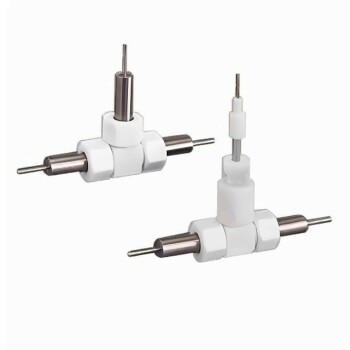
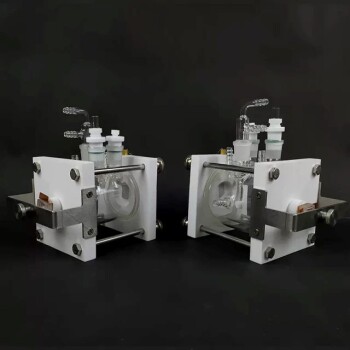
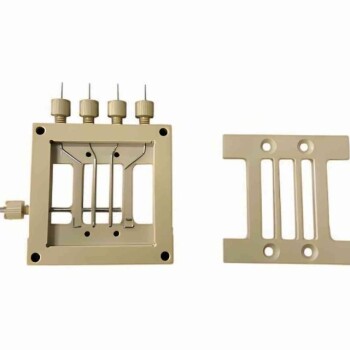
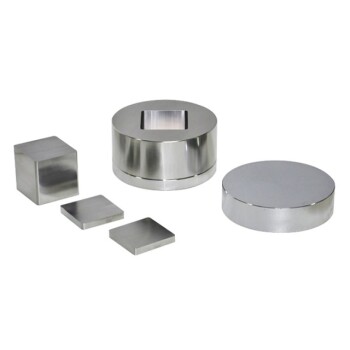
Specialized pressure test cells are the cornerstone of reliable solid-state battery characterization.
These cells provide the constant, monitorable mechanical pressure necessary to maintain physical contact between particles within the electrolyte and at the electrode-electrolyte interface. Without this controlled environment, internal voids and interfacial separation lead to massive experimental errors, making it impossible to obtain accurate ionic conductivity data or stable electrochemical impedance spectroscopy (EIS) results.
A specialized symmetric pressure cell acts as a precision environment that mimics the stack pressure of a real-world battery while eliminating variables caused by the mechanical instability of solid-solid interfaces.
The Physics of Solid-Solid Contact
Eliminating Interfacial Resistance
Unlike liquid electrolytes that naturally "wet" an electrode surface, solid-state electrolytes (SSEs) require external force to establish a cohesive pathway for ions. A specialized cell applies sustained mechanical pressure (often between 7 and 17 MPa) to bridge the gaps between dry particles.
Counteracting Volume Expansion
Materials like lithium metal and high-nickel cathodes undergo significant anisotropic volume changes during charge and discharge cycles. The pressure-retaining functions of the test cell prevent these materials from pulling away from the electrolyte, which would otherwise cause a catastrophic rise in impedance.
Inhibiting Lithium Dendrites
Continuous stack pressure helps maintain the mechanical integrity of the solid electrolyte layer. By ensuring a dense, void-free structure, the cell helps suppress the growth of lithium dendrites that could otherwise penetrate the electrolyte and cause a short circuit.
Engineering for Precision and Data Integrity
The Role of PEEK and Stainless Steel
High-quality test cells utilize PEEK (Polyether ether ketone) insulation linings to prevent electrical shorts through the cell body. These are paired with stainless steel or titanium pistons that apply force uniformly across the sample without deforming under high stress.
Standardization and Repeatability
Using a specialized cell allows researchers to apply specific torque or hydraulic force that is measurable and reproducible. This standardization is critical for comparing different electrolyte chemistries, as even minor variations in pressure can drastically alter recorded ionic conductivity.
Consolidating Powder Samples
Many solid-state electrolytes are initially tested as loose powders. Specialized test molds allow for the consolidation of these powders into dense, disk-shaped structures directly within the testing environment, ensuring the sample remains intact throughout the evaluation.
Understanding the Trade-offs
Over-Pressurization and Mechanical Stress
While high pressure improves contact, excessive force can lead to particle fracturing or internal short circuits. It is essential to find the "saturation point" where contact resistance is minimized without compromising the structural integrity of the electrolyte.
Material Compatibility and Wear
The chemical compatibility of the pistons and sleeves must be verified for each chemistry. Over time, PEEK sleeves can undergo creep or deformation under sustained high pressure, which may lead to gradual pressure loss and "drift" in long-term cycle data.
How to Apply This to Your Project
Optimizing Your Testing Protocol
- If your primary focus is accurate ionic conductivity: Use a cell that allows for high-precision pressure monitoring to ensure measurements are taken at the point of maximum particle density.
- If your primary focus is long-term cycle life: Prioritize cells with robust pressure-retaining mechanisms (like heavy-duty springs or torque-locked pistons) to counteract volume changes over hundreds of hours.
- If your primary focus is lithium metal research: Select a cell design specifically rated to maintain high stack pressure to better evaluate dendrite suppression capabilities.
Implementing a specialized pressure cell ensures that your electrochemical data reflects the true properties of the material rather than the mechanical flaws of the test setup.
Summary Table:
| Feature | Function | Benefit to Researcher |
|---|---|---|
| Sustained Pressure | Bridges gaps between dry particles | Minimizes interfacial resistance for accurate conductivity data |
| PEEK Insulation | Provides electrical isolation | Prevents short circuits through the cell body during testing |
| Pressure Monitoring | Standardizes mechanical force | Ensures experimental repeatability and data integrity |
| Volume Compensation | Counteracts expansion/contraction | Maintains contact during cycles and suppresses lithium dendrites |
| In-situ Consolidation | Compresses powder into dense disks | Eliminates external handling errors and preserves sample structure |
Elevate your solid-state battery research with KINTEK’s precision-engineered characterization tools. Whether you need specialized symmetric pressure test cells, advanced hydraulic presses for pellet preparation, or high-temperature furnaces for material synthesis, KINTEK provides the robust solutions required for accurate and reproducible EIS data. Don't let mechanical instability compromise your results—leverage our expertise in battery research tools and laboratory consumables to drive your innovation forward. Contact our technical experts today to find the perfect equipment for your lab!
References
- Yannik Rudel, Wolfgang G. Zeier. Investigating the Influence of the Effective Ionic Transport on the Electrochemical Performance of Si/C‐Argyrodite Solid‐State Composites. DOI: 10.1002/batt.202300211
This article is also based on technical information from Kintek Solution Knowledge Base .
Related Products
- Customizable Swagelok Type Test Cells for Advanced Battery Research Electrochemical Analysis
- Sample Support Body for Electrochemical Tests
- Flat Corrosion Electrolytic Electrochemical Cell
- Custom Ion Conductivity Test Fixtures for Fuel Cell Research
- Electrolytic Electrochemical Cell for Coating Evaluation
People Also Ask
- How does a standardized electrochemical test cell assist in MOx/CNTf electrode screening? Optimize Material Ratios
- Why is a dedicated electrochemical test cell necessary for carbon steel? Ensure Precise Geothermal Corrosion Data
- What is the difference between a voltaic cell and an electrochemical cell? Understand the Two Types of Energy Conversion
- How do the electrochemical cell and three-electrode testing system collaborate? Optimize Zinc Anode Deposition Control
- Why must the electrochemical cell be continuously purged with nitrogen? Ensure Precision in Ni-Cr Corrosion Tests