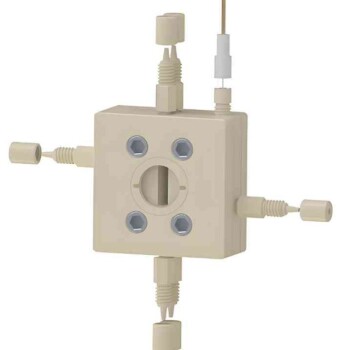
Precise environmental control is the defining reason a dedicated electrochemical test cell is required for evaluating carbon steel in geothermal contexts. It allows researchers to accurately replicate the high mineralization and anaerobic conditions specific to geothermal aquifers while rigidly fixing the geometry of the electrode array. This mechanical stability ensures uniform current distribution, which is a prerequisite for generating reliable data from sensitive measurement techniques.
The core function of the test cell is to eliminate geometric variables by fixing the relative positions of the working, reference, and auxiliary electrodes. This standardization ensures the reproducibility essential for Linear Polarization Resistance (LPR) and Electrochemical Impedance Spectroscopy (EIS) tests.
Simulating the Geothermal Environment
Replicating Anaerobic Conditions
Geothermal reservoir water is distinct due to its lack of oxygen and high mineral content. A dedicated test cell is designed to maintain these strict anaerobic conditions throughout the testing period.
Handling High Mineralization
The cell accommodates the specific chemistry of simulated geothermal water. It prevents external contamination that could alter the electrochemical behavior of the mineral-rich fluid, ensuring the carbon steel reacts only to the intended environment.
The Physics of Measurement Accuracy
Fixed Electrode Geometry
To measure corrosion accurately, the physical relationship between the carbon steel working electrode (WE), the reference electrode (RE), and the auxiliary electrode (AE) must remain constant.
A dedicated cell mechanically locks these components into precise, relative positions.
Uniform Current Distribution
The arrangement of the electrodes directly influences how electrical current flows through the electrolyte.
By standardizing the electrode spacing, the test cell ensures uniform current line distribution. This uniformity prevents localized distortions that could skew the corrosion rate calculations.
Pitfalls of Improper Setup
Instability in Advanced Measurements
Techniques like Linear Polarization Resistance (LPR) and Electrochemical Impedance Spectroscopy (EIS) are highly sensitive to environmental fluctuations.
Without a dedicated cell to stabilize the environment, these measurements can suffer from significant noise and drift, rendering the data unusable for modeling long-term corrosion behavior.
The Risk of Reproducibility Errors
If the electrode positions shift even slightly between tests, the internal resistance of the solution changes.
This variability introduces random error, making it impossible to compare results across different experiments or to accurately track the progression of corrosion over time.
Making the Right Choice for Your Goal
To ensure your corrosion data is valid for geothermal applications, consider the following priorities:
- If your primary focus is Data Accuracy: Prioritize a cell design that rigidly fixes the distance between the reference electrode and the carbon steel surface to minimize uncompensated resistance.
- If your primary focus is Environmental Simulation: Ensure the cell is fully sealed to maintain strict anaerobic conditions, preventing oxygen ingress from skewing the corrosion mechanism.
A dedicated test cell transforms corrosion testing from a rough estimation into a precise, reproducible science.
Summary Table:
| Feature | Importance in Geothermal Testing | Impact on Data Accuracy |
|---|---|---|
| Environmental Control | Replicates high mineralization & anaerobic conditions | Prevents contamination and oxygen-induced skewing |
| Fixed Electrode Geometry | Maintains constant WE, RE, and AE positioning | Ensures uniform current distribution and low noise |
| Mechanical Stability | Eliminates geometric variables during testing | Crucial for sensitive LPR and EIS measurements |
| Atmospheric Sealing | Maintains strict anaerobic status | Prevents external oxygen from altering corrosion mechanisms |
Elevate Your Corrosion Research with KINTEK Precision
Don't let unstable environments compromise your geothermal research. KINTEK specializes in high-performance laboratory equipment, providing the electrolytic cells and electrodes necessary for precise electrochemical analysis. Whether you are studying carbon steel durability or advanced material behavior, our solutions ensure the reproducibility and accuracy your lab demands.
From high-temperature high-pressure reactors to specialized battery research tools, KINTEK offers a comprehensive range of equipment including:
- Electrolytic Cells & Precision Electrodes for uniform current distribution.
- High-Temperature High-Pressure Reactors & Autoclaves for geothermal simulation.
- Advanced Thermal & Crushing Systems to support your entire material workflow.
Contact KINTEK today to consult with our experts and find the perfect electrochemical setup for your target applications!
References
- Chahinez Helali, Ioannis Ignatiadis. Corrosion Inhibition of Carbon Steel Immersed in Standardized Reconstituted Geothermal Water and Individually Treated with Four New Biosourced Oxazoline Molecules. DOI: 10.3390/met14121439
This article is also based on technical information from Kintek Solution Knowledge Base .
Related Products
- Electrolytic Electrochemical Cell for Coating Evaluation
- Customizable Swagelok Type Test Cells for Advanced Battery Research Electrochemical Analysis
- Sample Support Body for Electrochemical Tests
- Flat Corrosion Electrolytic Electrochemical Cell
- PTFE Electrolytic Cell Electrochemical Cell Corrosion-Resistant Sealed and Non-Sealed
People Also Ask
- What is the volume range of the coating evaluation electrolytic cell? A Guide to Choosing the Right Size
- How does the design of an electrochemical electrolytic cell influence the coating uniformity? Optimize Your Catalysts
- What is the correct shutdown and disassembly procedure after an experiment? Ensure Safety and Protect Your Equipment
- How do the electrochemical cell and three-electrode testing system collaborate? Optimize Zinc Anode Deposition Control
- What is the difference between a voltaic cell and an electrochemical cell? Understand the Two Types of Energy Conversion