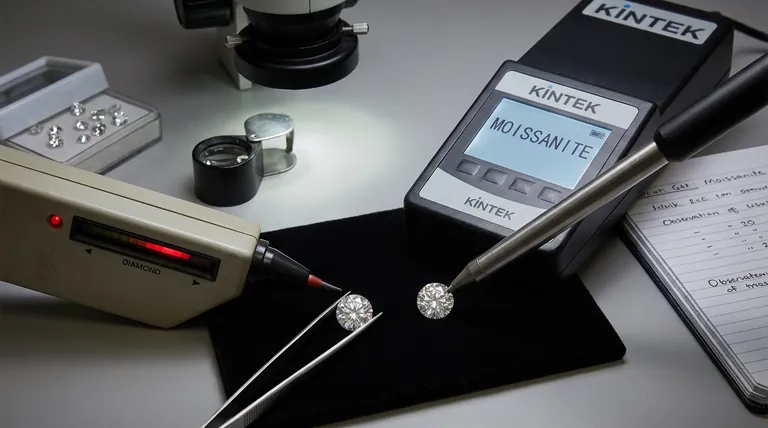
It’s a scenario that keeps jewelers and appraisers awake at night. A client presents a brilliant, fiery stone for sale or appraisal. You grab your trusted electronic tester, press the tip to the gem, and wait for the beep. It confirms: "Diamond." You make a confident, high-value offer.
Days later, a nagging doubt or a second opinion reveals the devastating truth: it’s not a diamond. It’s moissanite, a convincing imitation. Suddenly, you’re facing a significant financial loss, a potential blow to your professional reputation, and the unnerving question: why did my tool fail me?
The Frustrating Cycle of Uncertainty
If this has happened to you, you are not alone. This is a widespread and costly problem in the gem trade. When faced with inconsistent results, many professionals fall into a frustrating loop of trial and error:
- "Maybe the tester is old?" You buy a new one, only to find it makes the same mistake.
- "Perhaps the stone is dirty?" You clean it meticulously, but the results don't change.
- "Am I using it wrong?" You re-read the manual and practice your technique, yet the uncertainty remains.
These are not just technical frustrations; they have serious business consequences. Every false positive erodes your profit margins. Every questionable appraisal risks damaging the customer trust you’ve worked so hard to build. You waste valuable time re-testing stones and second-guessing your own judgment, when you should be focused on serving clients and growing your business.
The Root Cause: A Simple Flaw in a Common Tool
The problem isn't your technique or a faulty device. The problem is that many standard testers are built on an outdated scientific premise. They are designed to solve a problem that has since evolved.
Here’s the simple science behind it.
The Heat Test: Good, But Not Good Enough
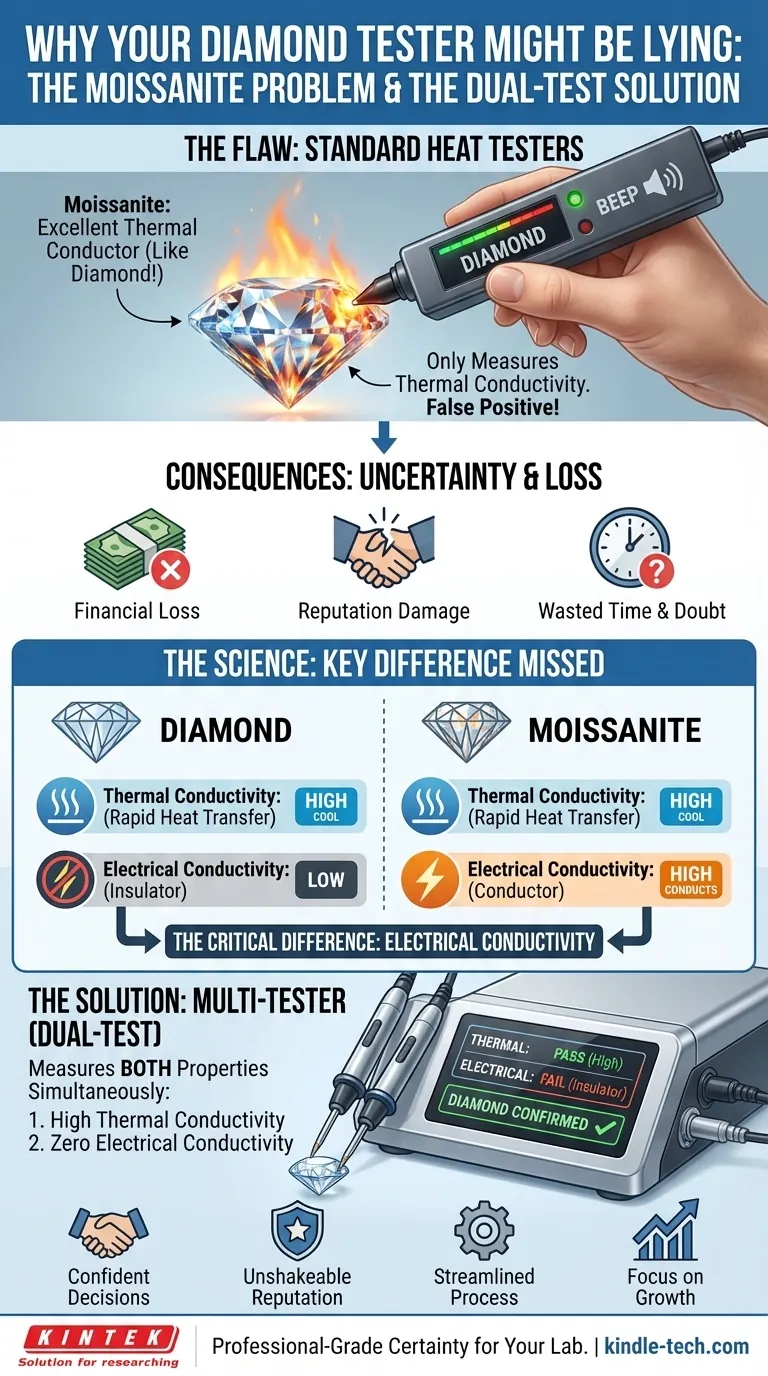
Your standard diamond tester works by measuring thermal conductivity. Diamonds are exceptional heat conductors; they pull heat away from a source faster than almost any other material. When the heated tip of the tester touches a diamond, it cools rapidly, and the device signals "Diamond."
For years, this was a reliable way to distinguish diamonds from simple fakes like glass or cubic zirconia.
The Moissanite Problem: A Thermal Twin
The game changed with the arrival of moissanite. This lab-created stone is not just a visual look-alike; it is also an excellent thermal conductor, nearly on par with a diamond.
This is the core of the problem: a tester that only measures heat cannot reliably tell the difference between a diamond and a moissanite. It sees rapid heat transfer and gives you a false positive. The common "solutions" fail because they don't address this fundamental flaw—they are still trying to solve the puzzle with only half the information.
The Real Solution: Adding a Second, Crucial Test
To definitively separate a diamond from its most convincing imposter, you must look for a property that they do not share. That property is electrical conductivity.
- Diamonds are electrical insulators. They do not conduct electricity.
- Moissanite, on the other hand, is an electrical conductor.
Therefore, to solve this problem once and for all, you need a tool designed to measure both properties simultaneously. A true, professional-grade verification tool will confirm two things:
- High thermal conductivity (like a diamond)
- Zero electrical conductivity (unlike moissanite)
A device that can perform this dual-test—often called a multi-tester—is not just another gadget. It is an instrument designed from a deeper understanding of the material science. It moves beyond a simple "hot or cold" measurement to provide a clear, scientifically-backed "yes" or "no."
This is the principle behind the reliable equipment that professionals trust. At KINTEK, we specialize in providing lab-grade tools that are built for certainty. Our multi-testers are engineered to perform this critical dual analysis because we know that for a professional, "close enough" is never good enough. The value isn't in the beep; it's in the confidence that comes from using a tool that can't be fooled.
Beyond Verification: The Power of Certainty
When you eliminate the guesswork from stone identification, you unlock more than just peace of mind. You create new business potential.
With a reliable multi-tester, you can:
- Make faster, more confident purchasing decisions on the spot, capitalizing on opportunities your competitors might hesitate on.
- Build an unshakeable reputation for accuracy and integrity, making you the go-to expert in your area.
- Streamline your intake and appraisal process, saving time and reducing the risk of human error.
- Focus on high-value activities like client relationships and business growth, rather than wasting energy on re-verification and damage control.
The challenge of distinguishing diamond from moissanite is a perfect example of a broader truth in any technical field: without the right tools, you're operating on guesswork. Your work, whether in gemology, research, or quality control, demands certainty. At KINTEK, we provide the professional-grade lab equipment and consumables that turn ambiguity into answers. If you're facing a challenge that requires precise, reliable measurement, let's talk. Contact Our Experts to discuss how we can equip your lab for success.
Visual Guide
Related Products
- CVD Diamond Dressing Tools for Precision Applications
- High Precision Diamond Wire Cutting Machine Laboratory Saw Precision Wire EDM Cutting Machine
- CVD Diamond Cutting Tool Blanks for Precision Machining
- 12 Inch 24 Inch High Precision Automatic Diamond Wire Cutting Machine Laboratory Saw Precision Wire EDM Cutting Machine
- Precision Wire Saw Laboratory Cutting Machine with 800mm x 800mm Workbench for Diamond Single Wire Circular Small Cutting