Yes, absolutely. Filter paper is specifically designed for the purpose of separating insoluble solid particles from a liquid or gas. This process, known as filtration, is a fundamental technique used in countless scientific and everyday applications, from a chemistry lab to brewing a cup of coffee.
The core principle is simple: filter paper acts as a physical barrier with microscopic pores. These pores are large enough to allow liquid molecules to pass through but small enough to trap the larger, undissolved solid particles.
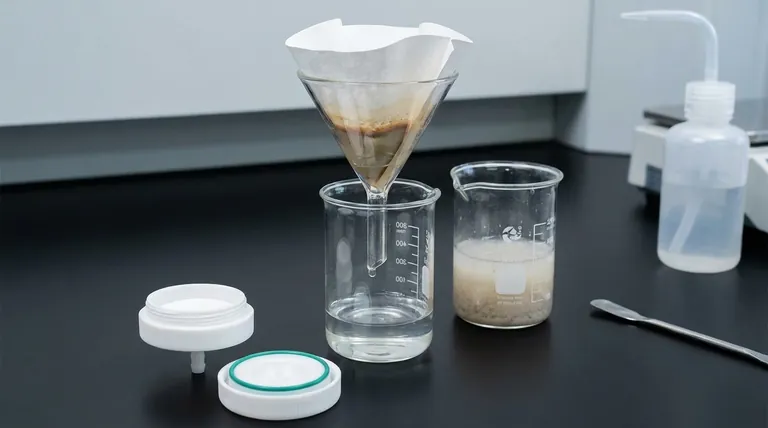
The Mechanics of Filtration: How it Works
Filtration is a physical separation method, meaning it does not involve a chemical reaction. The success of the separation relies entirely on the size difference between the components of the mixture.
The Porous Medium
Filter paper is typically made from refined cellulose fibers. These fibers are processed and pressed together to form a sheet filled with a random mesh of microscopic gaps, or pores.
The Filtrate and the Residue
During filtration, two distinct components are produced. The liquid that successfully passes through the filter paper is called the filtrate. The solid particles that are caught and remain on the surface of the paper are called the residue or retentate.
The Critical Factor: Pore Size
The effectiveness of filter paper is defined by its pore size, which is the average diameter of the openings in the paper mesh. This size determines the smallest particle the paper can reliably trap.
Key Properties to Consider for Your Goal
Not all filter papers are the same. Choosing the correct one depends on the specific requirements of your mixture.
Particle Retention
This is the most crucial property, directly related to pore size and often measured in micrometers (µm).
- Coarse filters have large pores and are used for retaining large particles or gelatinous precipitates.
- Fine filters have very small pores and are necessary for capturing tiny crystalline solids.
Filtration Speed (Flow Rate)
Filtration speed refers to how quickly the liquid can pass through the paper. There is a direct trade-off between speed and particle retention.
- Faster papers have larger pores, which retain only larger particles.
- Slower papers have smaller pores, providing finer filtration but taking more time.
Wet Strength
The paper must be strong enough to hold its shape and avoid tearing when saturated with liquid and supporting the weight of the residue. This is especially important in vacuum filtration setups.
Common Filtration Setups
The method you use to perform the filtration can dramatically affect its speed and efficiency.
Gravity Filtration
This is the most basic setup. The filter paper is folded into a cone, placed in a funnel, and positioned over a collection vessel like a beaker or flask. The force of gravity alone pulls the liquid through the paper. This method is simple but can be slow.
Vacuum (Suction) Filtration
For a much faster separation, vacuum filtration is used. This involves a specialized flat-bottomed funnel (a Büchner funnel), a filter flask with a side-arm, and a vacuum source. The vacuum creates a pressure difference that actively pulls the liquid through the paper, drastically reducing filtration time.
Understanding the Trade-offs and Limitations
While powerful, filtration is not a universal solution for all mixtures. Understanding its limitations is key to avoiding failed experiments.
The Insoluble Requirement
Filtration can only separate insoluble solids—particles that do not dissolve in the liquid. If a solid is dissolved (e.g., salt in water), it forms a solution, and its individual ions or molecules will pass through the filter pores with the water.
The Particle Size Problem
If the solid particles are smaller than the pores in the paper, they will simply pass through with the filtrate. This is common with colloidal suspensions, where particles are too small to be trapped by standard filter paper.
The Clogging Issue
Extremely fine or gelatinous solids can quickly block the pores of the filter paper. This issue, known as clogging or blinding, can slow the filtration process to a complete halt.
Making the Right Choice for Your Task
Use your goal to determine the correct paper and method.
- If your primary focus is a simple, non-critical separation (e.g., sand from water): A standard, medium-pore-size paper and a simple gravity filtration setup are sufficient.
- If your primary focus is to collect a fine solid product quickly: Use a paper with a fine pore size rating in a vacuum filtration setup to maximize speed and product dryness.
- If your filtrate is cloudy after separation: Your solid particles are passing through the paper; you must select a filter paper with a smaller pore size.
- If your filtration has stopped completely: The paper is likely clogged; you may need to use a paper with a larger pore size or use a filter aid.
By understanding these core principles, you can confidently select the right filter paper and method to achieve a clean and effective separation.
Summary Table:
| Property | Description | Key Consideration |
|---|---|---|
| Pore Size | Average diameter of openings in the paper mesh. | Determines the smallest particle size that can be trapped. |
| Filtration Speed | How quickly liquid passes through the paper. | Faster speed = larger pores; slower speed = finer filtration. |
| Wet Strength | The paper's ability to resist tearing when wet. | Critical for supporting residue weight, especially in vacuum filtration. |
| Method | Setup used for the filtration process. | Gravity Filtration (simple, slow) vs. Vacuum Filtration (fast, efficient). |
Achieve precise and reliable separations in your lab with the right filtration equipment from KINTEK.
Whether you are purifying a chemical product, clarifying a solution, or collecting a precious solid, the correct filter paper and setup are critical for success. KINTEK specializes in high-quality lab equipment and consumables, including a wide range of filter papers designed for various pore sizes and strengths.
Our experts can help you select the perfect filtration solution for your specific application, ensuring efficiency and accuracy in your workflow.
Contact us today via our [#ContactForm] to discuss your laboratory needs and discover how KINTEK can support your research and development goals.
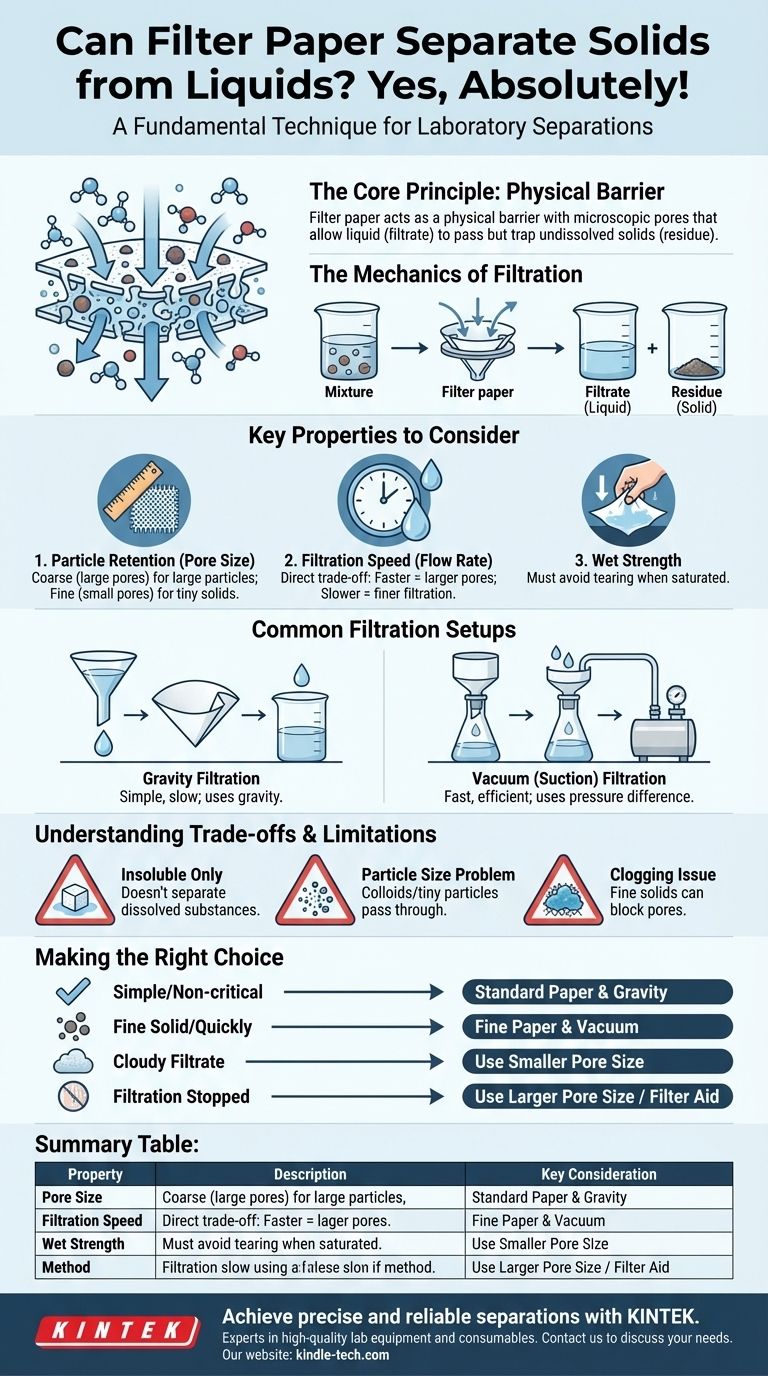
Visual Guide
Related Products
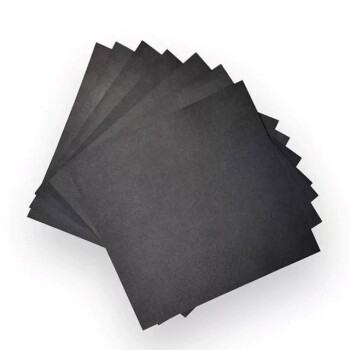
- Hydrophilic Carbon Paper TGPH060 for Battery Lab Applications
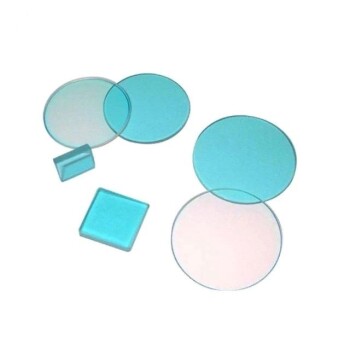
- Shortpass Filters for Optical Applications
- Longpass Highpass Filters for Optical Applications
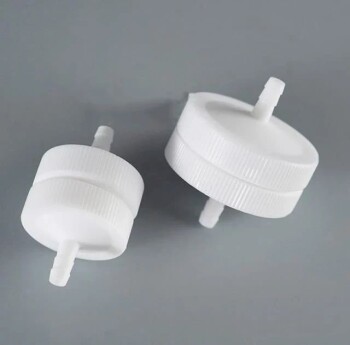
- Custom PTFE Teflon Parts Manufacturer for Sampling Filters
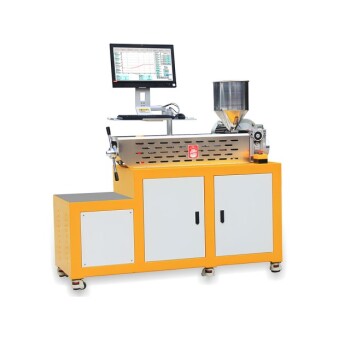
- Filter Testing Machine FPV for Dispersion Properties of Polymers and Pigments
People Also Ask
- Why is carbon paper placed between the powder and the graphite mold? Protect Your LTPO Electrolytes & Tooling
- How to make carbon fiber conductive? Bridge the Insulating Gaps in Your Composite
- Why is carbon paper commonly selected as a current collector for manganese dioxide cathodes? Unlock Battery Efficiency
- How is carbon paper constructed? The Engineered Porous Scaffold for High-Performance Applications
- How can the lifespan of carbon paper be extended? Reinforce Edges with Epoxy for Maximum Durability