Yes, diamond testers work, but their reliability depends entirely on the technology they use and the specific question you're asking. They are highly effective at distinguishing diamonds from common, cheap simulants like glass or cubic zirconia by measuring how a stone conducts heat or electricity. However, more sophisticated simulants, particularly moissanite, can fool basic testers.
A diamond tester's job is not to verify a "natural diamond" but to detect a specific physical property. While they reliably identify the material's characteristics, basic models cannot distinguish a diamond from moissanite, and no field tester can differentiate between a natural and a lab-grown diamond.
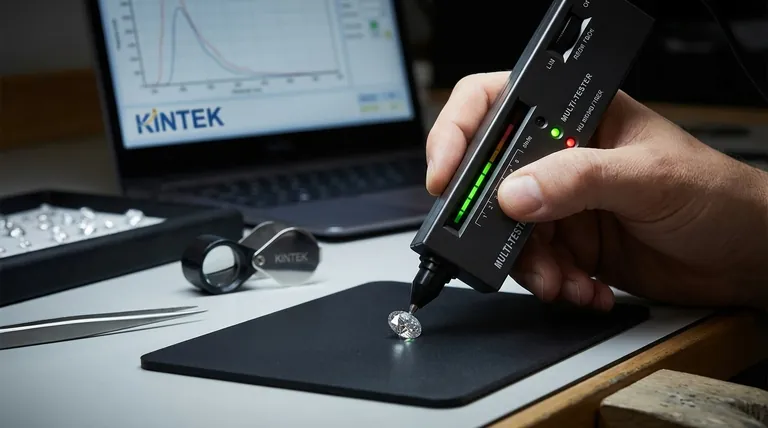
How Diamond Testers Function
At their core, these devices are not "diamond detectors" but rather "property meters." They measure how quickly heat or electricity moves through a gemstone, a key physical characteristic that sets diamonds apart from most other materials.
The Thermal Conductivity Test
Most common and affordable diamond testers are thermal conductivity testers. They work on a simple principle: diamonds are exceptional thermal conductors, meaning they dissipate heat very quickly.
The device has a small, heated metal tip. When you touch it to the gemstone, it measures how rapidly the heat is pulled away from the tip.
If the heat is drawn away quickly, the device signals "diamond." If the heat dissipates slowly (as it would with glass or cubic zirconia), it indicates the stone is not a diamond.
The Electrical Conductivity Test
Some more advanced testers, often called "multi-testers," add a second test: electrical conductivity.
While diamonds are typically electrical insulators, a specific simulant called moissanite is electrically conductive. This secondary test is designed almost exclusively to solve the moissanite problem.
The Critical Limitation: Moissanite
The single biggest challenge for basic diamond testers is moissanite, a popular and brilliant diamond simulant created in a lab.
Why Moissanite Fools Basic Testers
Moissanite is also an excellent thermal conductor, nearly as good as a diamond. A standard thermal-only tester will touch moissanite, sense the rapid heat transfer, and incorrectly identify it as a diamond.
This is the most common reason for a "false positive" result and the primary weakness of entry-level testers.
The Role of Multi-Testers
This is where multi-testers become essential. After a positive thermal test, a multi-tester will automatically perform an electrical conductivity test.
Because moissanite conducts electricity and diamond does not, the device can correctly differentiate between the two, providing a "moissanite" reading instead of a false "diamond" reading.
What About Lab-Grown Diamonds vs. Simulants?
It is crucial to understand the difference between a diamond simulant and a lab-grown diamond. This distinction is key to interpreting a tester's results correctly.
Lab-Grown Diamonds Test as "Diamond"
A lab-grown diamond is physically, chemically, and optically identical to a mined diamond. It has the same crystal structure and the same properties of thermal and electrical conductivity.
Therefore, any diamond tester will correctly identify a lab-grown diamond as "diamond." These testers cannot distinguish between mined and lab-grown diamonds.
Common Simulants are Easily Detected
Simulants like Cubic Zirconia (CZ), glass, or YAG are poor thermal conductors. Any basic, functional diamond tester will instantly and correctly identify these materials as fakes.
Understanding the Trade-offs and Inaccuracies
Even with the right technology, results can be misleading if not operated correctly.
User Error and Calibration
The most common source of error is the user. The probe must be placed flat on the stone's surface, and the user must ensure the device is properly calibrated before use. Testing a dirty stone can also lead to inaccurate readings.
Stone Size and Temperature
Very small stones (melee) may not have enough surface area for the probe to get an accurate reading. Likewise, a stone that is very cold or hot can temporarily affect the results.
Not a Substitute for a Gemologist
A handheld tester is a screening tool, not a certified appraisal instrument. It provides a data point about a physical property, not a definitive gemological identification or valuation. For that, nothing replaces the expertise of a certified gemologist using laboratory-grade equipment.
How to Interpret Your Tester's Results
Your choice of tool and your interpretation of its reading should align directly with your goal.
- If your primary focus is screening for cheap fakes: A basic thermal tester is a reliable and cost-effective tool for quickly separating diamonds from glass or cubic zirconia.
- If your primary focus is distinguishing diamond from moissanite: You must use a multi-tester that checks for both thermal and electrical conductivity.
- If your primary focus is determining a diamond's origin (natural vs. lab-grown): No handheld tester can provide this answer; it requires advanced gemological laboratory equipment.
Ultimately, a diamond tester is a valuable tool for its intended purpose, provided you understand its limitations.
Summary Table:
| Tester Type | What It Measures | Detects Diamonds? | Detects Moissanite? | Key Limitation |
|---|---|---|---|---|
| Basic Thermal Tester | Thermal Conductivity | Yes | No (False Positive) | Cannot distinguish diamond from moissanite |
| Advanced Multi-Tester | Thermal & Electrical Conductivity | Yes | Yes | Cannot distinguish natural from lab-grown diamonds |
Need precise and reliable lab equipment for accurate material analysis? KINTEK specializes in high-quality laboratory equipment and consumables, serving professionals who require dependable results. Whether you're in gemology, materials science, or quality control, our tools are designed to meet rigorous standards. Contact us today to find the right solution for your laboratory needs and ensure your testing is as accurate as possible.
Visual Guide

Related Products
- CVD Diamond Dressing Tools for Precision Applications
- High Precision Diamond Wire Cutting Machine Laboratory Saw Precision Wire EDM Cutting Machine
- CVD Diamond Cutting Tool Blanks for Precision Machining
- 12 Inch 24 Inch High Precision Automatic Diamond Wire Cutting Machine Laboratory Saw Precision Wire EDM Cutting Machine
- Precision Wire Saw Laboratory Cutting Machine with 800mm x 800mm Workbench for Diamond Single Wire Circular Small Cutting
People Also Ask
- What is chemical vapor deposition of diamond? Grow High-Purity Diamonds Atom-by-Atom
- What is CVD diamond? The Ultimate Guide to Lab-Grown Diamonds and Their Uses
- How do CVD diamonds grow? A Step-by-Step Guide to Lab-Grown Diamond Creation
- How do you identify a CVD diamond? The Definitive Guide to Lab-Grown Diamond Verification
- What color diamonds are CVD? Understanding the Process from Brown Tint to Colorless Beauty