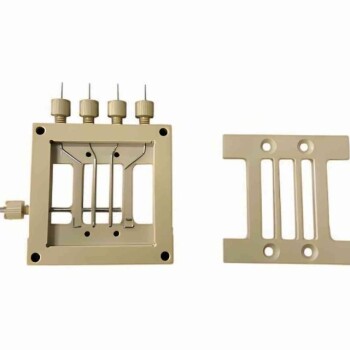
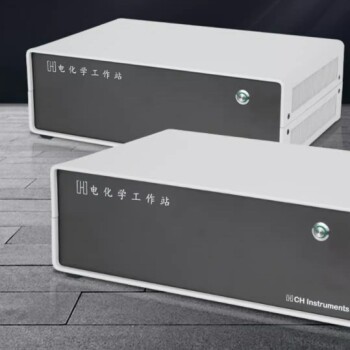
High-performance battery testing systems evaluate N-NVP/N-CN materials by conducting rigorous galvanostatic charge-discharge (GCD) tests on assembled coin cells. These systems precisely control current rates—ranging from 1 C to as high as 200 C—to measure the material’s capacity, stability, and efficiency under varying stress levels over thousands of cycles.
A high-performance battery testing system serves as the definitive tool for quantifying how surface-lattice modifications and carbon networks enhance sodium storage. By recording long-term cycling data and rate performance, it identifies the material's ability to maintain high energy density and structural integrity during rapid power delivery.
Precision Control of Electrochemical Stress
High-Current Rate Capability
The testing system evaluates the "power" aspect of N-NVP/N-CN by applying extremely high current densities, often reaching up to 200 C. This allows researchers to determine how effectively the surface-modified material handles rapid sodium-ion transport without significant capacity loss.
Long-Term Cycling Stability
To simulate real-world longevity, these systems automate the charge-discharge process for up to 10,000 cycles. By recording data over this extended period, the system reveals the material's cycling stability and its resistance to structural degradation over time.
Galvanostatic Charge-Discharge (GCD) Profiling
The system generates GCD curves that illustrate the voltage plateaus and specific capacity of the material. These profiles are essential for understanding the electrochemical potential at which sodium insertion and extraction occur within the N-NVP/N-CN framework.
Quantifying Performance and Efficiency
Capacity Retention Analysis
High-precision sensors record minute variations in discharge capacity to calculate the capacity retention rate. This metric is the primary indicator of how much of the initial sodium storage capability remains after thousands of high-speed cycles.
Coulombic Efficiency Monitoring
By comparing the charge and discharge capacities within each cycle, the system calculates Coulombic efficiency. This data highlights the reversibility of the sodium storage reactions and the effectiveness of the carbon coating (N-CN) in mitigating side reactions.
Voltage Gradient and Decay Evaluation
The system tracks the evolution of the voltage profile to detect voltage decay or shifts in the discharge platform. Such data is critical for identifying internal phase transitions or increasing internal resistance that could hinder performance.
Understanding the Trade-offs
High-Rate Testing vs. Kinetic Insight
While high-current testing (200 C) demonstrates power capability, it may mask slower degradation mechanisms that only appear at lower rates. A comprehensive evaluation requires a balance between ultra-fast testing and low-rate cycles to capture the full electrochemical picture.
Data Volume vs. Signal Clarity
Generating data for 10,000 cycles creates massive datasets that require sophisticated software for analysis. Without high-precision hardware, the subtle "noise" in the voltage signal could be mistaken for material instability, leading to inaccurate conclusions about the N-NVP/N-CN structure.
Practical Limitations of Coin Cells
Testing is typically performed on coin cells, which are ideal for material characterization but may not perfectly mirror the thermal and mechanical stresses of large-scale pouch cells. Results must be interpreted as "intrinsic material performance" rather than "final battery pack behavior."
How to Apply These Findings to Your Research
Making the Right Choice for Your Goal
- If your primary focus is rapid-charging applications: Prioritize testing at extreme rates (50 C to 200 C) to verify the kinetic advantages of the surface-lattice modifications.
- If your primary focus is grid-scale energy storage: Focus on long-term cycling data (6,000+ cycles) at moderate rates to ensure the material can provide a decade of reliable service.
- If your primary focus is structural optimization: Use high-precision GCD curves to analyze how different carbon coating thicknesses affect the voltage plateau and internal resistance.
By leveraging the full diagnostic power of a high-performance battery testing system, you can move beyond simple observation to a deep, quantitative understanding of sodium storage kinetics.
Summary Table:
| Evaluation Parameter | Testing Method | Key Metric for N-NVP/N-CN |
|---|---|---|
| Rate Capability | GCD at 1 C to 200 C | High-rate sodium-ion transport efficiency |
| Longevity | 10,000+ automated cycles | Capacity retention percentage |
| Reaction Reversibility | Coulombic efficiency monitoring | Carbon coating (N-CN) effectiveness |
| Structural Health | Voltage gradient/decay analysis | Internal resistance & phase stability |
Advance Your Battery Innovation with KINTEK
Precise evaluation of sodium-ion materials starts with superior laboratory equipment. KINTEK provides the critical tools needed for every stage of your research—from synthesizing advanced N-NVP/N-CN structures in our high-temperature atmosphere and CVD furnaces to preparing high-density electrodes with our precision hydraulic pellet presses.
Our comprehensive portfolio of battery research tools and consumables, including electrolytic cells, high-purity ceramics, and specialized crucibles, ensures your data is accurate and reproducible. Whether you are focused on grid-scale storage or rapid-charging technology, KINTEK delivers the reliability your lab demands.
Ready to scale your energy storage breakthroughs? Contact KINTEK Experts Today to find the perfect equipment for your material testing workflow!
References
- Hui Zhang, Xiaoxian Zhao. Surface Crystal Modification of Na<sub>3</sub>V<sub>2</sub>(PO<sub>4</sub>)<sub>3</sub> to Cast Intermediate Na<sub>2</sub>V<sub>2</sub>(PO<sub>4</sub>)<sub>3</sub> Phase toward High‐Rate Sodium Storage. DOI: 10.1002/advs.202306168
This article is also based on technical information from Kintek Solution Knowledge Base .
Related Products
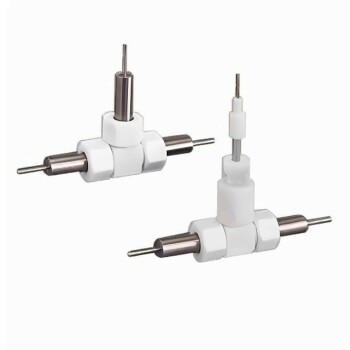
- Customizable Swagelok Type Test Cells for Advanced Battery Research Electrochemical Analysis
- Battery Lab Equipment 304 Stainless Steel Strip Foil 20um Thick for Battery Test
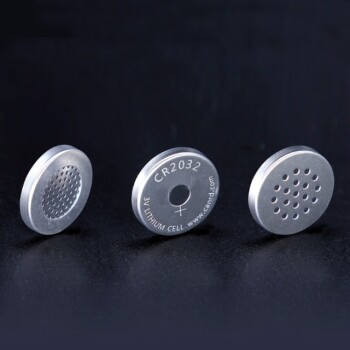
- Button Battery Case for Battery Lab Applications
- Cylindrical Battery Steel Case for Battery Lab
- Laboratory Hydraulic Press Lab Pellet Press for Button Battery
People Also Ask
- How does a standardized electrochemical test cell assist in MOx/CNTf electrode screening? Optimize Material Ratios
- Why is a dedicated electrochemical test cell necessary for carbon steel? Ensure Precise Geothermal Corrosion Data
- What is the difference between a voltaic cell and an electrochemical cell? Understand the Two Types of Energy Conversion
- How do the electrochemical cell and three-electrode testing system collaborate? Optimize Zinc Anode Deposition Control
- Why must the electrochemical cell be continuously purged with nitrogen? Ensure Precision in Ni-Cr Corrosion Tests