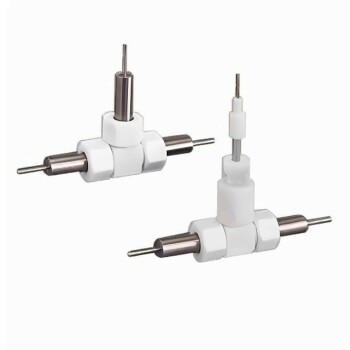
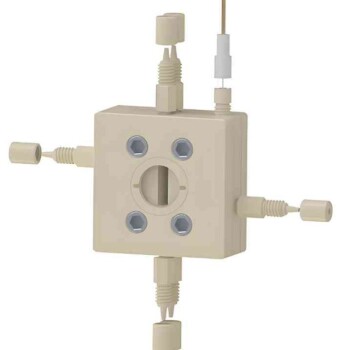
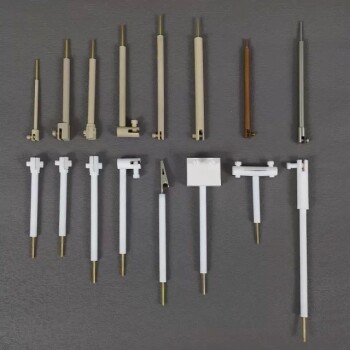
A standardized electrochemical test cell serves as a precise, miniaturized diagnostic platform designed to evaluate the performance of Metal Oxide/Carbon Nanotube Fiber (MOx/CNTf) electrodes before they are deployed in larger systems. By utilizing a three-electrode or two-electrode configuration, this tool allows researchers to isolate and test specific mass fractions of metal oxides in a controlled environment.
The core value of this test cell lies in risk reduction and resource efficiency. It enables the rigorous optimization of electrode ratios at a micro-scale, ensuring that only the most efficient and stable compositions are integrated into full-scale desalination components.
The Mechanics of Preliminary Screening
Evaluating Mass Fractions
The primary function of the test cell is to determine the ideal composition of the electrode.
It allows you to test various mass fractions of metal oxides against the carbon nanotube fiber backbone. By isolating these variables, you can pinpoint the exact ratio that yields the highest performance.
Quantifying Key Metrics
Screening is only as good as the data it produces. The test cell provides accurate measurements of three critical performance indicators:
- Geometric capacitance: The charge-storage capability per unit area.
- Coulombic efficiency: The efficiency of charge transfer during the cycle.
- Internal resistance: The opposition to current flow within the cell.
These metrics provide the empirical evidence needed to justify moving a specific electrode design forward.
Diagnostic Techniques Utilized
Cyclic Voltammetry (CV)
This technique is used to map the electrochemical behavior of the electrode.
CV helps you understand how the electrode reacts to changing voltages, providing insight into its capacitive nature and stability.
Galvanostatic Charge-Discharge (GCD)
GCD is critical for measuring real-world endurance.
By charging and discharging the cell at a constant current, this method directly measures coulombic efficiency. It reveals how well the electrode maintains its charge over time.
Electrochemical Impedance Spectroscopy (EIS)
To understand energy loss, you must understand resistance.
EIS analyzes the impedance of the cell over a range of frequencies. This data is essential for calculating internal resistance, which directly impacts the energy efficiency of the final component.
Understanding the Trade-offs
The Scale Gap
While highly effective for screening, the test cell is a miniaturized platform.
It isolates electrochemical performance but does not fully replicate the complex hydrodynamic conditions of a full-scale desalination system. It is a tool for material optimization, not system-level simulation.
Optimization vs. Integration
High performance in a test cell does not guarantee instant success in a large component.
The data provided optimizes the electrode ratios, but factors such as assembly constraints and large-scale durability must still be verified after this preliminary phase.
Making the Right Choice for Your Goal
To maximize the utility of your preliminary screening, align your testing focus with your specific engineering objectives:
- If your primary focus is Storage Capacity: Prioritize Geometric Capacitance data derived from Cyclic Voltammetry to ensure maximum charge density.
- If your primary focus is Energy Efficiency: Scrutinize Coulombic Efficiency results from Galvanostatic Charge-Discharge to minimize energy loss during cycles.
- If your primary focus is Power Delivery: Focus on minimizing Internal Resistance via Electrochemical Impedance Spectroscopy to ensure rapid charge transfer.
Use these standardized metrics to validate your design logic before committing resources to full-scale manufacturing.
Summary Table:
| Metric Evaluated | Diagnostic Technique | Key Insight for MOx/CNTf |
|---|---|---|
| Geometric Capacitance | Cyclic Voltammetry (CV) | Measures charge-storage capability per unit area. |
| Coulombic Efficiency | Galvanostatic Charge-Discharge (GCD) | Evaluates charge transfer efficiency and real-world endurance. |
| Internal Resistance | Electrochemical Impedance Spectroscopy (EIS) | Analyzes energy loss and power delivery potential. |
| Mass Fractions | Variable Electrode Loading | Identifies the optimal metal oxide to carbon nanotube ratio. |
Accelerate Your Electrode Research with KINTEK Precision
Transitioning from material innovation to full-scale deployment requires rigorous validation. At KINTEK, we specialize in providing the high-performance laboratory equipment needed to refine your designs. Whether you are optimizing MOx/CNTf electrodes or developing next-generation energy storage, our comprehensive range of electrolytic cells, electrodes, and battery research tools ensures your preliminary screening is both accurate and scalable.
Our expertise extends to a full suite of laboratory solutions, including:
- High-Temperature Furnaces (Muffle, Tube, Vacuum) for electrode annealing.
- Crushing & Milling Systems for precise material preparation.
- High-Pressure Autoclaves & Reactors for advanced synthesis.
Don't let inefficient ratios slow down your desalination or energy projects. Contact KINTEK today to discover how our specialized consumables and equipment can enhance your lab's efficiency and drive your research forward.
References
- Cleis Santos, Juan J. Vilatela. Interconnected metal oxide CNT fibre hybrid networks for current collector-free asymmetric capacitive deionization. DOI: 10.1039/c8ta01128a
This article is also based on technical information from Kintek Solution Knowledge Base .
Related Products
- Electrolytic Electrochemical Cell for Coating Evaluation
- Customizable Swagelok Type Test Cells for Advanced Battery Research Electrochemical Analysis
- Sample Support Body for Electrochemical Tests
- Flat Corrosion Electrolytic Electrochemical Cell
- H-Type Double-Layer Optical Electrolytic Electrochemical Cell with Water Bath
People Also Ask
- What is the volume range of the coating evaluation electrolytic cell? A Guide to Choosing the Right Size
- How does the design of an electrochemical electrolytic cell influence the coating uniformity? Optimize Your Catalysts
- What is the correct shutdown and disassembly procedure after an experiment? Ensure Safety and Protect Your Equipment
- How do the electrochemical cell and three-electrode testing system collaborate? Optimize Zinc Anode Deposition Control
- What is the difference between a voltaic cell and an electrochemical cell? Understand the Two Types of Energy Conversion