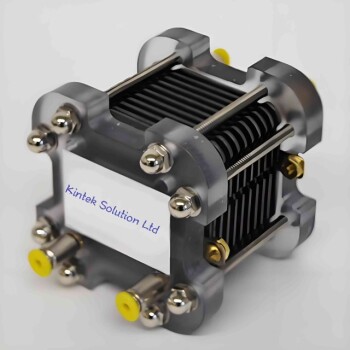
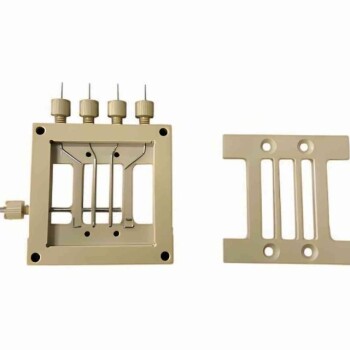
The three-electrode electrolytic cell functions by isolating the measurement of voltage from the flow of current to ensure precise electrochemical data. specifically for 8620 steel in simulated environments, this system uses the steel as the working electrode, a platinum wire as the counter electrode, and a saturated calomel electrode as the reference. This configuration directs current through the platinum wire while measuring potential against the stable calomel electrode, preventing electrical interference from skewing the corrosion data.
Core Takeaway The primary value of this system is the elimination of polarization errors common in simpler setups. By separating the sensing component (reference) from the current-carrying component (counter), the system provides an unadulterated reflection of the 8620 steel's corrosion behavior, specifically within aggressive chloride-thiosulfate solutions.
The Anatomy of the 8620 Steel Test Setup
To understand how the system functions, you must first understand the specific role of each component dictated by the primary reference configuration.
The Working Electrode: 8620 Steel
The 8620 steel sample serves as the working electrode. This is the material under investigation.
In this context, the focus is often on the borided layer of the steel. The system is designed to monitor electrochemical reactions occurring strictly at the interface between this steel surface and the electrolyte.
The Counter Electrode: Platinum Wire
A platinum wire acts as the counter electrode (sometimes called the auxiliary electrode).
Its primary function is to complete the electrical circuit. Current flows between the working electrode and this platinum wire. Platinum is selected for its inertness, ensuring it conducts current without reacting significantly with the electrolyte itself.
The Reference Electrode: Saturated Calomel
A saturated calomel electrode (SCE) serves as the reference.
Unlike the other two electrodes, no significant current flows through the reference. Its sole purpose is to maintain a stable, known potential against which the working electrode can be measured.
How the System Ensures Accuracy
The functional mechanics of this system are designed to solve a specific problem: obtaining a "true reflection" of corrosion behavior.
Decoupling Current and Potential
In a standard two-electrode system, the same electrode carries current and measures voltage. This causes the potential to drift as the electrode reacts (polarizes).
The three-electrode system splits these functions. The current loop exists between the 8620 steel and the platinum wire. The voltage measurement loop exists between the 8620 steel and the calomel reference.
Eliminating Auxiliary Polarization
The primary reference highlights that this setup eliminates the influence of auxiliary electrode polarization.
When current flows through the platinum counter electrode, that electrode may polarize (change characteristics). However, because the potential is measured against the isolated calomel electrode, changes in the platinum electrode do not distort the measurement of the steel.
Controlled Electrochemical Environment
This geometry creates a highly controlled environment. It allows the instrument (potentiostat) to focus potential control solely on the interface of the 8620 steel.
This is critical for accurate testing in chloride-thiosulfate solutions, where complex corrosion dynamics require precise data on coating protection and charge transfer resistance.
Understanding the Critical Advantage
It is important to recognize why this complexity is necessary versus a simpler setup.
The Pitfall of Two-Electrode Systems
If you were to remove the reference electrode, the system would measure the potential difference across the entire cell, including the voltage drop in the solution and the reactions at the counter electrode.
This would result in data that reflects the entire cell's resistance, rather than the specific corrosion properties of the 8620 steel.
The Precision of Three-Electrode Systems
By introducing the third electrode, the system compensates for solution resistance (IR drop).
This ensures that the data collected represents the true kinetics of the steel's surface reactions—oxidation (corrosion) and reduction—without artifacts from the testing equipment itself.
Making the Right Choice for Your Goal
When applying this testing methodology to your projects, consider the following recommendations based on your specific objectives.
- If your primary focus is material characterization: Ensure the working electrode (8620 steel) is properly isolated so that the current density calculations reflect only the exposed surface area of the borided layer.
- If your primary focus is data validity: Verify that the platinum counter electrode has a larger surface area than the working electrode to prevent it from becoming a limiting factor in the current flow.
- If your primary focus is environmental simulation: Monitor the saturated calomel reference closely; while stable, it must be maintained properly to ensure the baseline potential remains constant in chloride-thiosulfate solutions.
Ultimately, the three-electrode system is the industry standard for specific corrosion testing because it is the only way to mathematically separate the steel's behavior from the test apparatus itself.
Summary Table:
| Component | Electrode Type | Material Used | Primary Function |
|---|---|---|---|
| Working Electrode | Primary | 8620 Steel | Material under investigation/corrosion site |
| Counter Electrode | Auxiliary | Platinum Wire | Completes the electrical circuit for current flow |
| Reference Electrode | Sensing | Saturated Calomel | Provides stable potential for voltage measurement |
| Potentiostat | Control | Instrument | Manages current and potential decoupling |
Elevate Your Electrochemical Research with KINTEK
Precision in corrosion testing starts with high-quality equipment. KINTEK specializes in advanced laboratory solutions designed for rigorous material science and battery research. Whether you are analyzing 8620 steel or developing next-generation energy storage, our comprehensive portfolio offers the reliability you need.
Our Specialized Range Includes:
- Electrochemical Excellence: High-precision electrolytic cells, specialized electrodes, and battery research consumables.
- Thermal Processing: Muffle, tube, vacuum, and CVD/PECVD furnaces for advanced material synthesis.
- Sample Preparation: Precision crushing, milling, and hydraulic presses (pellet, hot, isostatic).
- Fluid & Lab Management: High-pressure reactors, autoclaves, and cooling solutions (ULT freezers, freeze dryers).
Don't let instrumentation errors compromise your data. Contact KINTEK today to find the perfect electrochemical cell and laboratory setup tailored to your specific research environment!
References
- Ezazul Haque Sabuz, Ishraq Shabib. Improving the Mechanical and Electrochemical Performance of Additively Manufactured 8620 Low Alloy Steel via Boriding. DOI: 10.3390/cmd4040032
This article is also based on technical information from Kintek Solution Knowledge Base .
Related Products
- H Type Electrolytic Cell Triple Electrochemical Cell
- PTFE Electrolytic Cell Electrochemical Cell Corrosion-Resistant Sealed and Non-Sealed
- Customizable PEM Electrolysis Cells for Diverse Research Applications
- Electrolytic Electrochemical Cell Gas Diffusion Liquid Flow Reaction Cell
- Electrolytic Electrochemical Cell with Five-Port
People Also Ask
- What is a H type cell? A Guide to Divided Electrochemical Cells for Accurate Experiments
- How should the electrolyte be prepared and added to the H-type electrolytic cell? Best Practices for Purity and Safety
- What is the technical necessity of using an H-type electrolytic cell for NO3RR tests? Protect Your Ammonia Yields
- How does the design of an H-type electrolytic cell benefit the neutral water electrolysis process for metal recovery?
- What is the primary function of an H-type electrolytic cell in NitRR? Ensure Accurate Product Yields