The electrochemical cell and the three-electrode testing system collaborate by decoupling the electrical current from the potential measurement. This configuration allows an electrochemical workstation to maintain a precise, stable voltage at the interface of the zinc anode, ensuring that zinc ions deposit into uniform nanostructures rather than hazardous dendrites.
This collaboration transforms a simple chemical reaction into a controlled manufacturing process. By isolating the measurement of electrical potential from the flow of current, the system provides the stability required to grow specific zinc crystal planes that enhance battery safety and longevity.
The Functional Roles of the Three-Electrode Architecture
The Working Electrode as the Deposition Substrate
The working electrode (WE), often composed of materials like carbon cloth or modified glass carbon, serves as the physical site for zinc ion reduction. It provides the surface area where zinc nanostructures are nucleated and grown under the direct influence of the applied electric field.
The Reference Electrode as the Precision Benchmark
The reference electrode (RE), such as Ag/AgCl or Saturated Calomel, acts as a stable voltage "ruler" that does not participate in the chemical reaction. Its sole purpose is to provide a constant potential benchmark, allowing the workstation to accurately monitor the exact energy level at the working electrode surface.
The Counter Electrode and Circuit Integrity
The counter electrode (CE), typically a platinum plate or wire, completes the electrical circuit by facilitating the necessary return current. By forcing the current to flow through the CE rather than the RE, the system prevents the reference electrode from becoming polarized, which would otherwise lead to inaccurate voltage readings.
Facilitating Uniform Deposition via the Electrochemical Cell
Managing Ion Distribution and Organic Coordination
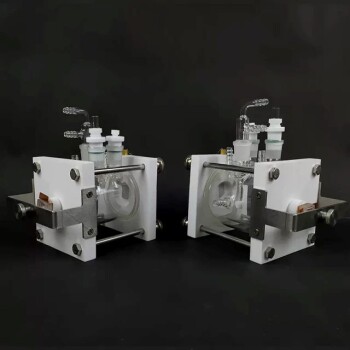
The electrochemical cell acts as the vessel that houses the electrolyte, providing the medium for ion transport between the electrodes. This environment allows organic ligands or specific ion concentrations to coordinate near the electrode surface, which is essential for controlling the morphology of the depositing zinc layer.
The Prevention of Dendrite Formation
By utilizing high-precision potential control, the system ensures that zinc ions are deposited at a rate that favors uniform growth. This precise regulation inhibits the formation of "dendrites"—needle-like structures that can pierce battery separators and cause short circuits—thereby significantly improving battery safety.
Real-Time Monitoring and Data Acquisition
The interaction between the electrodes and the electrochemical workstation enables the recording of Cyclic Voltammetry (CV) and Galvanostatic Charge-Discharge (GCD) data. These metrics allow researchers to observe the charge storage mechanisms and the efficiency of the zinc deposition in real-time.
Understanding the Trade-offs
Complexity versus Stability
The primary trade-off of a three-electrode system is its increased complexity compared to a two-electrode setup. While it offers superior precision for research and development, it requires more sophisticated instrumentation and careful maintenance of the reference electrode to prevent drift.
Electrode Material Limitations
While platinum is an ideal counter electrode due to its inertness, it is prohibitively expensive for large-scale industrial applications. Furthermore, the choice of reference electrode must be carefully matched to the electrolyte; for instance, a Hg/Hg2SO4 electrode is preferred in acidic environments where a standard Ag/AgCl electrode might fail or contaminate the solution.
Applying This System to Your Project
Recommendations for Success
- If your primary focus is fundamental material research: Use a three-electrode setup with a high-precision Ag/AgCl reference electrode to isolate the specific deposition potentials of new zinc nanostructures.
- If your primary focus is maximizing deposition surface area: Prioritize the use of carbon cloth as the working electrode to provide a flexible, high-surface-area substrate for zinc growth.
- If your primary focus is analyzing redox kinetics: Utilize the electrochemical workstation to perform Differential Pulse Voltammetry (DPV) to capture high-sensitivity data on ion coordination.
The synergy of the three-electrode system ensures that the electrochemical cell remains a controlled environment, turning unpredictable zinc growth into a predictable, high-performance anode.
Summary Table:
| Component | Primary Function | Role in Zinc Deposition |
|---|---|---|
| Working Electrode (WE) | Deposition Substrate | Site for zinc ion reduction and nanostructure growth. |
| Reference Electrode (RE) | Voltage Benchmark | Provides a stable potential 'ruler' to monitor surface energy. |
| Counter Electrode (CE) | Circuit Completion | Carries return current to prevent reference electrode polarization. |
| Electrochemical Cell | Reaction Vessel | Houses electrolyte and facilitates uniform ion transport. |
| Electrochemical Workstation | Control & Data Acquisition | Regulates precise voltage and records CV/GCD metrics in real-time. |
Elevate Your Battery Research with KINTEK Precision
Achieving uniform zinc deposition and preventing dendrite formation requires absolute control over your electrochemical environment. At KINTEK, we provide the specialized laboratory equipment and high-purity consumables necessary to turn complex material science into predictable, high-performance results.
Our extensive portfolio is designed to support every stage of your research:
- Advanced Electrolytic Cells & High-Precision Electrodes for stable three-electrode testing and analysis.
- Battery Research Tools & Consumables, including PTFE products, high-quality ceramics, and crucibles.
- High-Temperature High-Pressure Reactors & Autoclaves for innovative material synthesis.
- Material Preparation Systems, including crushing, milling, and hydraulic presses for electrode fabrication.
Ready to enhance your lab's efficiency and data accuracy? Contact KINTEK today to consult with our experts on the right solutions for your specific electrochemical projects.
References
- Himanshu Gupta, Prashanth W. Menezes. Recent technological advances in designing electrodes and electrolytes for efficient zinc ion hybrid supercapacitors. DOI: 10.1039/d3ya00259d
This article is also based on technical information from Kintek Solution Knowledge Base .
Related Products
- Electrolytic Electrochemical Cell for Coating Evaluation
- Electrolytic Electrochemical Cell with Five-Port
- H-Type Double-Layer Optical Electrolytic Electrochemical Cell with Water Bath
- Side Window Optical Electrolytic Electrochemical Cell
- PTFE Electrolytic Cell Electrochemical Cell Corrosion-Resistant Sealed and Non-Sealed
People Also Ask
- What is the volume range of the coating evaluation electrolytic cell? A Guide to Choosing the Right Size
- How does the design of an electrochemical electrolytic cell influence the coating uniformity? Optimize Your Catalysts
- What is the correct shutdown and disassembly procedure after an experiment? Ensure Safety and Protect Your Equipment
- What is the difference between a voltaic cell and an electrochemical cell? Understand the Two Types of Energy Conversion
- What is the difference between electrolyte and electrode cell? Master the Fundamentals of Electrochemical Systems