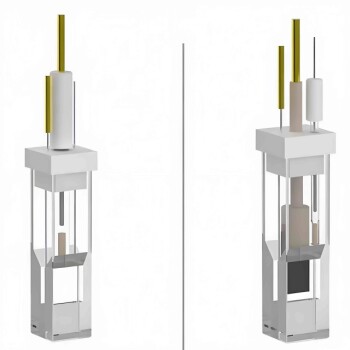
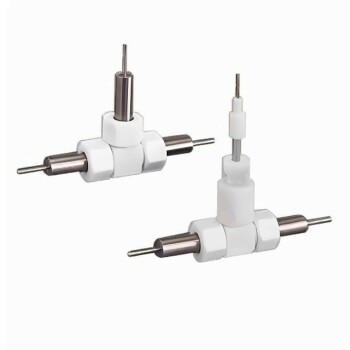
The design of the electrolytic cell is the critical determinant in achieving coating uniformity on carbon fiber composite catalysts. It directly regulates current distribution and ensures the melt fully wets the fiber bundles, maintaining consistent electrical potential throughout the material. By controlling these variables, the cell design dictates whether metal ions nucleate and reduce evenly, preventing defects and ensuring total coverage from the fiber's surface to its core.
A precisely engineered cell design eliminates shielding effects and guarantees uniform metal ion reduction. This ensures nanocrystalline coatings are distributed evenly across the entire fiber structure, rather than accumulating only on the exterior.
The Mechanics of Uniformity
To understand how cell design influences the final product, we must look at the specific electrochemical mechanisms it controls.
Optimizing Current Distribution
The geometry of the cell must facilitate a uniform flow of electricity.
If the current distribution is uneven, metal ions will reduce at different rates across the composite.
A well-designed cell ensures consistent current density, leading to uniform coating thickness.
Ensuring Full Melt Wetting
Carbon fiber bundles are dense and difficult to penetrate.
The cell design must promote fluid dynamics that allow the electrolyte melt to fully saturate (wet) these bundles.
Without full wetting, inner fibers remain dry and electrically isolated, preventing any coating deposition.
Maintaining Electrical Potential
Consistent potential is required for stable electrochemical reactions.
Variations in potential can lead to unpredictable nucleation sites.
Proper design maintains a stable electrical environment, ensuring the reaction occurs simultaneously across all fibers.
Overcoming Physical Barriers
The primary challenge in coating fiber bundles is getting the material to the center of the bundle.
Preventing Shielding Effects
In poorly designed cells, outer fibers can block the current and ions from reaching the inner fibers.
This "shielding effect" results in a thick coating on the outside and little to no coating on the inside.
Optimized cell geometry minimizes this interference, allowing ions to bypass outer layers.
Uniform Nucleation and Reduction
The goal is for metal ions to nucleate (begin forming solids) everywhere at once.
When the cell design balances current and wetting, reduction happens uniformly.
This leads to a consistent nanocrystalline structure throughout the depth of the composite.
Understanding the Trade-offs
While maximizing uniformity is the goal, it introduces specific engineering challenges.
Complexity vs. Flow
Designs that force deep wetting may impede electrolyte flow rates.
You must balance the need for penetration with the need for fresh electrolyte replenishment.
Electrical Contact vs. Saturation
Ensuring full saturation can sometimes compromise the physical electrical contacts required for the circuit.
The design must secure the fibers for conduction without blocking the melt from wetting those contact points.
Making the Right Choice for Your Goal
Optimizing your electrolytic cell requires aligning the design with your specific performance metrics.
- If your primary focus is catalytic efficiency: Prioritize designs that eliminate shielding effects to ensure the maximum number of nanocrystals are exposed on the fiber core.
- If your primary focus is structural consistency: Focus on uniform current distribution to prevent uneven coating thicknesses that could create stress points.
Ultimately, the electrolytic cell is not merely a vessel, but a precision tool that defines the quality and performance of the final catalyst.
Summary Table:
| Key Factor | Impact on Coating Uniformity | Role of Cell Design |
|---|---|---|
| Current Distribution | Regulates thickness and reduction rates. | Ensures uniform density to prevent uneven plating. |
| Melt Wetting | Determines internal fiber coverage. | Promotes fluid dynamics to saturate dense fiber bundles. |
| Electrical Potential | Controls nucleation site stability. | Maintains a stable environment for simultaneous reactions. |
| Shielding Effects | Creates thick outer/thin inner coatings. | Optimizes geometry to allow ion penetration to the core. |
| Structural Integrity | Prevents stress points and peeling. | Balances flow and contact for nanocrystalline consistency. |
Elevate Your Electrochemical Research with KINTEK
Precise coating uniformity starts with a high-performance environment. KINTEK specializes in advanced laboratory equipment, providing researchers with the high-precision electrolytic cells and electrodes needed to master complex reactions. Whether you are developing carbon fiber composite catalysts or exploring battery research, our comprehensive portfolio—including high-temperature furnaces, high-pressure reactors, and specialized consumables like PTFE and ceramics—is designed to meet the rigorous demands of modern material science.
Ready to eliminate shielding effects and achieve superior catalytic efficiency?
Contact our technical experts today to find the perfect solution for your laboratory’s unique challenges.
References
- Yu. V. Stulov, С. А. Кузнецов. Electrochemical Synthesis of Functional Coatings and Nanomaterials in Molten Salts and Their Application. DOI: 10.3390/coatings13020352
This article is also based on technical information from Kintek Solution Knowledge Base .
Related Products
- Electrolytic Electrochemical Cell with Five-Port
- Electrolytic Electrochemical Cell for Coating Evaluation
- PTFE Electrolytic Cell Electrochemical Cell Corrosion-Resistant Sealed and Non-Sealed
- Super Sealed Electrolytic Electrochemical Cell
- H-Type Double-Layer Optical Electrolytic Electrochemical Cell with Water Bath
People Also Ask
- What is the correct shutdown and disassembly procedure after an experiment? Ensure Safety and Protect Your Equipment
- What are the three essential components that comprise an electrolytic cell? Key Elements of Chemical Synthesis
- How does the design of an electrolytic cell affect the production yield of ferrate(VI)? Optimize Efficiency & Purity
- What is galvanic cell or electrolytic cell? Unlock the Secrets of Electrochemical Power
- What materials are used for the body of a super-sealed electrolytic cell and what are their properties? Select the Right Material for Your Experiment