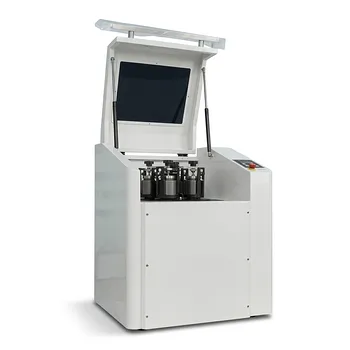
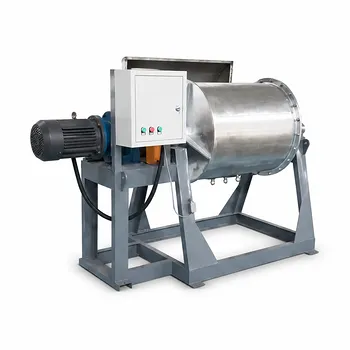
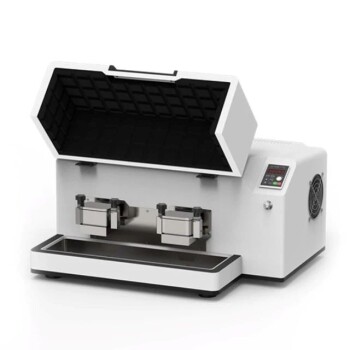
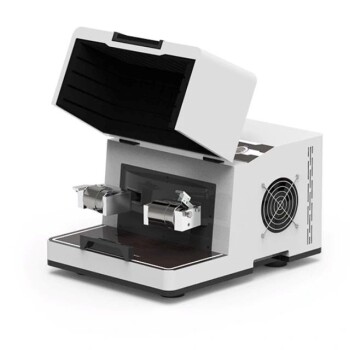
The Planetary Ball Mill achieves uniformity through a unique dual-motion mechanism. By simultaneously rotating the mill jar on its own axis while revolving it around a central point, the machine generates intense centrifugal forces. These mechanical forces drive the aluminum and graphite powders into complex, multi-dimensional movements that break apart agglomerates and force the distinct materials to mix thoroughly.
Core Takeaway Mixing materials with vastly different densities, such as aluminum and graphite, presents a significant challenge for standard mixers. The planetary ball mill utilizes high-energy centrifugal force to overcome these disparities, achieving both macro and micro-scale uniformity essential for fabricating high-performance composite materials.
The Mechanics of Uniformity
The Dual-Motion Principle
The "planetary" designation comes from the machine's specific movement pattern. The milling jars allow for simultaneous rotation and revolution.
While the jar rotates around its own axis, it also revolves around a central sun wheel. This is distinct from simple rotary mixers that only tumble material in one direction.
Generating Centrifugal Force
This combination of movements creates significant centrifugal force. It is this force, rather than gravity alone, that acts as the primary driver of the mixing process.
The force accelerates the grinding media (balls) and the powder mixture, creating high-energy impacts. These impacts are crucial for forcing the aluminum coating onto the graphite substrate.
Complex Multi-Dimensional Movement
Because the forces are dynamic, the powder does not settle in layers. Instead, the materials are subjected to complex, multi-dimensional movements inside the jar.
This chaotic motion prevents dead spots within the container, ensuring that every particle is subjected to the mixing action.
Overcoming Material Challenges
Handling Density Disparities
One of the primary difficulties in creating aluminum-graphite composites is the significant difference in density between the two materials.
In low-energy mixing, the heavier aluminum would naturally separate from the lighter graphite. The high centrifugal forces of the planetary ball mill overpower this tendency to segregate, keeping both powders suspended in the mix.
Breaking Up Agglomerates
Fine powders, particularly graphite, have a natural tendency to clump together, or agglomerate.
The mechanical force generated by the ball mill effectively shatters these agglomerates. By breaking these clusters down, the mill exposes the individual particles, allowing the aluminum to coat the graphite surface evenly.
Achieving Macro and Micro-Scale Mixing
The process results in uniformity on two levels. Macro-scale mixing ensures that the ratio of aluminum to graphite is consistent throughout the entire batch.
Micro-scale mixing ensures that individual graphite particles are intimately contacted by aluminum particles. This level of precision is non-negotiable for the fabrication of high-performance composites.
Understanding Process Control (Trade-offs)
Energy vs. Material Integrity
While high energy is required for mixing, excessive force can damage the crystalline structure of the graphite.
It is critical to balance the rotational speed and duration. You need enough energy to coat the particles, but not so much that you pulverize the graphite structure entirely.
Media Selection
The choice of grinding balls affects the outcome. Heavier balls provide more impact force, which helps with coating but risks crushing softer materials.
Using the correct size and material density for the balls is essential to achieve uniformity without introducing contamination or structural damage.
Optimizing Your Mixing Strategy
To get the most out of a planetary ball mill for aluminum-coated graphite, consider your specific end-goal:
- If your primary focus is Coating Uniformity: Prioritize a milling protocol that maximizes multi-dimensional movement to ensure complete de-agglomeration of the graphite.
- If your primary focus is Material Structure: Optimize the rotational speed to generate sufficient mixing force while minimizing the impact energy that could degrade the graphite's properties.
By mastering the balance of centrifugal force and milling time, you ensure the consistent material quality required for advanced composite applications.
Summary Table:
| Feature | Mechanism | Benefit for Aluminum-Graphite Mixing |
|---|---|---|
| Dual-Motion Pattern | Simultaneous rotation and revolution | Prevents material settling; eliminates mixing dead spots |
| Centrifugal Force | High-energy mechanical acceleration | Overpowers density disparities between Al and Graphite |
| Multi-Dimensional Movement | Chaotic, high-impact particle paths | Breaks up graphite agglomerates for even surface coating |
| Process Control | Adjustable speed and milling time | Balances thorough coating with crystalline structure integrity |
Elevate Your Material Research with KINTEK Precision
Achieving perfect uniformity in complex composites like aluminum-coated graphite requires industrial-grade precision and power. KINTEK specializes in advanced laboratory equipment, offering high-performance planetary ball mills, crushing and milling systems, and sieving equipment designed to overcome density disparities and agglomeration challenges.
Whether you are developing next-generation battery materials or high-strength composites, our expertise in high-temperature furnaces, hydraulic presses, and specialized consumables ensures your lab operates at the cutting edge of technology.
Ready to optimize your mixing consistency? Contact KINTEK today to find the perfect milling solution for your application!
Related Products
- High Energy Planetary Ball Mill for Laboratory Horizontal Tank Type Milling Machine
- Laboratory Planetary Ball Mill Rotating Ball Milling Machine
- High-Energy Omnidirectional Planetary Ball Mill Milling Machine for Laboratory
- High Energy Planetary Ball Mill Milling Machine for Laboratory
- Laboratory Horizontal Planetary Ball Mill Milling Machine
People Also Ask
- What is the role of a planetary ball mill in sulfide-based solid-state batteries? Engineer High-Performance Cathodes
- What are the parameters of a planetary ball mill? Master Speed, Time, and Media for Perfect Grinding
- What is the function of a planetary ball mill for nanostructured eutectic steel? Essential Prep for High-Strength Alloys
- What role does a planetary ball mill play in the preparation of NASICON-type solid electrolytes like LATP and LAGP?
- What is the function of a planetary ball mill in solid-state electrolyte prep? Milling vs. SDS Methods Explained