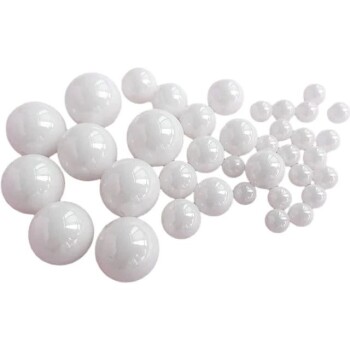
Zirconia grinding media are essential for SiHfCNO refining due to their extreme hardness, high density, and exceptional wear resistance. This combination ensures that the precursor remains free from metallic or aluminum contaminants while providing the mechanical energy necessary to achieve a refined, uniform powder structure. By resisting self-wear, zirconia media maintain the precise chemical composition required for high-performance SiHfCNO nanocomposite ceramics.
Core Takeaway: Zirconia jars and balls provide a "contamination-free" milling environment that preserves the high chemical purity of SiHfCNO precursors while maximizing grinding efficiency through superior kinetic energy transfer.
Preserving Chemical Purity and Integrity
Eliminating Metallic and Aluminum Contamination
SiHfCNO precursor polymer residues are high-hardness materials that can easily abrade standard grinding tools. Zirconia (ZrO2) resists self-wear, preventing the introduction of metal ions or aluminum elements into the mixture. This is critical because even trace impurities can degrade the final properties of the nanocomposite ceramic.
Maintaining Nanocomposite Stoichiometry
The chemical purity of the resulting SiHfCNO ceramic is directly tied to the milling process. Using zirconia media ensures that the chemical fingerprint of the precursor remains unaltered by the grinding environment. This allows for a more predictable and stable transformation from polymer to ceramic during subsequent processing.
Maximizing Mechanical and Grinding Efficiency
High Impact Kinetic Energy
Zirconia is characterized by its high density, which is significantly greater than that of traditional alumina or polymer media. This high density provides substantial impact kinetic energy during the milling process. This energy is necessary to break down tough precursor residues and refine them into a fine powder.
Achieving Uniform Particle Size Distribution
The high hardness and toughness of zirconia allow for consistent energy transfer to the reaction system. This results in uniform micron-level mixing and refinement of the raw components. A consistent particle size is a prerequisite for obtaining a uniform microstructure during the sintering phase.
Understanding the Trade-offs
The Risk of Trace Zirconium Introduction
While zirconia is highly wear-resistant, it is not invincible; over long durations, trace amounts of zirconium dioxide may still be introduced to the sample. However, unlike metallic impurities, trace zirconia is often chemically compatible with many high-performance ceramic systems and rarely causes side reactions.
Weight and Equipment Stress
The high density of zirconia media means that the overall weight of the grinding assembly will be significantly higher than when using alumina or plastic. This increased weight places higher mechanical stress on the planetary mill or ball mill motor and bearings. Users must ensure their equipment is rated for the specific load of dense zirconia jars and balls.
How to Apply This to Your Project
When selecting grinding media for SiHfCNO refining, your choice should align with your specific purity requirements and equipment capabilities.
- If your primary focus is Maximum Chemical Purity: Utilize high-purity yttria-stabilized zirconia (YSZ) balls and jars to virtually eliminate metallic ion contamination.
- If your primary focus is Rapid Particle Size Reduction: Leverage the high density of zirconia to increase the kinetic energy of the milling process, reducing the time required to reach the nanometer scale.
- If your primary focus is Cost-Effectiveness on Low-Hardness Samples: Consider whether alumina media might suffice, though for SiHfCNO, zirconia remains the technical gold standard to prevent abrasive wear.
By prioritizing zirconia media, you ensure that the sophisticated chemistry of your SiHfCNO precursor is protected, leading to a superior final ceramic product.
Summary Table:
| Feature | Advantage | Impact on SiHfCNO Refining |
|---|---|---|
| Extreme Hardness | Exceptional wear resistance | Eliminates metallic and aluminum contamination |
| High Density | Superior kinetic energy | Achieves rapid and uniform micron-level refinement |
| Chemical Inertness | Preserves stoichiometry | Maintains the precise chemical fingerprint of the precursor |
| YSZ Stabilization | High fracture toughness | Prevents media breakage during high-energy planetary milling |
Elevate Your Material Research with KINTEK Precision
Precision in SiHfCNO ceramic refining starts with the right tools. KINTEK specializes in high-performance laboratory equipment, providing the industry-leading crushing and milling systems and zirconia grinding media (YSZ jars and balls) required to maintain the strict chemical purity your precursors demand.
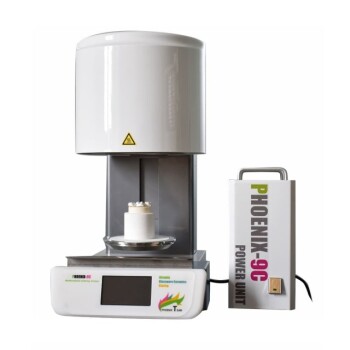
Beyond milling, our comprehensive portfolio includes high-temperature furnaces (CVD, PECVD, vacuum) and isostatic hydraulic presses to support your entire ceramic fabrication workflow. Whether you are a researcher aiming for nanometer-scale uniformity or a lab manager seeking reliable consumables like ceramics and crucibles, KINTEK delivers the quality and technical expertise you need.
Ready to optimize your milling efficiency and eliminate contamination? Contact our specialists today to find the perfect solution for your high-performance ceramic projects.
References
- Rahul Anand, Shantanu K. Behera. Structural evolution and oxidation resistance of polysilazane‐derived SiCN–HfO <sub>2</sub> ceramics. DOI: 10.1111/jace.19358
This article is also based on technical information from Kintek Solution Knowledge Base .
Related Products
- Laboratory Jar Ball Mill with Alumina Zirconia Grinding Jar and Balls
- Precision Machined Zirconia Ceramic Ball for Engineering Advanced Fine Ceramics
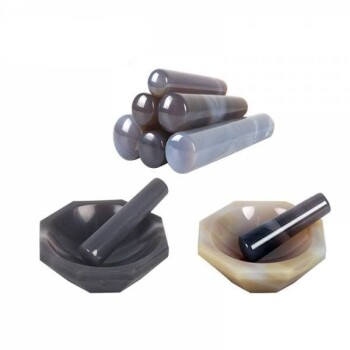
- Laboratory Jar Mill with Agate Grinding Jar and Balls
- Laboratory Ball Mill Jar Mill with Metal Alloy Grinding Jar and Balls
- Nature Agate Mortar and Pestle for Grinding and Mixing
People Also Ask
- What are the primary functions of using a ball mill for BZCY72 powder? Achieve High Purity and Enhanced Sintering
- In what way does a laboratory ball mill affect material properties when modifying PHBV/pulp fiber composites?
- Why is a laboratory ball mill required for ultra-fine fly ash? Unlock Nano-Scale Adsorption Power
- What is the function of a laboratory ball mill in the preparation of AMMCs? Optimize Dispersion & Grain Refinement
- What is the function of a laboratory ball mill in the pretreatment of waste tire char (WTC)? Optimize Material Reactivity