The primary precautions for blending metal powders fall into two critical categories: mitigating immediate safety hazards like explosions and health risks, and ensuring the final material quality by achieving homogeneity and preventing contamination. These measures involve controlling the environment, using appropriate equipment, and following strict handling protocols.
Blending metal powders is not merely a mixing step; it is a critical control point where the safety of your operation and the integrity of your final product are simultaneously at risk. Success requires a dual focus on preventing catastrophic events and guaranteeing material consistency.
The Dual Risks of Powder Blending: Safety and Quality
Understanding the "why" behind each precaution is essential for developing a robust process. The risks are not theoretical; they are responsible for incidents and product failures across industries from additive manufacturing to traditional powder metallurgy.
Mitigating Explosion and Fire Hazards
Many finely divided metal powders, such as aluminum, titanium, and magnesium, are highly combustible. When suspended in air at the right concentration, they can behave like a vapor, creating a significant explosion risk known as a combustible dust explosion.
The primary goal is to eliminate the "dust explosion pentagon": fuel (the powder), an oxidizer (air), dispersion (a dust cloud), confinement (the blender vessel), and an ignition source.
Key precautions include using explosion-proof (XP-rated) equipment and electrical systems in the blending area. All equipment, including the blender, containers, and operators, must be grounded and bonded to prevent the buildup and discharge of static electricity, a common ignition source.
For highly reactive materials, blending under an inert atmosphere (e.g., argon or nitrogen) is non-negotiable. This displaces the oxygen, removing a key element required for a fire or explosion.
Preventing Respiratory and Health Risks
Metal powders represent a significant inhalation hazard. Particles can be small enough to be inhaled deep into the lungs, leading to long-term health issues.
Certain metals, such as cobalt, nickel, and beryllium, are known carcinogens or sensitizers. Prolonged exposure can cause severe respiratory diseases.
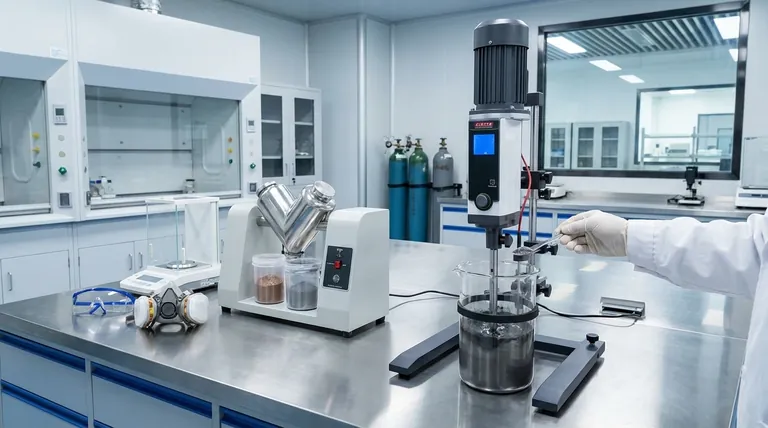
Operators must use appropriate Personal Protective Equipment (PPE), with a focus on respiratory protection. This often means wearing a properly fitted respirator (e.g., N95, P100, or PAPR) and not just a simple dust mask. Effective Local Exhaust Ventilation (LEV) or processing within a fume hood is also critical to capture stray dust at the source.
Ensuring Material Integrity and Homogeneity
Beyond safety, the entire purpose of blending is to produce a perfectly consistent feedstock. A failure in blending leads directly to defects and inconsistent performance in the final part.
Achieving a Homogeneous Mixture
Homogeneity is the state where every sample taken from the powder batch has the same composition. This is challenging because powders of different sizes, densities, or shapes have a natural tendency to segregate (separate).
The choice of blender is critical. Low-shear blenders like V-blenders or double-cone blenders are gentle and effective for free-flowing powders. High-energy mixers like Turbula mixers or high-shear mills are better for breaking up agglomerates but can alter particle shape.
Process parameters must be carefully validated. You must determine the optimal blending time, rotation speed, and fill volume for your specific material combination to achieve homogeneity without causing segregation from over-blending.
Preventing Cross-Contamination
Contamination from other metal powders, cleaning agents, or environmental debris can be catastrophic for final part properties, especially in demanding applications like aerospace or medical implants.
Strict protocols must be in place. This includes using dedicated blenders and tools for specific alloy families. If shared equipment is unavoidable, a validated, documented cleaning procedure is essential to ensure no residue remains between batches.
Protecting Against Environmental Degradation
Many metal powders are sensitive to their environment. Reactive powders can oxidize on contact with air, while others can absorb moisture from the atmosphere, which affects flowability and performance during processing.
Blending and storage should occur in a climate-controlled environment where both temperature and humidity are monitored. For highly sensitive materials, handling exclusively within a glovebox under an inert atmosphere may be necessary.
Understanding the Trade-offs
Choosing the right blending strategy involves balancing competing factors. There is no single "best" method; the optimal choice depends on your material and your goal.
Blender Type vs. Material Properties
A high-shear mixer might be necessary to distribute a small amount of a critical alloying element, but it could also flatten or work-harden your primary powder, negatively affecting its compressibility or flow characteristics. A gentle V-blender preserves particle shape but may fail to break up stubborn agglomerates.
Blending Time vs. Segregation Risk
It is a common misconception that more blending is always better. While under-blending results in an inconsistent mix, over-blending is a real phenomenon. For powders with different densities or sizes, extended blending can cause them to segregate again, with heavier or smaller particles settling to the bottom.
Batch Size and Scalability
A process validated on a small laboratory scale does not always transfer directly to large-scale production. The physics of powder flow and mixing efficiency change with batch size. Any scale-up requires re-validation of your blending parameters to ensure consistent results.
Implementing a Robust Blending Protocol
Your specific precautions should be tailored to the primary risk you are trying to mitigate.
- If your primary focus is safety with reactive materials (e.g., aluminum, titanium): Your protocol must prioritize explosion-proof equipment, comprehensive grounding and bonding, and blending under an inert gas atmosphere.
- If your primary focus is perfect homogeneity for high-performance parts: Your protocol must center on careful blender selection, rigorous validation of blending time, and routine sampling to verify the mixture uniformity.
- If your primary focus is preventing contamination for critical applications (e.g., medical, aerospace): Your protocol must enforce the use of dedicated equipment, meticulous cleaning verification, and strict environmental controls.
Mastering the blending process is a fundamental pillar of producing safe, reliable, and high-quality components from metal powders.
Summary Table:
| Precaution Category | Key Focus Areas |
|---|---|
| Safety (Explosion/Fire) | Explosion-proof equipment, grounding/bonding, inert atmosphere (for reactive powders) |
| Safety (Health) | Respiratory PPE (N95/P100/PAPR), local exhaust ventilation, fume hoods |
| Quality (Homogeneity) | Appropriate blender type (V-blender, Turbula), validated blending time/speed, preventing segregation |
| Quality (Contamination) | Dedicated equipment, strict cleaning protocols, climate-controlled environment |
Achieve Perfect Powder Blending with KINTEK
Blending metal powders is a critical step where safety and material integrity converge. KINTEK specializes in providing the robust lab equipment and expert guidance you need to master this process. We understand the challenges of preventing explosions, ensuring operator safety, and achieving a perfectly homogeneous mixture free from contamination.
Our range of solutions, including explosion-proof blenders and accessories for inert gas handling, is designed to meet the stringent demands of industries like additive manufacturing and powder metallurgy. Let us help you build a safer, more reliable, and higher-quality blending protocol.
Contact our experts today to discuss your specific metal powder blending needs and discover how KINTEK can support your laboratory's success.
Visual Guide

Related Products
- Folding Molybdenum Tantalum Boat With or Without Cover
- Laboratory Ball Mill Jar Mill with Metal Alloy Grinding Jar and Balls
- XRF & KBR steel ring lab Powder Pellet Pressing Mold for FTIR
- Round Bidirectional Press Mold for Lab
People Also Ask
- Why is a molybdenum crucible selected for lead-bismuth eutectic corrosion experiments? Ensure Pure Testing Results
- What is the advantage of molybdenum? Unlock Superior High-Temperature Performance
- What are the pros and cons of molybdenum? Harness Its High-Temperature Power
- Why is an alumina boat and Ti3AlC2 powder bed necessary for Ti2AlC sintering? Protect MAX Phase Purity
- What is the maximum operating temperature for molybdenum? Key Factors for High-Temp Performance