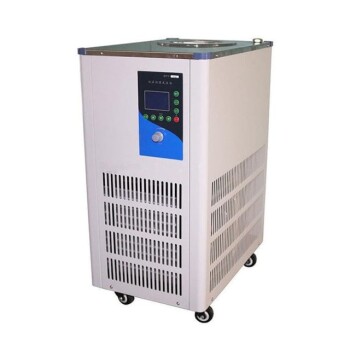
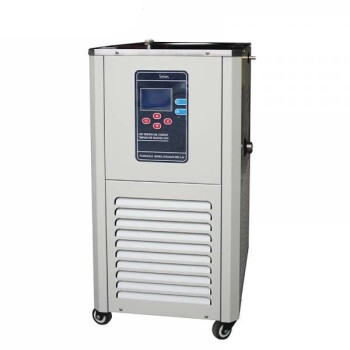
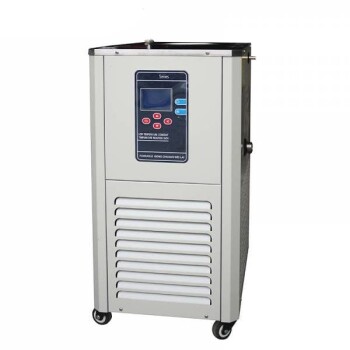
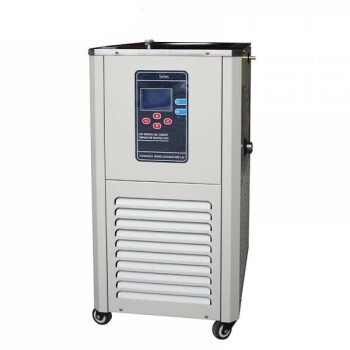
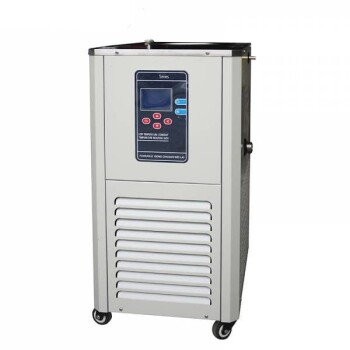
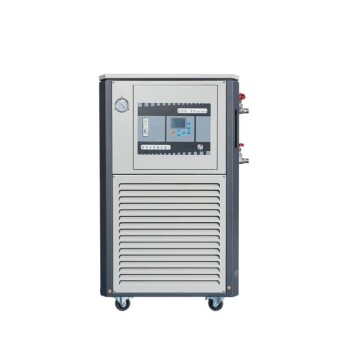
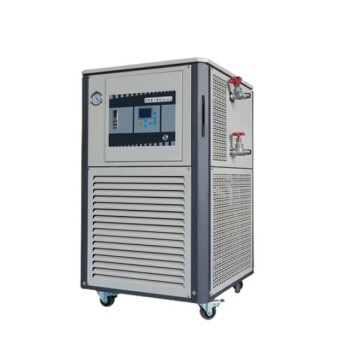
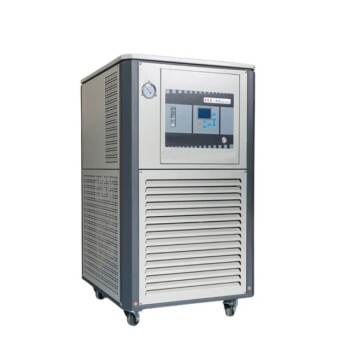
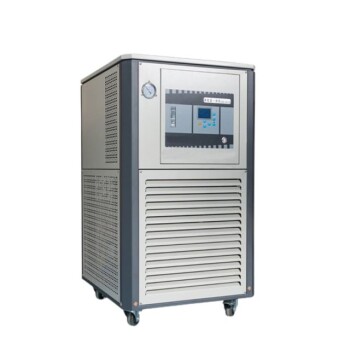
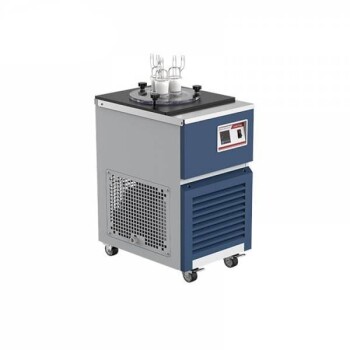
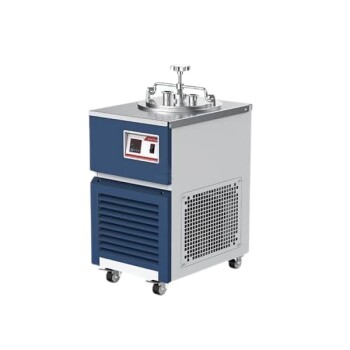
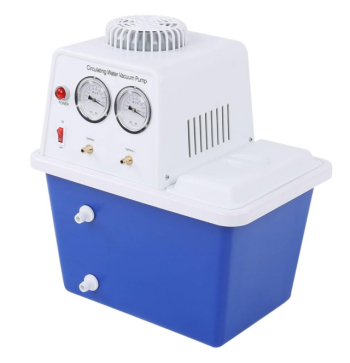
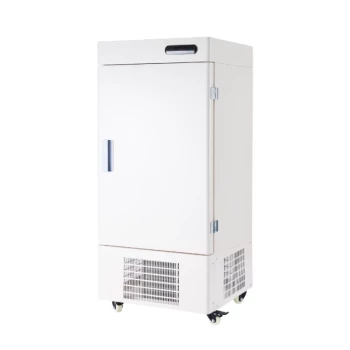
Precision thermal stabilization. A circulating cooling chiller maintains a constant, precise temperature environment during the testing of nanoporous carbon. Since gas adsorption is inherently exothermic, the chiller counteracts heat generation and external temperature fluctuations to ensure the process remains strictly isothermal. This stability is critical for obtaining accurate, scientifically comparable data on adsorption capacity and selectivity.
The circulating cooling chiller acts as a thermal anchor, neutralizing the exothermic heat produced during adsorption to maintain the strict isothermal conditions necessary for valid data analysis and material characterization.
The Role of Temperature in Gas Adsorption
Maintaining Isothermal Conditions
Gas adsorption is an exothermic process, meaning it releases heat as gas molecules adhere to the surface of the nanoporous carbon. If this heat is not managed, the local temperature of the sample increases, which shifts the adsorption equilibrium and reduces the amount of gas the material can hold. The chiller provides forced liquid circulation to remove this excess heat, ensuring the experiment stays at a fixed temperature point.
Eliminating Environmental Interference
Laboratory environments often experience temperature fluctuations due to HVAC cycling or other equipment. Because nanoporous materials are highly sensitive to thermal changes, even minor shifts can lead to inaccurate isotherm data. The chiller isolates the analysis system from these external variables, providing a stable "thermal bubble" for the duration of the test.
Ensuring Data Integrity and Comparability
Accuracy in Adsorption Capacity
The primary goal of testing nanoporous carbon is often to determine its CO2 capture capacity. Without a chiller, the measured capacity would be artificially low due to the heat-induced energy of the gas molecules. Precise temperature control ensures that the resulting data reflects the true physical properties of the carbon structure.
Validation of IAST Selectivity
Researchers use Ideal Adsorbed Solution Theory (IAST) to predict how a material will perform in complex gas mixtures. These calculations rely on pure-component isotherms measured at the exact same temperature. The chiller ensures that all data points are collected under identical thermal conditions, making selectivity calculations scientifically valid.
Understanding the Trade-offs and Limitations
Operational Maintenance Requirements
While chillers provide essential stability, they require regular maintenance to remain effective. Coolant levels must be monitored, and the system must be checked for biological growth or mineral buildup that can reduce heat transfer efficiency. Failure to maintain the chiller can lead to "thermal drift," where the temperature slowly rises over several hours of testing.
Mechanical Vibration and Noise
Recirculating chillers use pumps and compressors that generate mechanical vibrations. If the chiller is not properly isolated from the high-precision gas adsorption instrument, these vibrations can interfere with sensitive pressure transducers. It is vital to use flexible tubing and potentially place the chiller on a separate surface to prevent data "noise."
Optimizing Your Adsorption Testing Setup
How to Apply This to Your Project
To ensure the highest quality data when characterizing nanoporous carbon, consider the following recommendations based on your specific requirements:
- If your primary focus is high-precision research: Invest in a high-stability chiller with digital PID control to minimize thermal fluctuations to within ±0.1 K.
- If your primary focus is operational efficiency: Choose a closed-loop recirculating chiller over tap water to reduce water waste and prevent internal scaling within your analysis instrument.
- If your primary focus is long-term dynamic experiments: Ensure the chiller has an integrated alarm system for low flow or high temperature to protect your samples and equipment during unattended runs.
By effectively managing the heat of adsorption, a circulating cooling chiller transforms a variable-prone process into a reliable source of high-quality material data.
Summary Table:
| Key Function | Core Benefit | Impact on Results |
|---|---|---|
| Exothermic Neutralization | Counteracts heat released during gas adherence | Maintains true adsorption equilibrium |
| Environmental Isolation | Shields samples from lab temperature fluctuations | Eliminates thermal drift and data noise |
| Precision Regulation | Provides stable PID-controlled thermal environment | Validates IAST selectivity and capacity |
Optimize Your Research Precision with KINTEK
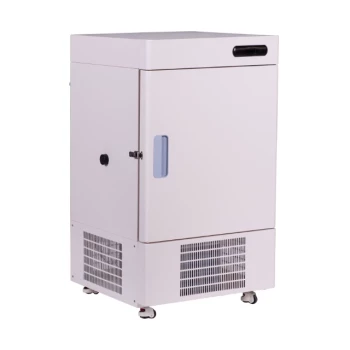
Achieving accurate gas adsorption isotherms requires uncompromising thermal stability. KINTEK specializes in providing high-performance laboratory equipment designed for the most demanding research environments. Whether you are characterizing nanoporous carbon or developing next-generation materials, our precision cooling solutions—including recirculating chillers, ULT freezers, and cold traps—ensure your experiments remain strictly isothermal.
Our extensive portfolio supports every stage of material science:
- Thermal Processing: High-temperature furnaces (Muffle, Vacuum, CVD, PECVD) and induction melting systems.
- Pressure & Reaction: High-temperature high-pressure reactors, autoclaves, and hydraulic pellet presses.
- Sample Prep: Crushing, milling, and sieving equipment.
- Specialized Tools: Electrolytic cells, battery research consumables, and high-purity ceramics.
Don't let thermal fluctuations compromise your data integrity. Contact KINTEK today to discover how our tailored equipment solutions can enhance your laboratory's efficiency and scientific accuracy.
References
- Dipendu Saha, Dean Bates. One-Step Synthesis of Sulfur-Doped Nanoporous Carbons from Lignin with Ultra-High Surface Area, Sulfur Content and CO2 Adsorption Capacity. DOI: 10.3390/ma16010455
This article is also based on technical information from Kintek Solution Knowledge Base .
Related Products
- 40L Chiller Water Bath Cooling Circulator Low Temperature Constant Temperature Reaction Bath
- 100L Chilling Circulator Cooling Water Circulator for Low Temperature Constant Temperature Reaction Bath Water Bath Cooling
- 80L Chilling Circulator Cooling Water Circulator for Water Bath Cooling and Low Temperature Constant Temperature Reaction Bath
- 20L Chiller Water Bath Cooling Circulator Low Temperature Constant Temperature Reaction Bath
- 50L Chiller Water Bath Cooling Circulator Low Temperature Constant Temperature Reaction Bath
People Also Ask
- Why is a circulating water chiller required for Prussian Blue nanoparticles? Ensure Stability & Batch Reproducibility
- What is the necessity of a circulating water bath in chlorate production? Optimize Yield & Purity with Precision
- For which types of substances are water baths and chillers considered ideal? Essential Care for Sensitive Samples
- What is the primary function of water baths and chillers? Mastering Precise Thermal Stability for Liquid Samples
- How does a constant temperature circulator support the leaching reaction of gold scrap? Optimize Gold Recovery Results