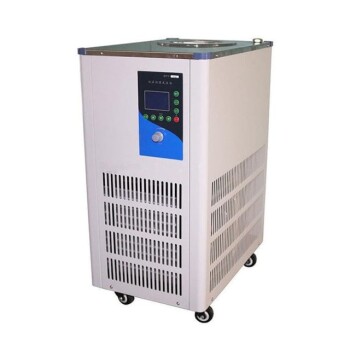
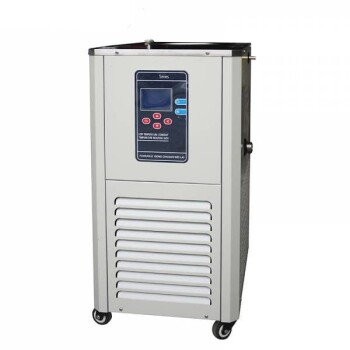
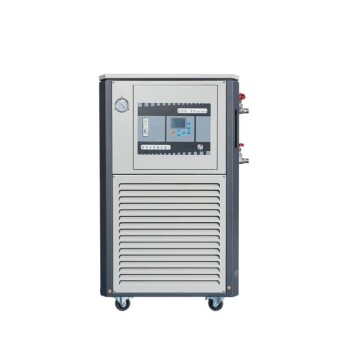
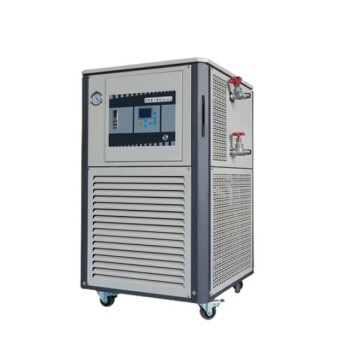
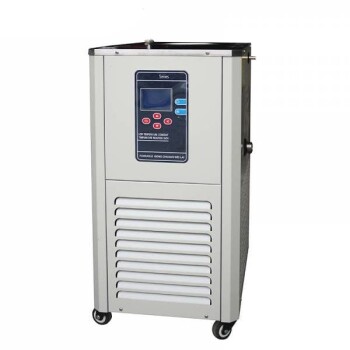
A constant temperature circulator acts as the primary control mechanism for the thermodynamic stability of the gold leaching process. By continuously regulating fluid through the reactor jacket, it ensures the liquid-solid reaction between gold scrap and hydrochloric acid remains within a precise, operator-defined temperature range.
Precision is the prerequisite for analysis. By eliminating thermal fluctuations, a constant temperature circulator transforms the leaching process from a chaotic reaction into a controlled environment, enabling the accurate calculation of activation energy and reaction kinetics.
The Role of Thermodynamic Control
Stabilizing the Reaction Environment
Gold leaching is a liquid-solid reaction highly sensitive to thermal changes. A constant temperature circulator isolates the process from ambient fluctuations by circulating thermal fluid around the reactor.
This creates a precise thermodynamic environment, ensuring that any observed changes in the leaching rate are due to chemical variables rather than temperature spikes or drops.
Regulating Leaching Rates
Leaching rates generally increase significantly with temperature. Without active regulation, the reaction speed could vary unpredictably.
The circulator automatically adjusts to maintain the system within a specific target range, such as 18°C to 30°C. This consistency allows researchers to observe the pure relationship between temperature and reaction speed.
Enabling Kinetic Analysis
Calculating Activation Energy
To understand the energy barriers of gold recovery, scientists must calculate the activation energy. This calculation is mathematically impossible if the temperature varies during the experiment.
By holding the temperature constant at different set points (e.g., running one test at 18°C and another at 30°C), the circulator provides the stable data points required for the Arrhenius equation.
Determining Reaction Mechanisms
Understanding the underlying mechanism of the reaction is critical for process optimization. You must determine if the process is controlled by chemical kinetics or by diffusion.
A constant temperature circulator ensures that the reaction remains in a steady state. This allows for the isolation of kinetic data, proving whether the reaction speed is limited by the chemical attack on the gold surface or the movement of ions through the solution.
Understanding the Trade-offs
Equipment Complexity vs. Data Value
Using a circulator adds mechanical complexity to the setup compared to a simple heated bath. It requires correct plumbing to the reactor jacket and maintenance of the thermal fluid.
However, this complexity is the "cost" of obtaining scientific validity. Simple heating methods often create hot spots or gradients that ruin the accuracy required for kinetic modeling.
Thermal Inertia
While a circulator is precise, it is not instant. There is always a brief period of thermal inertia where the fluid in the jacket must equilibrate with the reactor contents.
Operators must allow sufficient time for the system to stabilize at the target temperature (e.g., 25°C) before initiating the leaching reaction to ensure data integrity.
Making the Right Choice for Your Goal
To maximize the utility of a constant temperature circulator in gold leaching, align your settings with your specific analytical needs:
- If your primary focus is Kinetic Modeling: Ensure the temperature is held strictly constant to allow for the accurate calculation of activation energy.
- If your primary focus is Process Efficiency: Utilize the upper limits of the controlled range (e.g., 30°C) to maximize leaching rates while maintaining safety and control.
Control the temperature, and you control the reliability of your data.
Summary Table:
| Feature | Impact on Gold Leaching Reaction |
|---|---|
| Thermodynamic Stability | Eliminates thermal fluctuations for a controlled reaction environment. |
| Leaching Rate Regulation | Maintains target temperatures (e.g., 18-30°C) to prevent unpredictable speeds. |
| Activation Energy Data | Provides stable data points necessary for the Arrhenius equation. |
| Mechanism Isolation | Distinguishes between chemical kinetic control and diffusion control. |
| Jacketed Circulation | Prevents hot spots and thermal gradients common in simple heating baths. |
Elevate Your Material Recovery with KINTEK Precision
At KINTEK, we understand that in gold recovery and precious metal analysis, precision is everything. Our advanced cooling solutions, including high-performance constant temperature circulators and ULT freezers, are engineered to provide the rigorous thermodynamic control required for accurate kinetic modeling and efficient leaching processes.
Beyond temperature control, KINTEK specializes in a comprehensive range of laboratory equipment including high-temperature furnaces, crushing and milling systems, and high-pressure reactors tailored for the most demanding research environments. Whether you are refining scrap or conducting foundational battery research, our premium consumables and equipment ensure your data is as reliable as your process is efficient.
Ready to optimize your lab’s thermal stability? Contact our technical experts today to find the perfect solution for your specific application.
References
- Dilara Tokkan, Osman Nuri Ata. The leaching kinetics of gold from gold scraps in CI2-saturated HCl solutions. DOI: 10.5505/pajes.2018.39259
This article is also based on technical information from Kintek Solution Knowledge Base .
Related Products
- High Temperature Constant Temperature Heating Circulator Water Bath Chiller Circulator for Reaction Bath
- 100L Chilling Circulator Cooling Water Circulator for Low Temperature Constant Temperature Reaction Bath Water Bath Cooling
- 50L Chiller Water Bath Cooling Circulator Low Temperature Constant Temperature Reaction Bath
- 40L Chiller Water Bath Cooling Circulator Low Temperature Constant Temperature Reaction Bath
- 5L Chilling Circulator Cooling Water Bath Circulator for Low Temperature Constant Temperature Reaction Bath
People Also Ask
- What is the necessity of a circulating water bath in chlorate production? Optimize Yield & Purity with Precision
- How do constant temperature circulators impact weight-loss immersion tests? Ensure Precision in Corrosion Analysis
- Why is a constant temperature water bath used for precursor storage in CVD? Achieve Stable Nanocrystalline SiC Deposition
- Why is a high-precision constant temperature water bath necessary for anaerobic digestion? Ensure Success at 37±0.02°C
- Why are constant temperature water baths critical in thiourea leaching? Master Gold Recovery with Precision Heat