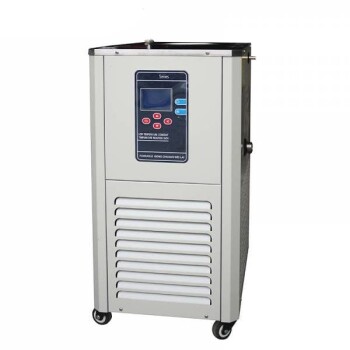
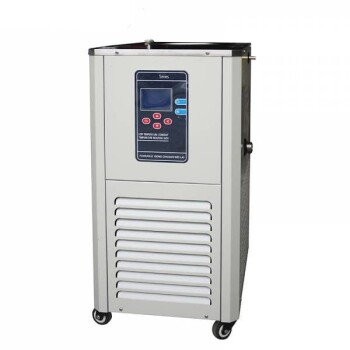
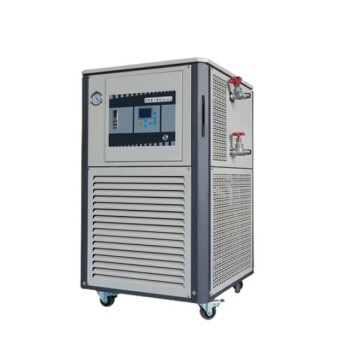
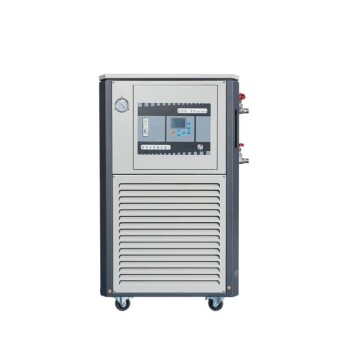
Precise temperature control is the deciding factor in the structural integrity of copper nanostructures. A recirculating cooling system or thermostatic water bath functions as a stabilizer, actively removing the heat generated during the exothermic oxidation process to maintain the electrolyte between 5 and 25 degrees Celsius. This cooling effect is essential to prevent the chemical dissolution of the oxide layer, ensuring that delicate nanoneedles or honeycomb patterns do not collapse during formation.
Core Takeaway The anodic oxidation of copper is an exothermic reaction that naturally heats the surrounding electrolyte. Without active cooling to counteract this heat, the rate of chemical corrosion will outpace the rate of oxide growth, resulting in dissolved or collapsed nanostructures rather than well-ordered arrays.
The Mechanics of Reaction Control
Counteracting Exothermic Heat
The oxidation of copper is an exothermic reaction, meaning it releases significant energy in the form of heat.
Without intervention, this heat accumulates in the electrolyte, raising the temperature of the reaction environment. A recirculating cooling system continuously draws heat away to maintain a stable baseline.
The Critical Temperature Range
To achieve optimal results, the electrolyte temperature is typically held constant between 5 and 25 degrees Celsius.
Maintaining this specific range is not merely about safety; it is a parameter that dictates the physical properties of the final material.
Impact on Nanostructure Morphology
Inhibiting Chemical Corrosion
The electrolyte used in anodic oxidation is chemically active and acts to dissolve (etch) the oxide layer as it forms.
Higher temperatures accelerate this chemical corrosion. By keeping the bath cool, you inhibit excessive etching, allowing the oxide layer to build up rather than dissolving immediately.
Preventing Structural Collapse
One of the most common failure modes in copper oxidation is the collapse of nanoneedles.
If the temperature rises unchecked, the structural walls of the nanomorphologies become too weak to support themselves. Cooling ensures the mechanical stability required for these delicate features to stand upright.
Ensuring Uniformity
Temperature fluctuations lead to inconsistent reaction rates across the copper surface.
A thermostatic water bath ensures the environment is uniform, leading to well-ordered, uniformly sized honeycomb or filamentous nanomorphologies.
Understanding the Trade-offs
The Balance of Growth vs. Etching
Anodic oxidation relies on a delicate competition between two forces: the electrochemical growth of the oxide and the chemical etching by the electrolyte.
While high temperatures favor rapid etching (destruction), ultra-low temperatures might slow the reaction kinetics too much. The goal is a "stable physical and chemical environment" where these rates are perfectly balanced to sculpt the desired features.
Stability as a Prerequisite
Just as with other valve metals like titanium, a stable environment is a prerequisite for highly oriented arrays.
Lacking a cooling system introduces a variable (heat) that increases over time, making the process unrepeatable and the results unpredictable.
Making the Right Choice for Your Goal
To ensure the success of your copper anodic oxidation process, align your temperature control strategy with your specific morphological targets:
- If your primary focus is Structural Integrity: Maintain the bath at the lower end of the range (closer to 5°C) to maximize the inhibition of chemical corrosion and prevent nanoneedle collapse.
- If your primary focus is Uniformity: Ensure your cooling system has a high recirculation rate to eliminate "hot spots" near the anode, guaranteeing consistent honeycomb or filamentous pore sizing across the entire sample.
Ultimately, active cooling transforms the oxidation process from a chaotic chemical reaction into a precise, tunable manufacturing method.
Summary Table:
| Feature | Without Active Cooling (High Temp) | With Recirculating Cooling (5-25°C) |
|---|---|---|
| Exothermic Heat | Accumulates, raising electrolyte temp | Continuously removed/stabilized |
| Chemical Etching | Accelerated; dissolves oxide layer | Inhibited; allows for layer buildup |
| Morphology | Collapsed nanoneedles/disordered | Stable nanomorphologies (honeycomb) |
| Repeatability | Low; reaction rates fluctuate | High; controlled and predictable |
| Structural Integrity | Weakened walls; structural failure | Mechanical stability maintained |
Optimize Your Nanostructure Precision with KINTEK
Don't let exothermic heat compromise your research outcomes. KINTEK specializes in advanced laboratory equipment designed for precision, including high-performance cooling solutions (ULT freezers, cold traps, and recirculating chillers) that ensure the structural integrity of your copper nanostructures.
Beyond temperature control, our comprehensive portfolio features electrolytic cells and electrodes, high-temperature furnaces, and battery research tools tailored for demanding laboratory environments. Whether you are performing anodic oxidation or high-pressure synthesis, KINTEK provides the reliable consumables and systems you need to achieve repeatable, high-quality results.
Ready to enhance your lab's efficiency? Contact KINTEK today to find the perfect equipment solution for your specific application.
References
- Damian Giziński, Tomasz Czujko. Nanostructured Anodic Copper Oxides as Catalysts in Electrochemical and Photoelectrochemical Reactions. DOI: 10.3390/catal10111338
This article is also based on technical information from Kintek Solution Knowledge Base .
Related Products
- High Temperature Constant Temperature Heating Circulator Water Bath Chiller Circulator for Reaction Bath
- Double-Layer Water Bath Electrolytic Electrochemical Cell
- 20L Heating Chilling Circulator Cooling Water Bath Circulator for High and Low Temperature Constant Temperature Reaction
- Double Layer Five-Port Water Bath Electrolytic Electrochemical Cell
- 5L Heating Chilling Circulator Cooling Water Bath Circulator for High and Low Temperature Constant Temperature Reaction
People Also Ask
- What is the necessity of a circulating water bath in chlorate production? Optimize Yield & Purity with Precision
- How do constant temperature circulators impact weight-loss immersion tests? Ensure Precision in Corrosion Analysis
- How does a constant temperature circulator support the leaching reaction of gold scrap? Optimize Gold Recovery Results
- Why is a constant temperature water bath used for precursor storage in CVD? Achieve Stable Nanocrystalline SiC Deposition
- Why is a high-precision constant temperature water bath necessary for anaerobic digestion? Ensure Success at 37±0.02°C