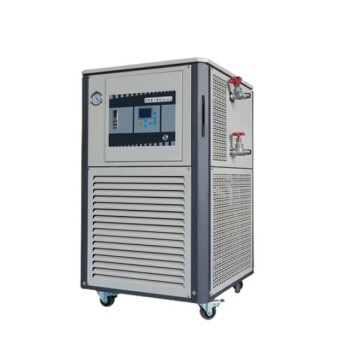
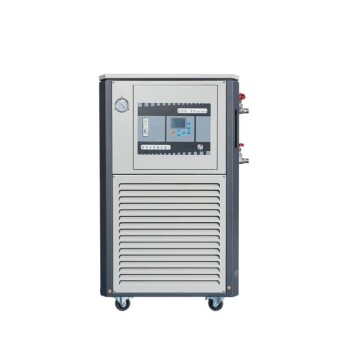
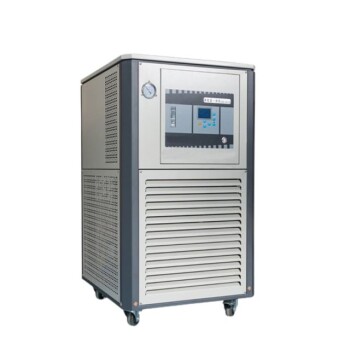
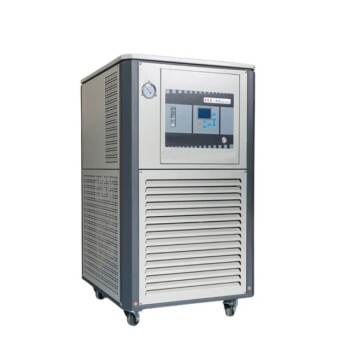
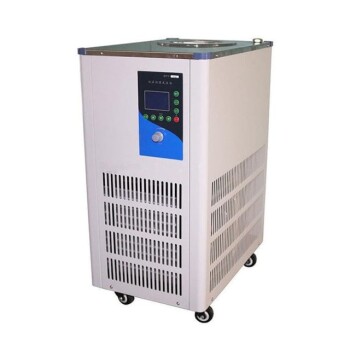
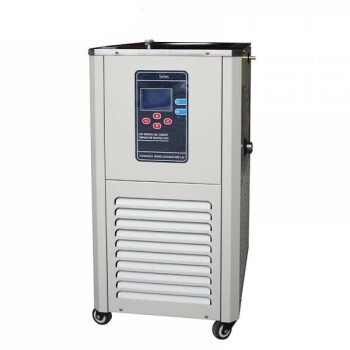
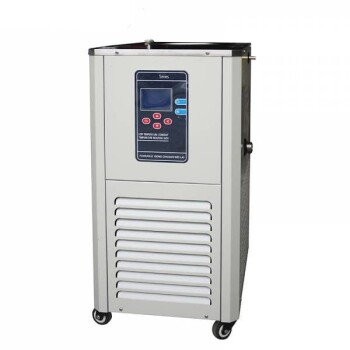
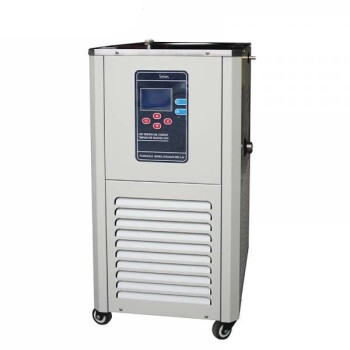
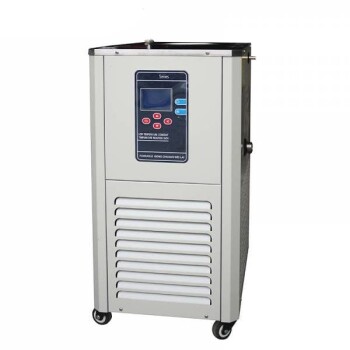
A high-precision constant temperature circulator serves as the thermal anchor for accurate kinetic experiments. It functions by actively pumping a fluid—maintained at a strictly controlled temperature—through the jacket of a chemical reactor. This continuous circulation minimizes temperature fluctuations within the leaching process, ensuring the internal reaction environment remains stable regardless of external conditions or heat generated by the reaction itself.
By eliminating thermal variance, this equipment transforms temperature from an unpredictable variable into a fixed constant. This stability is a mathematical prerequisite for validating kinetic models and is the only way to derive reliable activation energy data.
The Role of Thermal Stability in Kinetic Modeling
Enabling the Shrinking Core Model (SCM)
The Shrinking Core Model is a standard framework used to describe how solid particles (like minerals) dissolve in fluid.
To determine which step controls the reaction rate—such as diffusion through a fluid film or the chemical reaction at the surface—the model assumes steady-state conditions.
A circulator ensures these boundary conditions are met. Without a constant temperature, the data will not fit the model linearities, rendering the analysis of minerals like chalcopyrite impossible.
Overcoming Kinetic Barriers
Mineral dissolution often faces significant kinetic barriers that prevent the reaction from starting or proceeding efficiently.
Consistent thermal energy provides the "push" needed to surmount these barriers.
By maintaining the system at a precise set point, researchers ensure that the energy supplied is sufficient to sustain the transformation without overheating the sample.
Deriving Accurate Physicochemical Parameters
Calculating Activation Energy
Activation energy cannot be measured directly; it is calculated by comparing reaction rates at different, specific temperatures.
This calculation relies on the Arrhenius equation, which is exponentially sensitive to temperature changes.
If the circulator fails to hold the temperature constant, the resulting activation energy values will be statistically invalid.
Isolating Reaction Rate Constants
The rate at which minerals transform is highly sensitive to thermal input.
For example, the transformation of wollastonite to calcium carbonate accelerates significantly with heat.
A high-precision circulator ensures that the rate constants derived from the experiment reflect the true chemical kinetics, rather than artifacts of equipment instability.
Understanding the Trade-offs
Circulators vs. Laboratory Ovens
While circulators are ideal for jacketed reactors, they are not the only solution for thermal control.
For high-pressure hydrothermal reactors that lack an external jacket, a high-performance laboratory oven is often required to create a stable thermal field.
Researchers must choose the equipment that matches their vessel geometry: circulators for conductive heat transfer through a jacket, and ovens for convective heat transfer in sealed systems.
Thermal Lag Considerations
A circulator controls the temperature of the fluid in the jacket, not the reactor interior directly.
There is always a brief delay for heat to transfer through the reactor wall to the solution.
Precise studies must account for this lag time to ensure the internal solution has actually reached the target temperature before data collection begins.
Making the Right Choice for Your Goal
- If your primary focus is modeling leaching kinetics (e.g., SCM): Use a circulator with a jacketed reactor to satisfy the strict stability requirements needed to distinguish between diffusion and chemical reaction control.
- If your primary focus is high-pressure hydrothermal synthesis: Evaluate whether your vessel allows for jacketed circulation; if not, utilize a high-performance oven to maintain a continuous thermal field.
Ultimate precision in mineralogy is not about generating heat, but about controlling it to reveal the true nature of the reaction.
Summary Table:
| Feature | Impact on Kinetic Studies | Benefit to Researcher |
|---|---|---|
| Active Fluid Circulation | Eliminates thermal variance in jacketed reactors | Ensures reaction environment stability |
| Precise Temperature Control | Satisfies SCM boundary conditions | Accurate identification of rate-limiting steps |
| Arrhenius Consistency | Provides stable T values for rate constants | Reliable calculation of activation energy |
| External Jacket Integration | Direct conductive heat transfer | Uniform heating for complex leaching processes |
Elevate Your Geochemical Precision with KINTEK
Precise kinetic modeling requires more than just heat; it requires absolute thermal stability. KINTEK provides the high-performance laboratory solutions needed to transform unpredictable variables into reliable data. Whether you are modeling mineral leaching with our high-precision constant temperature circulators and jacketed reactors, or conducting high-pressure hydrothermal synthesis using our advanced high-temperature high-pressure reactors and autoclaves, we have the tools to ensure your research integrity.
From crushing and milling systems for sample preparation to specialized cooling solutions and vacuum systems, KINTEK specializes in the equipment that powers modern laboratories. Don't let equipment instability compromise your activation energy data.
Ready to optimize your dissolution studies? Contact KINTEK today to find the perfect thermal control solution for your laboratory.
References
- Yuri V. Shklyaev, Д. А. Рогожников. Kinetics of nitric acid leaching of bornite and chalcopyrite. DOI: 10.15826/chimtech.2023.10.4.10
This article is also based on technical information from Kintek Solution Knowledge Base .
Related Products
- High Temperature Constant Temperature Heating Circulator Water Bath Chiller Circulator for Reaction Bath
- 5L Heating Chilling Circulator Cooling Water Bath Circulator for High and Low Temperature Constant Temperature Reaction
- 100L Heating Chilling Circulator Cooling Water Bath Circulator for High and Low Temperature Constant Temperature Reaction
- 10L Heating Chilling Circulator Cooling Water Bath Circulator for High and Low Temperature Constant Temperature Reaction
- 30L Heating Chilling Circulator Cooling Water Bath Circulator for High and Low Temperature Constant Temperature Reaction
People Also Ask
- What is the necessity of a circulating water bath in chlorate production? Optimize Yield & Purity with Precision
- How do constant temperature circulators impact weight-loss immersion tests? Ensure Precision in Corrosion Analysis
- How does a constant temperature circulator support the leaching reaction of gold scrap? Optimize Gold Recovery Results
- Why is a constant temperature water bath used for precursor storage in CVD? Achieve Stable Nanocrystalline SiC Deposition
- Why is a high-precision constant temperature water bath necessary for anaerobic digestion? Ensure Success at 37±0.02°C