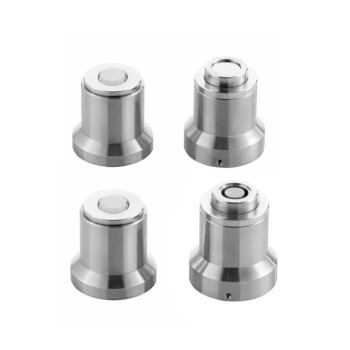
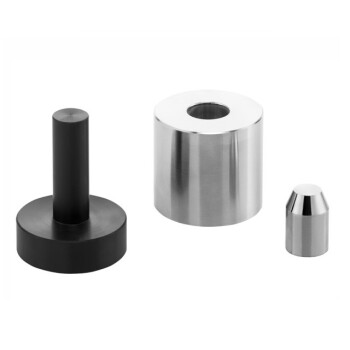
Titanium plungers serve a dual-purpose function within solid-state battery molds, acting simultaneously as high-strength mechanical pistons and electrical current collectors. They are responsible for transmitting hydraulic pressure to densify powder materials while providing a chemically stable, conductive pathway for electrochemical testing.
Core Takeaway Titanium plungers bridge the gap between mechanical integrity and electrochemical fidelity. By delivering necessary stack pressure while resisting corrosion from reactive sulfide electrolytes, they ensure the valid characterization of solid-state cells without introducing parasitic side reactions.
The Mechanical Role: Pressure Transmission
Densification of Materials
The primary mechanical function of the titanium plunger is to act as a force transmitter. It transfers force from a hydraulic press directly to the battery powder materials inside the mold.
This pressure is critical for densification, ensuring the loose powder is compacted into a solid, cohesive pellet.
Maintaining Interface Contact
Beyond initial compaction, the plunger maintains a constant external stack pressure, typically ranging from 1.5 MPa to over 10 MPa.
This continuous pressure is vital for solid-state batteries. It forces the electrode particles and electrolyte to remain in tight physical contact, thereby reducing interfacial resistance that would otherwise degrade performance.
Compensating for Volume Changes
During charge and discharge cycles, materials like lithium metal and high-nickel cathodes undergo significant expansion and contraction.
The plunger, often part of a specialized pressure-retaining system, compensates for these anisotropic volume changes. By preventing interface separation and crack propagation, the plunger helps preserve the structural integrity of the cell over long-term cycling.
The Electrochemical Role: Current Collection
Current Extraction
While serving as a mechanical piston, the titanium plunger also functions as a current collector.
Its high electrical conductivity allows it to efficiently extract current from the cell during operation. This eliminates the need for inserting separate, potentially fragile current collector foils that might disrupt the mechanical stack.
Enabling Advanced Testing
Because the plunger serves as the direct electrical link to the battery materials, it facilitates complex testing protocols.
It provides the stable connection required for Electrochemical Impedance Spectroscopy (EIS) and standard charge-discharge cycling, allowing researchers to measure the cell's internal properties accurately.
Chemical Stability Considerations
Resistance to Sulfide Electrolytes
A critical reason for selecting titanium over other conductive metals (like copper or aluminum) is its chemical stability.
The primary reference highlights that titanium is particularly stable in contact with sulfide electrolytes. These electrolytes are highly reactive and can corrode standard current collectors, which would contaminate the cell and skew test results.
Understanding the Trade-offs
Conductivity vs. Stability
While titanium is conductive, it is generally less conductive than copper or silver. However, this is a calculated trade-off.
In solid-state testing, chemical inertness is often prioritized over maximum conductivity. Using a more conductive metal that reacts with the electrolyte would introduce "noise" or false data into EIS readings, rendering the test useless.
Mechanical Rigidity Limits
The plunger is rigid, but the battery stack breathes (expands/contracts).
If the mold design does not include a spring or hydraulic compensation mechanism behind the plunger, the rigid plunger alone cannot maintain constant pressure; it would essentially act as a fixed wall. Therefore, the plunger relies on the surrounding mold infrastructure to actively manage pressure fluctuations.
Making the Right Choice for Your Goal
- If your primary focus is accurate EIS data: Rely on titanium plungers specifically for their chemical stability with sulfide electrolytes to prevent side reactions from altering your impedance spectra.
- If your primary focus is cycle life longevity: Ensure your plunger assembly applies continuous pressure (ideally around 8 MPa) to mechanically suppress particle separation caused by volume expansion.
Titanium plungers are not merely passive mold components; they are active electrochemical interfaces that define the quality and reliability of your solid-state battery data.
Summary Table:
| Function Category | Primary Role | Benefit to Battery Testing |
|---|---|---|
| Mechanical | Force Transmission | Compacts powder into dense pellets and reduces interfacial resistance. |
| Electrochemical | Current Collection | Extracts current directly, enabling accurate EIS and cycle testing. |
| Chemical | Corrosion Resistance | Specifically stable with reactive sulfide electrolytes to prevent data noise. |
| Structural | Volume Compensation | Manages expansion/contraction to prevent crack propagation during cycling. |
Elevate Your Battery Research with Precision Engineering
Unlock the full potential of your solid-state battery development with high-performance laboratory solutions from KINTEK. Whether you need specialized titanium plungers, high-pressure hydraulic presses, or precision-engineered battery research tools, our equipment ensures the mechanical integrity and electrochemical fidelity your data demands.
From isostatic presses for superior densification to advanced high-temperature furnaces and electrolytic cells, KINTEK provides the comprehensive tools required to overcome interfacial resistance and material expansion challenges.
Ready to optimize your lab's performance? Contact our experts today to discover how our tailored solutions can support your next breakthrough.
Related Products
- Button Battery Disassembly and Sealing Mold for Lab Use
- Button Battery Tablet Press Sealing Mold for Lab Use
People Also Ask
- What role do battery test molds or coin cell cases play? Optimize Your All-Solid-State Battery Assembly Today
- What are the parts of a mold assembly? A Guide to Injection Mold Components
- What is a molding tool used for? A Guide to Mass Production Efficiency
- What is a mold assembly? The Critical Final Step to a Functional Injection Mold
- What advantages do standardized laboratory compression-cell molds provide for c-LLZO? Optimize Battery Data Accuracy