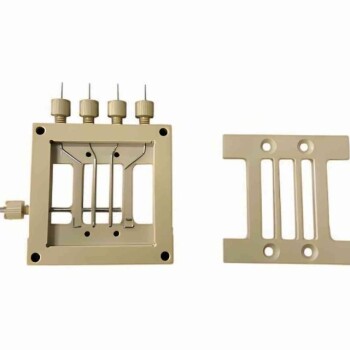
The primary function of a battery test fixture in all-solid-state battery cycling is to apply a consistent mechanical stack pressure to the cell. Specifically, this hardware is designed to maintain a constant pressure—typically around 5 MPa—throughout the electrochemical testing process to counteract internal physical changes.
In the context of all-solid-state batteries, the test fixture is not just a holder; it is an active mechanical stabilizer. By offsetting volume expansion, it preserves the critical contact between the electrode and electrolyte, which is the prerequisite for achieving a long cycle life.
The Mechanics of Solid-State Cycling
Addressing Lithium Volume Changes
During the cycling of an all-solid-state battery, lithium metal is deposited and stripped away.
This electrochemical process creates significant volume fluctuations within the cell. The test fixture is engineered to mechanically offset these changes as they happen.
Preventing Physical Separation
In a solid-state system, the interface between components is rigid. Unlike liquid electrolytes, solid materials cannot flow to fill gaps created by expansion or contraction.
Without the fixture, the volume changes caused by lithium movement would lead to physical separation at the electrode-electrolyte interface.
Ensuring Consistent Contact
The fixture applies a constant stack pressure, noted in your reference as approximately 5 MPa.
This continuous pressure forces the layers of the battery to remain in tight contact. This prevents poor connectivity at the interface, ensuring that ions can move efficiently between the anode and cathode.
The Consequence of Pressure Failure
Impact on Cycle Life
The most critical trade-off in testing these batteries is the dependency on mechanical pressure for longevity.
If the test fixture fails to maintain the target pressure (e.g., 5 MPa), the interface degrades. The reference highlights that maintaining this pressure is essential for helping the battery maintain a long cycle life.
The Risk of Poor Contact
If the fixture allows pressure to drop, the "poor contact" mentioned in the reference becomes inevitable.
This results in a disconnect between the active materials and the electrolyte, effectively rendering the battery unable to cycle correctly regardless of the chemical quality of the materials.
Optimizing Your Test Setup
To ensure accurate data and prolonged battery performance, you must prioritize the mechanical stability of your testing rig.
- If your primary focus is Cycle Life: Ensure your fixture is calibrated to maintain a constant 5 MPa pressure to prevent physical separation of layers over time.
- If your primary focus is Interface Analysis: Verify that the fixture effectively offsets volume changes during lithium deposition to rule out mechanical failure as a cause of poor performance.
The success of an all-solid-state battery test relies as much on the mechanical fidelity of the fixture as it does on the electrochemistry of the cell.
Summary Table:
| Feature | Function in Solid-State Testing | Impact on Battery Performance |
|---|---|---|
| Pressure Application | Maintains constant 5 MPa stack pressure | Ensures consistent ion transport and connectivity |
| Mechanical Offset | Counteracts lithium volume expansion/contraction | Prevents physical separation at the interface |
| Interface Stability | Active mechanical stabilization of rigid layers | Extends cycle life by avoiding contact failure |
| Calibration | Precise pressure monitoring during cycling | Eliminates mechanical variables from electrochemical data |
Elevate Your Battery Research with KINTEK Precision
Maximize the cycle life and data accuracy of your all-solid-state batteries with KINTEK’s advanced battery research tools and consumables. From precision-engineered test fixtures and electrolytic cells to specialized hydraulic presses (isostatic and pellet) and high-temperature furnaces, we provide the mechanical fidelity your electrochemical testing demands.
Don't let interface degradation compromise your results. Partner with KINTEK to access industry-leading cooling solutions, homogenizers, and high-pressure reactors tailored for the next generation of energy storage.
Contact our technical experts today to find the perfect fixture for your 5 MPa testing requirements!
Related Products
- Custom Ion Conductivity Test Fixtures for Fuel Cell Research
- Battery Lab Equipment 304 Stainless Steel Strip Foil 20um Thick for Battery Test
- Cylindrical Battery Steel Case for Battery Lab
- Customizable Swagelok Type Test Cells for Advanced Battery Research Electrochemical Analysis
- Button Battery Case for Battery Lab Applications
People Also Ask
- What is the purpose of using a high-precision capacitance manometer to monitor pressure during cathodic cage nitriding?
- Why is a capacitance manometer preferred for RF plasma systems? Ensure Precise Gas-Independent Pressure Monitoring
- Which thing is determined in ash content? Measure Inorganic Material for Quality Control
- Does strain hardening affect conductivity? Understanding the Strength vs. Conductivity Trade-Off
- What are acceptable methods of leak detection? Ensure Your System's Integrity with the Right Method