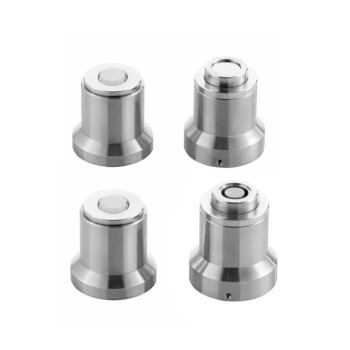
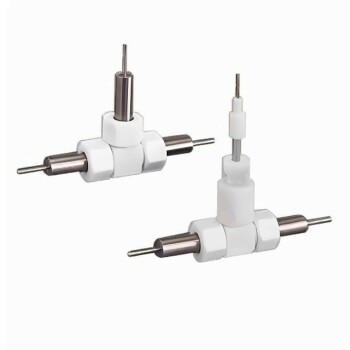
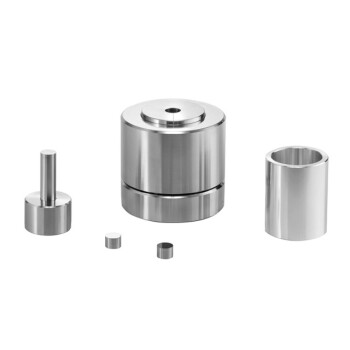
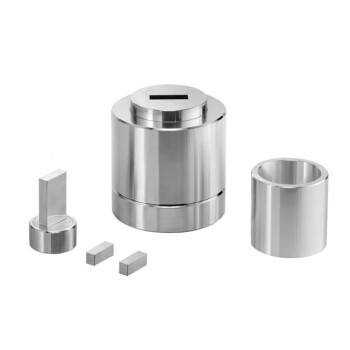
A stainless steel battery cell mold functions as a precision housing unit designed to apply constant mechanical pressure and provide a hermetically sealed environment for battery components. Specifically, it compresses the active "sandwich" structure—comprising the Lithium Iron Phosphate (LiFePO4) cathode, polymer electrolyte membrane, and lithium anode—to ensure optimal electrochemical performance during testing.
The mold’s primary utility lies in its threaded pressure structure, which minimizes interfacial impedance by forcing battery layers into tight contact while simultaneously shielding the reactive lithium anode from atmospheric degradation.
The Mechanics of the Assembly
Encapsulating the "Sandwich" Structure
The core role of the mold is to house the three critical layers of the battery.
It secures the LiFePO4 cathode, the polymer electrolyte membrane, and the lithium metal anode in a fixed vertical stack.
Applying Constant Pressure
A threaded pressure structure is integral to the mold's design.
By tightening this threaded mechanism, you apply a uniform, constant force across the entire surface area of the battery stack.
This mechanical stability prevents the layers from delaminating or shifting during the charge and discharge cycles.
Optimizing Electrochemical Performance
Reducing Interfacial Impedance
For a battery to function efficiently, electrons and ions must move freely between layers.
The mechanical pressure exerted by the mold ensures tight physical contact between the solid materials.
This significantly reduces interfacial impedance (resistance), which is often the bottleneck in solid-state or polymer electrolyte systems.
Ensuring Stable Ion Transport
Gaps or air pockets between the electrolyte and the electrodes disrupt the flow of ions.
The mold’s constant compression eliminates these voids, facilitating smooth and continuous ion transport between the anode and cathode.
Environmental Isolation
Creating a Hermetic Seal
Lithium metal anodes are highly reactive to moisture and oxygen found in ambient air.
The stainless steel mold provides a sealed environment that completely isolates the internal components from the atmosphere.
Preventing Chemical Degradation
Without this seal, ambient air would react with the lithium anode.
This reaction would degrade the material, compromising the cell's integrity and rendering test data useless.
Understanding the Trade-offs
Laboratory vs. Commercial Application
It is critical to understand that these molds (often referred to as Swagelok-type cells) are primarily designed for laboratory-scale testing and research.
They provide excellent data reliability but are too heavy and bulky for commercial applications like electric vehicles or consumer electronics.
Sensitivity to Torque
While pressure is vital, the manual nature of the threaded structure introduces a variable: torque.
Over-tightening can potentially crush delicate separator membranes, leading to short circuits. Conversely, under-tightening results in high resistance and poor performance.
Making the Right Choice for Your Goal
When utilizing stainless steel cell molds for LiFePO4 and polymer battery research, your assembly technique determines the quality of your data.
- If your primary focus is reducing internal resistance: Prioritize the consistency of the torque applied to the threaded structure to ensure maximum contact without damaging the polymer membrane.
- If your primary focus is anode longevity: rigorous verification of the mold's seal is required to ensure zero exposure of the lithium metal to the external environment.
Success in solid-state battery testing relies not just on the chemistry, but on the mechanical precision of the enclosure.
Summary Table:
| Feature | Function in LiFePO4 & Polymer Assembly |
|---|---|
| Threaded Structure | Applies constant mechanical pressure to minimize interfacial impedance. |
| Housing Unit | Secures the cathode, polymer electrolyte, and anode in a stable 'sandwich' stack. |
| Hermetic Seal | Protects reactive lithium anodes from moisture and atmospheric degradation. |
| Mechanical Stability | Prevents delamination of layers during charge/discharge cycles. |
| Laboratory Focus | Designed for high-reliability R&D and solid-state battery performance testing. |
Elevate Your Battery Research with KINTEK Precision
Unlock more accurate data and superior electrochemical performance in your LiFePO4 and polymer electrolyte studies. KINTEK specializes in high-performance laboratory equipment, providing the mechanical precision necessary for advanced battery assembly.
Beyond our specialized battery research tools and consumables, we offer a comprehensive suite of lab solutions, including:
- High-temperature furnaces (Muffle, Vacuum, CVD, and more)
- Hydraulic presses (Pellet, Hot, Isostatic) for electrode preparation
- High-pressure reactors and autoclaves
- Crushing, milling, and sieving systems
Ensure your research reflects the true potential of your materials. Contact KINTEK today to discuss your laboratory requirements and find the perfect tools for your next breakthrough.
Related Products
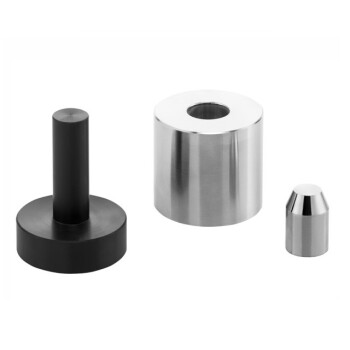
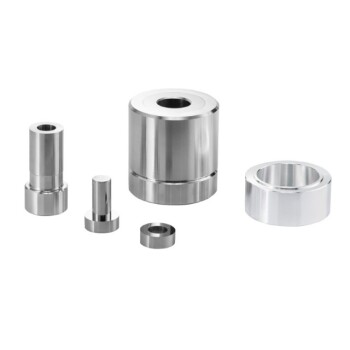
- Button Battery Disassembly and Sealing Mold for Lab Use
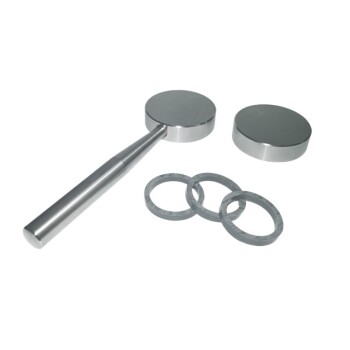
- Button Battery Tablet Press Sealing Mold for Lab Use
- Cylindrical Battery Steel Case for Battery Lab
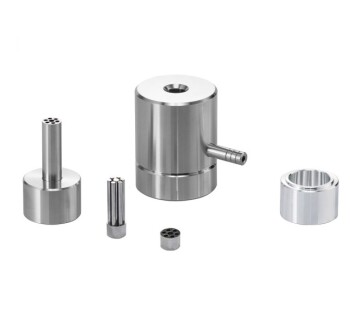
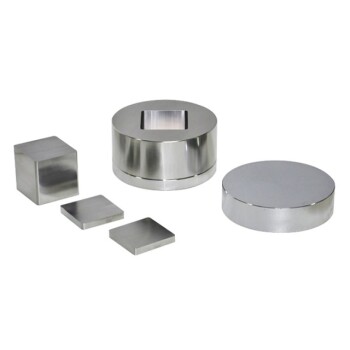
- Special Shape Press Mold for Lab
- Customizable Swagelok Type Test Cells for Advanced Battery Research Electrochemical Analysis
People Also Ask
- What role do battery test molds or coin cell cases play? Optimize Your All-Solid-State Battery Assembly Today
- What are the parts of a mold assembly? A Guide to Injection Mold Components
- What is a molding tool used for? A Guide to Mass Production Efficiency
- What is a mold assembly? The Critical Final Step to a Functional Injection Mold
- What advantages do standardized laboratory compression-cell molds provide for c-LLZO? Optimize Battery Data Accuracy