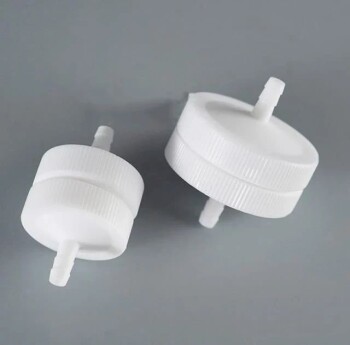
The primary purpose of using a 0.45μm microporous filter membrane is to physically separate suspended solids, microbial particles, and chemical precipitates from the water sample prior to chemical analysis. This step defines the sample's composition by isolating the soluble phase from the particulate phase.
Without this filtration, solid particles remaining in the sample would interfere with the measurement, leading to inaccurate data regarding the water's true chemical state.
Filtration is the critical control point that distinguishes "total" metals from "dissolved" metals. By removing precipitates like metal sulfides, this step ensures that your data reflects the actual efficiency of the wastewater treatment process.
The Mechanics of Separation
Removing Suspended Solids
Treated mine wastewater often contains high levels of turbidity and particulate matter. The 0.45μm membrane acts as a physical barrier, trapping these suspended solids while allowing the liquid filtrate to pass through.
Isolating Metal Sulfide Precipitates
A key objective in treating mine wastewater is often to precipitate heavy metals out of the solution. The filter captures these generated metal sulfide precipitates, preventing them from entering the filtrate.
Eliminating Biological Interference
Mine water can be biologically active. The microporous membrane effectively filters out microbial particles, which stabilizes the sample and prevents biological matter from interfering with sensitive analytical instruments.
Why Accuracy Depends on Filtration
Determining Soluble Heavy Metals
To assess how well a treatment process works, you must measure what remains dissolved in the water. Filtration ensures that the measurement of heavy metals, specifically Cu(II) (Copper) and Zn(II) (Zinc), represents only the soluble concentration, not the metals already trapped in solids.
Assessing Residual Sulfates
Accurate filtration is also required to determine residual sulfate levels. If solid sulfur compounds remain in the sample during analysis, they can cause false high readings for dissolved sulfate.
Validating Treatment Efficiency
The ultimate goal of analysis is to verify if the water is safe or meets discharge standards. By ensuring the filtrate is free of solids, the resulting data provides a direct and accurate assessment of the treatment efficiency.
Understanding the Limitations
The "Dissolved" Definition
It is important to recognize that 0.45μm is an operational definition, not a perfect chemical boundary. While it removes the vast majority of solids, extremely small colloidal particles smaller than 0.45μm may still pass through into the filtrate.
Potential for Clogging
Because mine wastewater is often rich in precipitates, these filters can clog rapidly. This requires careful handling to ensure the filtration pressure does not rupture the membrane or alter the sample equilibrium.
Making the Right Choice for Your Goal
To ensure your data effectively guides your water management strategy, apply these principles:
- If your primary focus is Regulatory Compliance: Adhere strictly to the 0.45μm standard to report dissolved concentrations accurately, as this is the industry benchmark for measuring soluble contaminants.
- If your primary focus is Process Optimization: Use the filtrate data to monitor residual Cu(II) and Zn(II); high levels indicate that your precipitation chemistry needs adjustment.
Accurate analysis begins with proper separation; treating the filtration step as a critical analytical standard ensures your efficiency assessments are always grounded in reality.
Summary Table:
| Feature | Function in Mine Wastewater Analysis |
|---|---|
| Pore Size | 0.45μm (Standard for defining "dissolved" components) |
| Solids Removal | Traps suspended solids, metal sulfides, and microbial particles |
| Target Analytes | Enables precise measurement of soluble Cu(II), Zn(II), and sulfates |
| Purpose | Prevents interference and validates treatment process efficiency |
| Operational Definition | Distinguishes between particulate and soluble chemical phases |
Optimize Your Lab’s Analytical Precision with KINTEK
Accurate wastewater analysis starts with high-quality separation tools. KINTEK specializes in premium laboratory equipment and consumables designed for the most demanding environments. Whether you are analyzing heavy metals in mine water or conducting advanced material research, our comprehensive range of products—including PTFE consumables, ceramic crucibles, and high-performance hydraulic presses—ensures your samples are prepared to the highest standards.
From high-temperature furnaces and reactors to specialized cooling solutions and homogenizers, KINTEK provides the reliability your research deserves. Enhance your data integrity and streamline your workflow today.
Contact KINTEK for Expert Laboratory Solutions
References
- Aracely Zambrano-Romero, Valeria Ochoa‐Herrera. Dynamics of Microbial Communities during the Removal of Copper and Zinc in a Sulfate-Reducing Bioreactor with a Limestone Pre-Column System. DOI: 10.3390/ijerph19031484
This article is also based on technical information from Kintek Solution Knowledge Base .
Related Products
People Also Ask
- What are the advantages of using PTFE filters for ionic component analysis? Ensure Accurate Sample Quantification
- Why are PTFE membrane filters selected for rice husk fractionation? Ensuring Purity in Harsh Separation Stages
- Is PTFE corrosion resistant? Discover the Ultimate Chemical Resistance for Your Lab
- What are the specific applications of PTFE in micro-batch slug flow systems? Enhance Your Microfluidic Reaction Purity
- How is PTFE utilized for insulation in Alloy 22 corrosion setups? Ensure Signal Purity & Accuracy