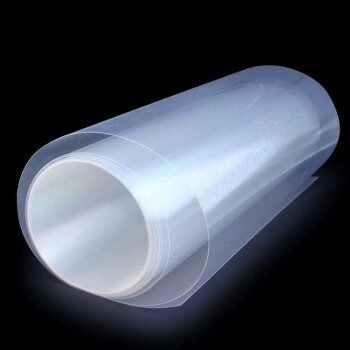
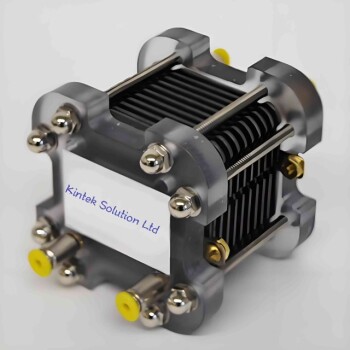
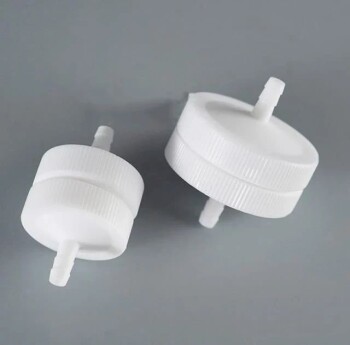
In a Microbial Fuel Cell (MFC), a Proton Exchange Membrane (PEM) acts as a critical selective barrier. Functioning as the internal gatekeeper between the anode and cathode chambers, materials such as Nafion or PTFE facilitate the necessary migration of protons while strictly physically isolating the organic fuel from the oxidant. This separation is the fundamental mechanism that prevents system failure and allows for the generation of usable electricity.
The PEM serves as the cell's filtration system, permitting positive charges to complete the circuit while blocking the mixing of wastewater and oxygen. Without this selective separation, the reactants would neutralize each other immediately, causing a chemical short circuit and eliminating any electrical output.
The Mechanics of Selective Separation
Facilitating Proton Migration
The primary role of the PEM is to create a conductive path for specific ions. It allows protons generated in the anode chamber to migrate through the membrane material to reach the cathode chamber. This movement is essential for completing the internal electrical circuit of the cell.
Blocking Fuel and Oxidant Mixing
While the membrane is permeable to protons, it must remain impermeable to other substances. It acts as a physical wall that prevents the organic wastewater (fuel) and oxygen (oxidant) from coming into direct contact. This isolation ensures that the distinct chemical environments required for the reaction are preserved.
Why Isolation Matters for Performance
Preventing Chemical Short Circuits
If the fuel and oxidant were to mix directly, they would react chemically inside the chamber rather than through the external circuit. This phenomenon, known as a chemical short circuit, consumes the fuel without generating electricity. The PEM eliminates this risk by forcing electrons to travel through the external wire to balance the charge.
Maintaining Potential Difference
Stable current generation relies on a sustained difference in electrical potential between the two electrodes. By physically isolating the anode fluid from the cathode fluid, the PEM maintains this voltage gradient. This allows the MFC to deliver a continuous and stable current.
Understanding the Trade-offs
The Consumable Nature of Membranes
The primary reference classifies the PEM as a "fundamental consumable" within the MFC assembly. This implies that while the membrane is structurally integral, it is a component that performs work and may be subject to wear or degradation over the operational life of the cell.
Material Specificity
Common materials used for this function include Nafion and PTFE. These are selected specifically for their ability to balance the opposing requirements of high proton conductivity and strict fluid separation. Choosing the wrong material can lead to high internal resistance or leakage, compromising the cell's efficiency.
Optimizing MFC Design
To ensure your Microbial Fuel Cell operates efficiently, you must select a membrane that balances conductivity with isolation.
- If your primary focus is maximizing current: Prioritize a membrane material that offers the lowest resistance to proton migration from the anode to the cathode.
- If your primary focus is preventing energy loss: Ensure the membrane provides a robust physical barrier to stop organic wastewater from penetrating into the oxygen-rich cathode chamber.
The Proton Exchange Membrane is the linchpin of the MFC, converting a chaotic chemical environment into a structured system capable of harvesting energy.
Summary Table:
| Feature | Function in MFC Construction | Benefit to System |
|---|---|---|
| Selective Permeability | Permits proton migration from anode to cathode | Completes the internal electrical circuit |
| Physical Barrier | Isolates organic fuel from oxidant (oxygen) | Prevents chemical short circuits and fuel loss |
| Voltage Stability | Maintains potential difference between electrodes | Ensures continuous and stable current generation |
| Material Durability | High-performance polymers like Nafion or PTFE | Balances low internal resistance with longevity |
Elevate Your MFC Research with KINTEK’s Precision Materials
Maximize your energy harvesting potential by choosing the right selective barriers for your Microbial Fuel Cells. KINTEK specializes in high-performance laboratory solutions, providing the essential electrolytic cells, electrodes, and PEM consumables required for advanced electrochemical research. Whether you are optimizing proton conductivity or ensuring robust chemical isolation, our comprehensive range of materials—from PTFE products to specialized catalysts—is designed to meet the rigorous demands of your laboratory.
Ready to boost your cell efficiency? Contact KINTEK today to discover how our expert-grade consumables can power your next breakthrough!
References
- Mustakeem Mustakeem. Electrode materials for microbial fuel cells: nanomaterial approach. DOI: 10.1007/s40243-015-0063-8
This article is also based on technical information from Kintek Solution Knowledge Base .
Related Products
- Proton Exchange Membrane for Batteries Lab Applications
- Customizable PEM Electrolysis Cells for Diverse Research Applications
- FS Electrochemical Hydrogen Fuel Cells for Diverse Applications
- Anion Exchange Membrane for Laboratory Use
- Custom PTFE Teflon Parts Manufacturer for Sampling Filters
People Also Ask
- What is the function of a proton exchange membrane in a PEC cell? Enhancing CO2 Reduction Safety and Efficiency
- What initial steps are required before using a new proton exchange membrane? Ensure Peak Performance and Longevity
- What should be done if a proton exchange membrane is found to be contaminated or damaged? Restore Performance or Replace for Safety
- How should a proton exchange membrane be installed? A Guide to Flawless Assembly for Peak Performance
- What contaminants should be avoided during the operation of a proton exchange membrane? Protect Your PEM from Heavy Metals & Organics