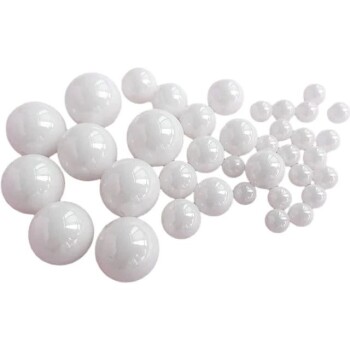
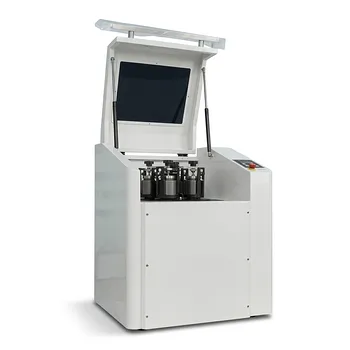
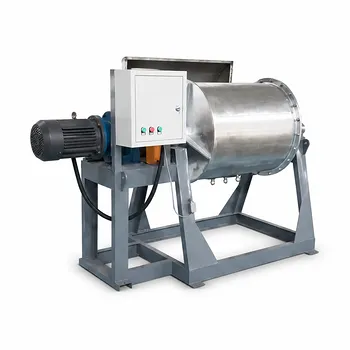
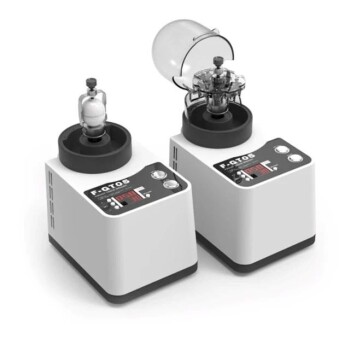
The primary purpose of using varying diameters of zirconia milling balls is to achieve precise control over the average particle size (D50) of solid electrolyte powders. By selecting specific diameters between 1mm and 10mm, technicians can engineer the particle size distribution to align perfectly with cathode particle dimensions.
Core Insight: Successful solid-state battery processing relies on geometric compatibility. The choice of ball diameter is not arbitrary; it is a calculated decision to optimize the particle size ratio ($\lambda$) between the cathode and the electrolyte, ensuring efficient ion transport.
Optimizing Particle Size Distribution
The fundamental reason for varying ball diameters is to target specific particle sizes during the milling process.
Controlling the Lambda Value ($\lambda$)
The efficiency of a solid-state battery depends heavily on the contact area between the cathode and the solid electrolyte.
By manipulating the ball diameter, you control the final particle size of the electrolyte. This allows you to optimize the $\lambda$ value, which is the specific particle size ratio between the active cathode material and the solid electrolyte.
Tailoring D50 for Compatibility
Different processing stages require different impact mechanics.
Larger balls (closer to 10mm) provide high-impact energy suitable for breaking down coarse precursors. Smaller balls (closer to 1mm) provide high friction and shear forces, essential for refining powders to the desired D50 (average diameter) without destroying the crystal structure.
The Criticality of Material Selection
While diameter controls size, the choice of Zirconia as the material controls purity.
Preventing Metallic Contamination
Solid electrolytes, particularly sulfides and garnet-types like LLZTO, are highly sensitive to metallic impurities.
Using stainless steel media would introduce iron or chromium into the powder due to wear. Zirconia is chemically inert, preventing these side reactions which would otherwise degrade electrochemical stability.
Hardness and Wear Resistance
The milling process often involves long durations of high-speed impact, sometimes exceeding five hours.
Zirconia possesses exceptional hardness, allowing it to pulverize hard oxides and withstand high-energy mechanochemical reactions without degrading. This ensures the media does not wear down and contaminate the batch.
Mechanochemical Effects
Beyond simple size reduction, the milling media facilitates critical chemical changes.
Inducing Amorphization
High-energy milling is often used to induce atomic-level mixing and amorphization.
For materials like lithium phosphate and lithium sulfate, this process generates glassy solid electrolytes. These amorphous phases often possess significantly higher ionic conductivity than their crystalline precursors.
Enhancing Sintering Activity
Finer milling with smaller diameter balls increases the specific surface area of the powder.
Refining pre-sintered coarse powders to the micron level enhances their surface energy. This increased reactivity improves the density and performance of the material during the subsequent sintering phase.
Understanding the Trade-offs
While zirconia milling is standard, improper implementation can lead to suboptimal results.
Impact Energy vs. Surface Area
There is a trade-off between the impact energy of large balls and the surface area coverage of small balls.
Using only small balls (e.g., 1mm) on coarse material may result in inefficient grinding due to insufficient impact force. Conversely, using only large balls (e.g., 10mm) on fine powder may fail to achieve the necessary micron-level refinement.
The Risk of Over-Milling
Extended milling times to achieve ultra-fine particle sizes can yield diminishing returns.
While zirconia is wear-resistant, extremely prolonged high-energy exposure can still introduce trace contamination or induce unwanted phase changes in sensitive electrolytes.
Making the Right Choice for Your Process
Selecting the correct milling ball diameter is a balance between geometric requirements and material properties.
- If your primary focus is Geometric Compatibility: Select a ball diameter that yields an electrolyte particle size providing the optimal $\lambda$ ratio relative to your cathode size.
- If your primary focus is Purity and Stability: Rely on Zirconia's inertness to prevent metallic contamination (Fe, Cr) during long-duration milling.
- If your primary focus is Reactivity: Use smaller diameter balls to maximize surface area and induce the amorphization necessary for high ionic conductivity.
Ultimatley, the diameter of the milling media is a tuning knob that aligns the physical dimensions of your electrolyte with the electrochemical requirements of your battery cell.
Summary Table:
| Ball Diameter Range | Primary Milling Mechanism | Processing Application |
|---|---|---|
| Large (5mm - 10mm) | High-Impact Energy | Breaking down coarse precursors & large aggregates |
| Medium (3mm - 5mm) | Balanced Impact & Friction | General size reduction & intermediate refining |
| Small (1mm - 3mm) | High Shear & Friction | Achieving ultra-fine D50, amorphization & surface area maximization |
| Material: Zirconia | Chemical Inertness | Preventing metallic contamination (Fe, Cr) in sulfide/garnet electrolytes |
Elevate your solid-state battery research with KINTEK’s precision engineering tools. From high-performance zirconia milling media and crushing systems to advanced high-temperature furnaces and vacuum sintering solutions, we provide the purity and precision your electrolytes demand. Whether you are optimizing particle ratios or scaling up production, our expertise in ball milling, hydraulic presses, and battery consumables ensures your materials reach peak electrochemical performance. Contact KINTEK today to find the perfect equipment for your laboratory needs!
Related Products
- Laboratory Jar Ball Mill with Alumina Zirconia Grinding Jar and Balls
- Precision Machined Zirconia Ceramic Ball for Engineering Advanced Fine Ceramics
- Laboratory Jar Mill with Agate Grinding Jar and Balls
- Laboratory Ball Mill Jar Mill with Metal Alloy Grinding Jar and Balls
- Laboratory Planetary Ball Mill Cabinet Planetary Ball Milling Machine
People Also Ask
- What are the primary functions of using a ball mill for BZCY72 powder? Achieve High Purity and Enhanced Sintering
- In what way does a laboratory ball mill affect material properties when modifying PHBV/pulp fiber composites?
- Why is a laboratory ball mill required for ultra-fine fly ash? Unlock Nano-Scale Adsorption Power
- What is the function of a laboratory ball mill in the preparation of AMMCs? Optimize Dispersion & Grain Refinement
- What is the function of a laboratory ball mill in the pretreatment of waste tire char (WTC)? Optimize Material Reactivity