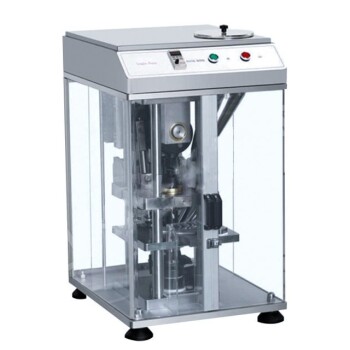
A 3D powder mixer serves as the critical homogenization agent in the manufacturing of metal-ceramic composites. It employs a complex, multi-dimensional motion mode to thoroughly blend metal matrix powders, such as copper or aluminum, with ceramic reinforcement powders like titanium carbide (TiC) or silicon carbide (SiC). This specialized movement is explicitly designed to prevent component segregation, ensuring the ceramic reinforcement is uniformly distributed throughout the metal matrix.
Core Insight: The 3D powder mixer is not merely a blender; it is a segregation countermeasure. By utilizing multi-dimensional motion, it guarantees the uniform distribution of reinforcement phases, which is the absolute prerequisite for achieving consistent mechanical properties in the final material.
The Mechanics of Effective Mixing
Multi-Dimensional Motion
Unlike standard mixers that may only rotate on a single axis, a 3D powder mixer utilizes multi-dimensional motion.
This complex movement pattern forces the particles to move in multiple directions simultaneously. This prevents dead spots and ensures that every particle is subjected to the mixing action.
Combining Dissimilar Materials
The primary challenge in creating metal-ceramic composites is blending materials with vastly different densities and characteristics.
The mixer effectively combines the metal base (e.g., copper or aluminum) with ceramic reinforcement phases (e.g., TiC or SiC). Without this specialized mixing, these distinct powders would naturally separate or clump together.
Why Uniformity is Non-Negotiable
Preventing Component Segregation
The greatest risk during the preparation phase is component segregation.
This occurs when lighter and heavier particles separate, leading to areas that are either distinctively metal or distinctively ceramic. The 3D mixer's role is to neutralize gravity and centrifugal forces to prevent this separation.
Ensuring Consistent Mechanical Properties
The physical properties of the final composite rely entirely on the uniform distribution achieved during mixing.
If the reinforcement phase is not evenly dispersed, the material will have weak points. A homogeneous mix serves as the foundational step for reliable strength and performance in the finished product.
Critical Process Context
The Precursor to Compaction
It is vital to understand that mixing is only the first step in a larger workflow.
Once the 3D powder mixer achieves a homogeneous blend, the material is typically moved to a hydraulic press for powder compaction.
The Risk of Process Defects
While compaction is responsible for pressing the powder into a strong, lightweight shape, it cannot correct errors made during mixing.
If the powder is segregated before it reaches the press, the final component will have permanent structural flaws. Therefore, the 3D mixer dictates the quality ceiling of the final compacted part.
Application Strategy for Composite Development
If your primary focus is Material Homogeneity:
- Prioritize the 3D powder mixer to eliminate segregation between metal and ceramic phases, ensuring the reinforcement is evenly dispersed.
If your primary focus is Structural Formation:
- Focus on the subsequent powder compaction stage using a hydraulic press to transform the blended mixture into a specific, lightweight shape.
If your primary focus is Mechanical Reliability:
- Verify that the 3D mixing cycle is sufficient to create a true matrix before compaction begins, as this establishes the material's consistency.
The success of a metal-ceramic composite is defined by the quality of the mixture; no amount of pressure in the compaction phase can compensate for a poorly blended matrix.
Summary Table:
| Feature | 3D Powder Mixer Role | Impact on Composite Quality |
|---|---|---|
| Motion Type | Multi-dimensional, multi-axis movement | Eliminates dead spots and prevents particle clustering |
| Material Blending | Combines dissimilar densities (e.g., Al/Cu with TiC/SiC) | Ensures even reinforcement phase distribution |
| Segregation Control | Neutralizes gravity and centrifugal forces | Prevents component separation during the mixing cycle |
| Mechanical Impact | Creates a uniform precursor matrix | Guarantees consistent strength and reliability in final parts |
| Process Integration | Prepares powder for hydraulic compaction | Establishes the quality foundation for structural formation |
Elevate Your Material Science with KINTEK Precision
Achieving a flawless metal-ceramic matrix requires more than just mixing—it requires engineering precision. KINTEK specializes in advanced laboratory equipment designed to meet the rigorous demands of material research.
Whether you are developing next-generation composites or optimizing powder metallurgy workflows, our comprehensive range of 3D powder mixers, crushing and milling systems, and high-precision hydraulic presses (pellet, hot, isostatic) ensures your materials achieve peak performance and structural integrity. From high-temperature furnaces for sintering to specialized ceramics and crucibles, KINTEK provides the end-to-end solutions necessary for consistent, high-quality results.
Ready to eliminate segregation and enhance your material reliability? Contact our technical experts today to find the perfect equipment for your lab.
Related Products
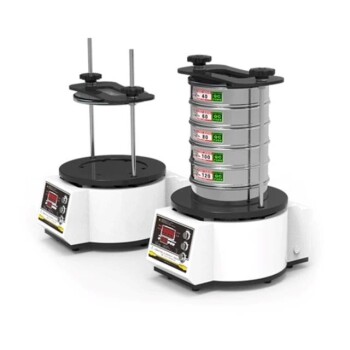
- Laboratory Wet Three-Dimensional Vibratory Sieve Shaker Machine
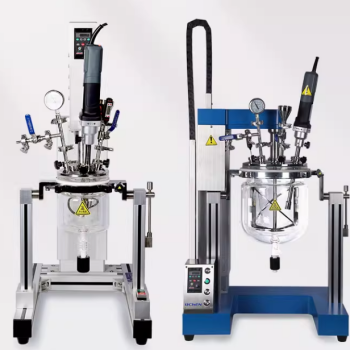
- High Performance Lab Homogenizer for Pharma Cosmetics and Food R&D
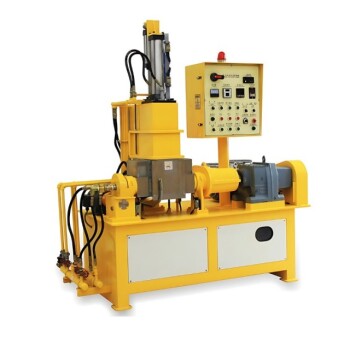
- Lab Internal Rubber Mixer Rubber Kneader Machine for Mixing and Kneading
- Laboratory Oscillating Orbital Shaker
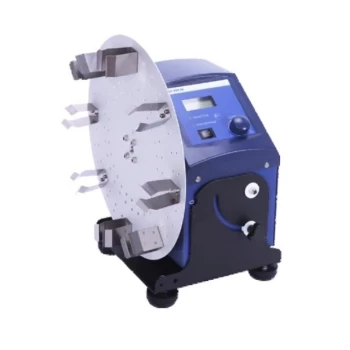
- Laboratory Disc Rotary Mixer for Efficient Sample Mixing and Homogenization
People Also Ask
- How does a laboratory vibratory sieve shaker facilitate the microstructural study of gas-atomized alloy powders?
- Why use a vibratory sieve shaker for PET powder? Achieve Precise Particle Size Control for Chemical Research
- How is a vibratory sieve shaker used in the particle size analysis of mechanically alloyed powders? Expert Guide
- What is the principle of vibratory sieve shaker? Achieve Accurate Particle Size Analysis
- What is the function of a vibratory sieve shaker? Achieve Precise Particle Size Analysis