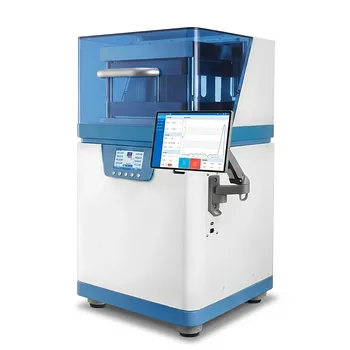
The high-pressure solvothermal reactor is the critical hardware that enables the precise synthesis of UiO-66-NDC by creating an environment where high temperature and autogenous pressure coexist. This closed system facilitates the thorough dissolution of zirconium ions and 2,6-naphthalenedicarboxylic acid ligands, allowing them to coordinate into a highly crystalline, ordered Metal-Organic Framework (MOF) skeleton.
The reactor serves as a controlled "pressure cooker" that forces precursors to overcome kinetic barriers, ensuring the formation of structurally intact crystals with regular pore structures. By maintaining solvents above their boiling points, it maximizes reactant solubility and promotes uniform nucleation across the MOF framework and its composites.
Enhancing Precursor Solubility and Reaction Activity
Overcoming Boiling Point Limitations
The primary role of the reactor is to maintain organic solvents, such as N,N-dimethylformamide (DMF), in a liquid or supercritical state at temperatures exceeding their normal boiling points. This environment significantly increases the solubility and reaction activity of the zirconium precursors and organic ligands.
Facilitating Metal-Ligand Coordination
Within this high-pressure environment, metal zirconium ions can effectively coordinate with 2,6-naphthalenedicarboxylic acid. The pressure accelerates the transformation from the initial gel phase to a crystalline MOF structure, ensuring the skeleton is dense and well-defined.
Achieving Structural Precision and High Crystallinity
Promoting Uniform Nucleation
A sealed, high-pressure reactor provides the stable heating required for uniform crystal nucleation. This stability is essential for growing the octahedral crystals characteristic of the UiO-66 series, preventing the formation of amorphous or irregular clusters.
Ensuring Ordered Framework Growth
By providing a constant environment over extended periods, the reactor ensures ordered growth of the MOF skeleton. This results in high crystallinity and regular pore structures, which are vital for the material’s performance in gas storage or catalysis.
The Reactor's Role in Composite Synthesis
Anchoring Phases to Supports
In the synthesis of UiO-66-NDC composites, the reactor facilitates the diffusion and recrystallization of components onto secondary supports. This ensures that the MOF is firmly and uniformly loaded onto carriers like carbon materials or biomass.
Creating Effective Interfaces
The high-pressure conditions help build robust metal-support interfaces. By promoting intimate contact at the molecular level, the reactor enables the formation of three-dimensional hierarchical structures that are often impossible to achieve at atmospheric pressure.
Understanding the Trade-offs
Equipment Integrity and Safety
While high autogenous pressure is necessary for crystal growth, it demands specialized stainless steel vessels to manage the risk of mechanical failure. The seal must be absolute; any leakage during the process will drop the pressure, lead to solvent loss, and result in poorly formed crystals.
Sensitivity to Temperature Fluctuations
Small variations in the reactor's internal temperature can drastically alter the morphology and purity of the UiO-66-NDC series. Because the reaction occurs in a sealed "black box," researchers cannot adjust parameters mid-process, making initial calibration of the reactor critical.
How to Optimize Your Synthesis Process
Application-Specific Recommendations
- If your primary focus is high structural purity: Utilize a reactor equipped with a PTFE liner to prevent metal ion contamination from the vessel walls and resist corrosion from polar solvents.
- If your primary focus is composite loading: Ensure the reactor maintains a constant temperature for at least 24 hours to allow sufficient time for the MOF to anchor firmly onto the support surface.
- If your primary focus is morphology control: Closely monitor the filling degree of the solvent in the reactor, as this directly dictates the autogenous pressure and the resulting crystal size.
By mastering the high-pressure solvothermal environment, you can consistently produce UiO-66-NDC materials with the precise crystallinity and structural integrity required for advanced technical applications.
Summary Table:
| Feature | Impact on UiO-66-NDC Synthesis | Key Benefit |
|---|---|---|
| Autogenous Pressure | Enhances solubility of Zr ions and ligands | Ensures a dense, well-defined skeleton |
| Sealed Environment | Facilitates uniform crystal nucleation | Creates regular pore structures & high purity |
| Thermal Stability | Promotes ordered growth over 24+ hours | Prevents amorphous clusters & defects |
| Solvothermal Interface | Builds robust metal-support bonds | Enables 3D hierarchical composite structures |
Elevate Your MOF Research with KINTEK Precision
Achieving the perfect crystalline structure for UiO-66-NDC requires equipment that can withstand rigorous solvothermal conditions. KINTEK specializes in high-performance laboratory solutions, offering a premium range of high-temperature high-pressure reactors and autoclaves designed for structural precision and safety.
Whether you are synthesizing advanced Metal-Organic Frameworks, conducting battery research, or requiring specialized PTFE products and ceramic crucibles, our portfolio is engineered to meet the strictest research standards. From crushing and milling systems to ultracold cooling solutions, we provide the tools you need to ensure reproducible results and superior material morphology.
Ready to optimize your synthesis process? Contact our laboratory specialists today to find the ideal reactor configuration for your next breakthrough.
References
- Xu Jia, Guomin Yu. Highly Efficient Photocatalytic Degradation of Tetracycline by Modifying UiO-66 via Different Regulation Strategies. DOI: 10.1021/acsomega.3c02762
This article is also based on technical information from Kintek Solution Knowledge Base .
Related Products
- Customizable Laboratory High Temperature High Pressure Reactors for Diverse Scientific Applications
- Customizable High Pressure Reactors for Advanced Scientific and Industrial Applications
- High Pressure Laboratory Autoclave Reactor for Hydrothermal Synthesis
- Stainless High Pressure Autoclave Reactor Laboratory Pressure Reactor
- Mini SS High Pressure Autoclave Reactor for Laboratory Use
People Also Ask
- How do high-pressure and high-temperature reactors ensure the effective treatment of lignocellulosic wastewater in WAO?
- What equipment is required for high-pressure high-temperature reactions? Master Extreme Chemistry Safely
- How do you control high pressure in a reactor? A Guide to Safe & Stable Operation
- How does initial oxygen pressure affect the wet oxidation of pharmaceutical sludge? Master Your Oxidation Depth
- Why is argon better than nitrogen for inert atmosphere? Ensure Absolute Reactivity & Stability