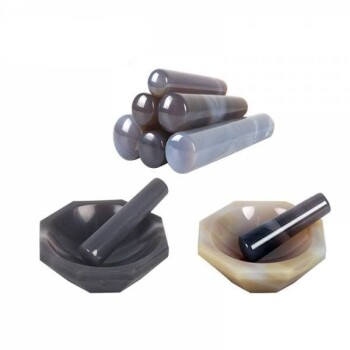
In the initial synthesis of LATP solid electrolytes, the role of an agate mortar is to facilitate the thorough grinding and intimate mixing of raw precursor powders. This manual process physically blends components like lithium carbonate, aluminum hydroxide, and titanium dioxide to create a uniform mixture prior to thermal treatment.
The agate mortar serves a dual purpose: it homogenizes the precursor blend while strictly maintaining purity. Its high hardness and low wear characteristics ensure that the grinding process does not introduce foreign contaminants, preserving the accurate stoichiometry essential for high-performance solid-state reactions.
Achieving Homogeneity and Precision
Mechanical Dispersion
The primary function of the agate mortar is to break down agglomerates in the raw materials. By grinding powders such as lithium carbonate and titanium dioxide, you ensure the particles are small enough to react efficiently.
Uniform Distribution
Successful solid-state synthesis relies on the reactants being in close contact. The mortar allows for the uniform dispersion of all components within the mixture. This physical uniformity is the necessary foundation for the subsequent chemical reactions that form the LATP crystal structure.
Stoichiometric Control
Ionic conductivity in solid electrolytes is highly sensitive to chemical composition. The grinding process in an agate mortar ensures that the specific ratio of aluminum hydroxide to other components is maintained exactly throughout the mixture.
Why Agate is the Material of Choice
High Hardness
Agate is an exceptionally hard mineral. This allows it to effectively grind harder precursor powders without the mortar itself degrading or scratching.
Low Wear Characteristics
The most critical advantage of agate is its resistance to wear. In softer mortars, the grinding action scrapes off microscopic amounts of the mortar material, introducing impurities into the sample.
Preventing Contamination
Because LATP performance relies on purity, even trace contaminants from a wearing mortar can alter the material's properties. Agate ensures that the final mixture contains only the intended precursors, guaranteeing accurate stoichiometry.
Understanding the Trade-offs
Manual vs. Mechanical Limits
While an agate mortar is excellent for high-purity, small-batch preparation, it relies on manual effort. It may not achieve the same level of microscopic refinement or reaction activity enhancement as automated methods like ball milling.
Scalability and Consistency
For larger batches or when extreme particle refinement is required, mechanical methods (such as the ball mill mentioned in supplementary contexts) utilize sustained forces over long periods (e.g., six hours). The agate mortar is best suited for the initial mixing phase or strictly controlled laboratory-scale synthesis where contamination control is paramount.
Making the Right Choice for Your Goal
To determine if manual grinding with an agate mortar is sufficient for your process, consider the scale and precision required:
- If your primary focus is absolute purity and small-scale stoichiometry: Rely on the agate mortar to prevent contamination and ensure the exact chemical ratios are preserved during the initial mix.
- If your primary focus is microscopic refinement and large-scale uniformity: Consider transitioning to mechanical ball milling after or instead of manual grinding to enhance reaction activity and process volume.
The agate mortar remains the gold standard for contamination-free mixing, laying the groundwork for a pure and effective solid electrolyte.
Summary Table:
| Feature | Benefit for LATP Synthesis |
|---|---|
| High Hardness | Effectively grinds hard precursor powders without tool degradation. |
| Low Wear | Minimizes contamination, preserving the exact stoichiometric ratio. |
| Manual Control | Ideal for small-scale batches requiring high-purity initial blending. |
| Contamination Control | Prevents foreign material ingress that could lower ionic conductivity. |
Elevate Your Solid-State Research with KINTEK
Precision in LATP synthesis begins with the right tools. KINTEK specializes in high-performance laboratory equipment designed for the rigorous demands of battery research and material science. Whether you require high-purity agate mortars for contamination-free manual mixing, or advanced crushing and milling systems and planetary ball mills for microscopic refinement, we have the solution.
Our extensive portfolio supports your entire workflow—from hydraulic pellet presses for electrolyte forming to high-temperature muffle and tube furnaces for critical sintering phases. Ensure the stoichiometry and performance of your solid electrolytes with KINTEK's premium consumables, including PTFE products, ceramics, and crucibles.
Ready to optimize your lab's efficiency and material purity? Contact our specialists today to find the perfect equipment for your specific research goals!
Related Products
- Nature Agate Mortar and Pestle for Grinding and Mixing
- Laboratory Jar Mill with Agate Grinding Jar and Balls
People Also Ask
- Why are agate mortars and pestles used for grinding iron oxide? Ensure Sample Purity for XRD Analysis
- What is the function of an agate mortar and pestle? Ensure Purity in Halide Solid-State Electrolyte Synthesis
- What is the primary function of an agate mortar and pestle? Optimize VO2+ CaZn2(PO4)2 Nanopowder Pre-Treatment
- Why is an agate mortar and pestle required for grinding Zr3(Al1-xSix)C2? Ensure Maximum Sample Purity
- Why is an agate mortar and pestle preferred for grinding MAX phase? Ensure Sample Purity & Zero Contamination