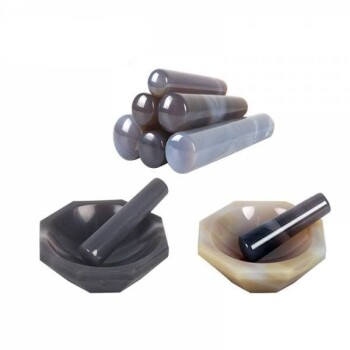
The necessity of an agate mortar lies in its specific ability to ensure chemical purity while maximizing reaction efficiency. In CO2-water-rock interaction experiments, you must grind carbonate rocks into micron-level powders to increase surface area without introducing external contaminants. Agate is uniquely suited for this because its extreme hardness and chemical inertness prevent the shedding of metal particles that would otherwise compromise the accuracy of your mineral dissolution and precipitation analyses.
The success of a geochemical experiment depends on the purity of the sample preparation. Agate mortars provide the critical balance of hardness required to pulverize rock and the chemical inertness necessary to prevent metal contamination, ensuring your data reflects true rock interactions rather than equipment artifacts.
Preserving Experimental Integrity
The Danger of Contamination
Standard grinding tools, such as those made of porcelain, steel, or brass, are prone to abrasion. During the vigorous grinding process, these softer or reactive materials can shed microscopic particles into your sample.
Agate’s Chemical Inertness
Agate is a cryptocrystalline variety of silica characterized by exceptional chemical stability. It does not react with carbonate rock samples, nor does it release trace metals or impurities.
Ensuring Analytical Accuracy
In CO2-water-rock experiments, you are often measuring minute changes in water chemistry and mineral composition. By using agate, you guarantee that any detected elements come solely from the rock sample, ensuring the validity of your dissolution and precipitation data.
Accelerating Reaction Kinetics
The Need for Surface Area
Geochemical reactions between rock and fluid occur at the interface of the materials. In a laboratory setting, standard rock chips react too slowly to provide useful data within a reasonable timeframe.
Achieving Micron-Level Powders
An agate mortar allows you to grind samples down to micron-level particle sizes. This creates a massive increase in specific surface area relative to the sample's mass.
Enhancing Fluid-Rock Contact
This increased surface area maximizes the contact zone between the carbonate rock and the CO2-water mixture. This effectively "speeds up" the geological clock, accelerating geochemical reactions to a pace that can be observed and measured in the lab.
Understanding the Trade-offs
Physical Effort and Time
Achieving a consistent micron-level powder using a manual agate mortar is labor-intensive. It requires significant time and physical effort compared to mechanical crushing methods, which can be a bottleneck for large sample sets.
Cost and Brittleness
High-quality agate equipment is significantly more expensive than ceramic or glass alternatives. Furthermore, while agate is hard, it is also brittle; dropping the pestle or subjecting the mortar to thermal shock can result in immediate, irreparable fracture.
Making the Right Choice for Your Experiment
Selecting the correct preparation tools is the first step toward reproducible results.
- If your primary focus is high-precision geochemical analysis: Prioritize the use of agate to completely eliminate the risk of metal impurities skewing your dissolution data.
- If your primary focus is reaction speed: Dedicate sufficient time to grinding the sample into a fine, consistent powder to maximize the specific surface area available for fluid contact.
By investing effort in the preparation phase with the correct materials, you secure the foundation for accurate and defensible experimental conclusions.
Summary Table:
| Feature | Agate Mortar Advantage | Impact on Experiment |
|---|---|---|
| Material Purity | Chemically inert silica | Prevents metal/trace element contamination |
| Hardness | Superior abrasion resistance | Ensures sample integrity without equipment shedding |
| Particle Size | Micron-level pulverization | Maximizes surface area for faster reaction kinetics |
| Surface Texture | Non-porous surface | Minimizes sample loss and cross-contamination |
Elevate Your Geochemical Precision with KINTEK
Don't let equipment artifacts compromise your research data. KINTEK specializes in high-performance laboratory equipment designed for the most demanding geochemical and material science applications. Whether you need high-purity agate mortars, crushing and milling systems, or high-temperature high-pressure reactors and autoclaves for CO2-water-rock simulations, we provide the tools necessary for reproducible, defensible results.
Our comprehensive range also includes PTFE products, ceramics, and crucibles to maintain chemical integrity throughout your workflow.
Ready to optimize your sample preparation? Contact our technical experts today to find the perfect solution for your lab's needs.
References
- Kaisar Ahmat, Jie Li. CO2-Water-Rock Interactions in Carbonate Formations at the Tazhong Uplift, Tarim Basin, China. DOI: 10.3390/min12050635
This article is also based on technical information from Kintek Solution Knowledge Base .
Related Products
- Nature Agate Mortar and Pestle for Grinding and Mixing
- Laboratory Jar Mill with Agate Grinding Jar and Balls
People Also Ask
- Why are agate mortars and pestles used for grinding iron oxide? Ensure Sample Purity for XRD Analysis
- What is the function of an agate mortar and pestle? Ensure Purity in Halide Solid-State Electrolyte Synthesis
- What is the primary function of an agate mortar and pestle? Optimize VO2+ CaZn2(PO4)2 Nanopowder Pre-Treatment
- Why is an agate mortar and pestle required for grinding Zr3(Al1-xSix)C2? Ensure Maximum Sample Purity
- Why is an agate mortar and pestle preferred for grinding MAX phase? Ensure Sample Purity & Zero Contamination