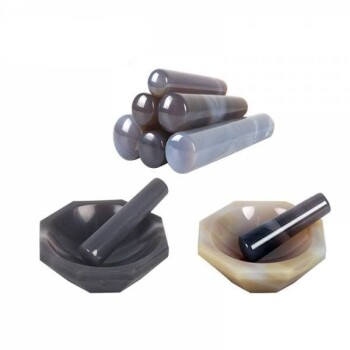
Agate mortars provide the critical advantage of contamination-free particle reduction, making them the technical standard for preparing sensitive sintering aids like B2O3-Li2CO3. Their specific material properties allow researchers to grind raw materials into fine powders without the grinding tool itself degrading and altering the chemical composition of the mixture.
The core value of using an agate mortar lies in its extreme hardness and resistance to abrasion. By preventing wear debris from entering the sample, agate ensures that the precise chemical ratio (stoichiometry) of the sintering aid is preserved, allowing for the correct liquid phase formation during heat treatment.
Material Integrity and Hardness
High Hardness Characteristics
Agate is a naturally hard mineral variant of silica. When used as a mortar and pestle, its surface resists scratching, chipping, or degrading under the mechanical stress of grinding.
Low Abrasion and Wear
Because of its high hardness, agate exhibits exceptionally low wear rates. This is technically superior to softer materials (like porcelain) which can shed microscopic particulates into the sample during vigorous grinding.
Preserving Chemical Stoichiometry
Preventing External Impurities
The introduction of "external impurities"—microscopic bits of the mortar itself—is a major technical risk in material science. For a B2O3-Li2CO3 mixture, even trace amounts of silica or other contaminants from a degrading mortar can alter the intended chemical balance. Using agate eliminates this variable, ensuring the final powder is chemically identical to the starting ingredients.
Ensuring Pure Liquid Phase Formation
Sintering aids are designed to react at specific temperatures. In this context, the B2O3-Li2CO3 mixture is intended to form a pure liquid phase at 600°C. If the mixture is contaminated by mortar debris, the melting point and phase behavior can shift unpredictably. Agate protects the purity required for this phase transition to occur exactly as predicted.
Operational Suitability
Optimization for Small Sample Volumes
Agate mortars are particularly effective for mixing small sample volumes. The smooth, non-porous surface ensures that valuable material is not lost in pores or cracks, allowing for high recovery rates of the ground powder.
Understanding the Operational Constraints
Manual Precision vs. Scalability
While agate is superior for purity, it is generally applied in manual or small-scale laboratory contexts. The technical advantage here is precision and control over the grind, rather than throughput or speed. It is a tool designed for exactitude, not mass production.
Making the Right Choice for Your Goal
To achieve the best results with your B2O3-Li2CO3 sintering aid, consider your specific experimental needs:
- If your primary focus is thermal predictability: Use agate to ensure the mixture forms the correct liquid phase at exactly 600°C without contaminant interference.
- If your primary focus is stoichiometric accuracy: Rely on agate's low wear profile to maintain the exact chemical ratio of Boron to Lithium throughout the grinding process.
Agate is not just a grinding tool; it is an assurance of chemical fidelity for high-precision material synthesis.
Summary Table:
| Technical Feature | Benefit for Sintering Aids | Impact on B2O3-Li2CO3 |
|---|---|---|
| High Hardness | Resists scratching and chipping | Prevents mortar debris from altering sample composition |
| Low Abrasion | Extremely low wear rates | Preserves exact chemical stoichiometry (Li:B ratio) |
| Non-Porous Surface | High sample recovery | Minimizes loss of expensive or small-volume materials |
| Chemical Inertness | No reaction with reagents | Ensures pure liquid phase formation at exactly 600°C |
Elevate Your Material Synthesis with KINTEK Precision
Maintaining the chemical integrity of your sintering aids is non-negotiable for predictable thermal behavior. KINTEK provides the high-purity laboratory tools necessary to prevent contamination and ensure stoichiometric accuracy.
Beyond our premium agate mortars and pestles, KINTEK specializes in a comprehensive range of laboratory solutions, including:
- Crushing & Milling Systems: Advanced grinding jars and media for consistent particle reduction.
- High-Temperature Furnaces: Muffle, tube, and vacuum furnaces for precise heat treatment.
- Hydraulic Presses: Pellet, hot, and isostatic presses for high-density sample preparation.
- Specialized Consumables: High-quality ceramics, crucibles, and PTFE products.
Ready to optimize your lab's workflow and ensure the purity of your research? Contact our technical experts today to find the perfect equipment and consumables for your specific application.
Related Products
- Nature Agate Mortar and Pestle for Grinding and Mixing
- Laboratory Jar Mill with Agate Grinding Jar and Balls
People Also Ask
- Why are agate mortars and pestles used for grinding iron oxide? Ensure Sample Purity for XRD Analysis
- What is the function of an agate mortar and pestle? Ensure Purity in Halide Solid-State Electrolyte Synthesis
- What is the primary function of an agate mortar and pestle? Optimize VO2+ CaZn2(PO4)2 Nanopowder Pre-Treatment
- Why is an agate mortar and pestle required for grinding Zr3(Al1-xSix)C2? Ensure Maximum Sample Purity
- Why is an agate mortar and pestle preferred for grinding MAX phase? Ensure Sample Purity & Zero Contamination