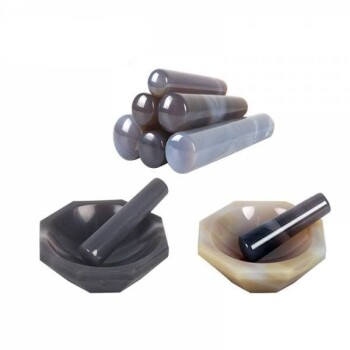
An agate mortar serves as a critical instrument for the gentle, contamination-free integration of solid-state battery components. It is primarily used to manually mix solid-state electrolytes, cathode active materials (such as single-crystal NMC or TiS2), and conductive additives like carbon nanofibers to create a composite cathode.
Core Takeaway The agate mortar facilitates the formation of essential ionic and electronic conductive networks through uniform dispersion. Its specific value lies in its ability to mix components thoroughly without introducing metallic impurities or applying excessive shear forces that could damage delicate crystal structures.
Eliminating Contamination Risks
The Value of Material Inertness
Agate is a naturally hard, chemically inert material with high wear resistance.
Using an agate mortar ensures that the mixing process does not introduce impurities into the mixture.
Preventing Metallic Interference
Standard metallic mixing tools can shed microscopic particles during the abrasion of mixing.
These metallic contaminants can be detrimental to high-voltage cathode materials, leading to short circuits or chemical instability.
The agate mortar completely avoids this risk, preserving the electrochemical purity required for high-performance solid-state batteries.
Balancing Dispersion with Integrity
Gentle Mechanical Action
Unlike high-speed automated mixers, an agate mortar relies on manual operation.
This allows for a "gentle" mixing process that avoids excessive mechanical shear forces.
Protecting Active Materials
High-energy mixing can crush or fracture delicate active material particles, such as single-crystal NMC.
It can also cause excessive deformation of the solid electrolyte.
The agate mortar ensures the components are mixed uniformly while maintaining their structural integrity.
Establishing Conductive Networks
Creating Uniform Interfaces
The goal of the composite cathode is to create a seamless path for both electrons and ions.
The smooth surface of the agate mortar aids in the uniform dispersion of carbon nanofibers and electrolyte powders among the cathode particles.
Optimizing Solid-Solid Contact
In solid-state batteries, performance relies heavily on the quality of the contact between solid particles.
The mortar and pestle apply sufficient pressure to establish these high-quality solid-solid contact interfaces.
This establishes the effective ion channels necessary for the battery to function efficiently.
Understanding the Trade-offs
Scalability vs. Precision
The agate mortar is a manual tool, making it inherently unscalable for mass production.
It is ideal for laboratory research, prototyping, and small-batch preparation where precision outweighs throughput.
Shear Force Limitations
While the mortar is excellent for protection, it lacks the high-shear capability of devices like twin-shaft ball mixers.
If a process requires high-speed rotation (e.g., 2000 rpm) to homogenize a wet slurry effectively, an agate mortar will not generate sufficient force.
Making the Right Choice for Your Goal
To determine if an agate mortar is the correct tool for your cathode preparation, consider your specific material constraints:
- If your primary focus is Purity and High Voltage: Use an agate mortar to eliminate the risk of metallic contaminants that could degrade electrochemical performance.
- If your primary focus is Particle Preservation: Use an agate mortar to mix delicate crystals or soft electrolytes without subjecting them to destructive shear forces.
- If your primary focus is Slurry Homogeneity: Consider a high-speed mixer, as manual mortar mixing may not provide the shear force needed for wet, binder-heavy formulations.
Select the tool that balances your need for uniform dispersion with the mechanical sensitivity of your active materials.
Summary Table:
| Feature | Benefit for Composite Cathodes | Why it Matters |
|---|---|---|
| Material Inertness | Zero metallic contamination | Prevents short circuits and chemical instability in high-voltage materials. |
| Manual Operation | Low shear force | Preserves the structural integrity of delicate single-crystal NMC and electrolytes. |
| High Wear Resistance | Long-term purity | Ensures no microscopic particles shed into the active material mixture. |
| Polished Surface | Uniform dispersion | Optimizes solid-solid contact interfaces for better ionic and electronic conductivity. |
Elevate Your Battery Research with KINTEK Precision
Achieving the perfect ionic conductive network requires more than just mixing—it requires the right tools to maintain material integrity and electrochemical purity. KINTEK specializes in high-quality laboratory equipment, including premium agate mortars and pestles, crushing and milling systems, and hydraulic pellet presses designed specifically for solid-state battery development.
From high-temperature furnaces for material synthesis to specialized electrolytic cells and battery research consumables, we provide the end-to-end solutions your lab needs to innovate.
Ready to optimize your cathode preparation? Contact KINTEK today to explore our comprehensive range of equipment and consumables tailored for advanced material science.
Related Products
- Nature Agate Mortar and Pestle for Grinding and Mixing
- Laboratory Jar Mill with Agate Grinding Jar and Balls
People Also Ask
- Why are agate mortars and pestles used for grinding iron oxide? Ensure Sample Purity for XRD Analysis
- What is the function of an agate mortar and pestle? Ensure Purity in Halide Solid-State Electrolyte Synthesis
- What is the primary function of an agate mortar and pestle? Optimize VO2+ CaZn2(PO4)2 Nanopowder Pre-Treatment
- Why is an agate mortar and pestle required for grinding Zr3(Al1-xSix)C2? Ensure Maximum Sample Purity
- Why is an agate mortar and pestle preferred for grinding MAX phase? Ensure Sample Purity & Zero Contamination