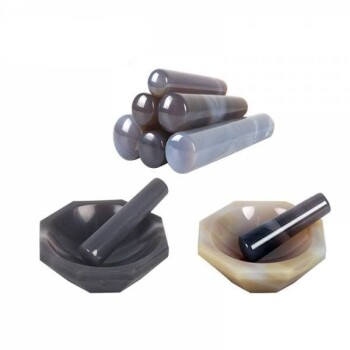
The primary function of an agate mortar in the pre-treatment of NaSICON samples is to facilitate the precise manual mixing of ceramic powder with transient liquid phases and dopant salts. This step ensures that trace amounts of liquids, such as acetic acid or sodium hydroxide, are uniformly distributed to coat the ceramic particles effectively.
The agate mortar is the critical tool for creating the necessary contact conditions for cold sintering. By physically grinding the components together, it forces liquid wetting agents to coat the solid particles evenly, triggering the essential dissolution-precipitation mechanism.
The Role of Mechanical Mixing in Cold Sintering
Facilitating Surface Coating
The success of cold sintering relies heavily on the interaction between the solid ceramic and the liquid medium.
The agate mortar is used to manually grind NaSICON ceramic powder with transient liquid phases. This physical action ensures that the liquid does not merely sit alongside the powder but actively wets the surface of the particles.
Integrating Dopant Salts
In addition to liquids, this stage often involves the introduction of dopant salts, such as NaPF6.
The mortar serves to pulverize these salts and mix them intimately with the NaSICON base. This creates a homogeneous mixture where the dopant is evenly available throughout the ceramic matrix.
Enabling the Reaction Mechanism
The ultimate goal of this pre-treatment is to prepare the sample for the dissolution-precipitation mechanism.
By ensuring the liquid phase (the solvent) and the solid phase (the solute) are in optimal contact, the agate mortar sets the stage for the chemical exchanges that will densify the material at low temperatures.
Understanding the Trade-offs
Manual Variability
While an agate mortar provides excellent control for small batches, it introduces operator variability.
The consistency of the coating depends on the pressure and duration applied by the human operator. This can lead to slight variations in the final sintered density between different batches or researchers.
Scalability Limits
Manual mixing in a mortar is inherently a lab-scale process.
While it is perfect for fundamental research and ensuring precise particle coating, it is difficult to scale up for industrial production without transitioning to automated ball milling or similar mechanical methods.
Optimizing Your Pre-Treatment Protocol
To ensure the highest quality NaSICON samples, consider your specific experimental goals:
- If your primary focus is reaction efficiency: Ensure you grind long enough to achieve a visible change in consistency, indicating the transient liquid has fully coated the particles.
- If your primary focus is reproducibility: Standardize the mixing time and attempt to maintain consistent pressure to minimize human error in the dissolution-precipitation setup.
Correct usage of the agate mortar is the first step toward achieving a dense, high-performance ceramic electrolyte.
Summary Table:
| Feature | Role in NaSICON Pre-treatment |
|---|---|
| Primary Function | Uniform distribution of transient liquids and dopant salts (e.g., NaPF6) |
| Mechanism | Facilitates particle wetting for the dissolution-precipitation process |
| Material Benefit | Agate prevents contamination and ensures high purity of ceramic powder |
| Key Outcome | Optimal particle-liquid contact for low-temperature densification |
Elevate Your Material Research with KINTEK Precision
Achieving the perfect dissolution-precipitation mechanism requires high-quality tools that ensure sample purity and consistency. KINTEK specializes in premium laboratory equipment and consumables designed for advanced material science. Whether you are working on NaSICON cold sintering or complex solid-state electrolytes, our professional-grade agate mortars, ball milling systems, and hydraulic pellet presses provide the reliability your research demands.
From high-temperature furnaces and CVD systems to specialized ceramics, crucibles, and PTFE products, KINTEK is your partner in laboratory excellence. Don't let equipment variability compromise your results. Contact our technical experts today to find the ideal solutions for your laboratory's crushing, milling, and sintering needs!
Related Products
- Nature Agate Mortar and Pestle for Grinding and Mixing
- Laboratory Jar Mill with Agate Grinding Jar and Balls
People Also Ask
- Why are agate mortars and pestles used for grinding iron oxide? Ensure Sample Purity for XRD Analysis
- What is the function of an agate mortar and pestle? Ensure Purity in Halide Solid-State Electrolyte Synthesis
- What is the primary function of an agate mortar and pestle? Optimize VO2+ CaZn2(PO4)2 Nanopowder Pre-Treatment
- Why is an agate mortar and pestle required for grinding Zr3(Al1-xSix)C2? Ensure Maximum Sample Purity
- Why is an agate mortar and pestle preferred for grinding MAX phase? Ensure Sample Purity & Zero Contamination