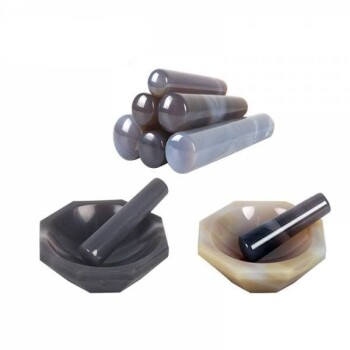
In the synthesis of cobalt ferrite (CoFe2O4) via chemical co-precipitation, the agate mortar serves a critical role in mechanical processing. Its primary function is to grind the dried precursor precipitates into a fine, uniform powder while maintaining absolute chemical purity.
The agate mortar acts as a contamination-free milling tool, converting dried precipitates into a homogeneous powder to ensure uniform thermal reaction during subsequent calcination steps.
The Role of Mechanical Reduction
Achieving Particle Uniformity
The co-precipitation process typically yields a dried solid that is clumpy or aggregated. The agate mortar is used to mechanically break down these agglomerates. This results in a fine, consistent powder necessary for the next stages of synthesis.
Creating a Homogeneous Base
Grinding the precipitate ensures that the cobalt and iron components are intimately mixed at a microscopic level. A highly homogeneous raw material base is essential for consistent results during later processing steps.
Why Agate is Critical for Purity
High Hardness
Agate is a naturally hard mineral silica structure. It resists abrasion and wear during the vigorous grinding action required to pulverize the cobalt ferrite precursors.
Chemical Inertness
Unlike metal or softer ceramic mortars, agate is chemically inert. It does not shed material into the sample, ensuring that no impurities are introduced during the grinding process.
Preventing Contamination
Any foreign material introduced during grinding could alter the magnetic or electronic properties of the final CoFe2O4 product. Using agate safeguards the sample against this specific type of cross-contamination.
Impact on Thermal Treatment
Preparing for Calcination
The ground powder serves as the input for thermal treatments, such as calcination or sintering. Because the powder is fine and uniform, it allows for even heat distribution.
Facilitating Solid-State Reactions
Uniform particle size promotes a consistent reaction throughout the material. This helps ensure the complete formation of the desired crystalline structure without localized defects.
Understanding the Limitations
Manual Labor Intensity
Using a manual agate mortar is labor-intensive compared to automated methods like ball milling. Achieving extremely fine, nanometer-scale particle sizes manually can be physically demanding and time-consuming.
Sample Volume Constraints
Mortars are generally limited to small batch sizes. While ideal for laboratory-scale synthesis and research, they are inefficient for industrial-scale mass production.
Ensuring Synthesis Success
Selecting the right grinding tool depends on your specific purity requirements and the scale of your project.
- If your primary focus is high purity: Rely on the agate mortar to strictly prevent metallic or ceramic contamination from the grinding media.
- If your primary focus is large-scale production: You may need to investigate automated milling, provided you can mitigate the risk of impurity introduction.
The agate mortar remains the gold standard for producing high-quality, contamination-free cobalt ferrite powders in laboratory settings.
Summary Table:
| Feature | Benefit in CoFe2O4 Synthesis |
|---|---|
| High Hardness | Resists abrasion to prevent sample contamination from the mortar material. |
| Chemical Inertness | Ensures no unwanted reactions occur during the mechanical grinding process. |
| Particle Reduction | Breaks down agglomerates for a consistent, fine powder base. |
| Homogenization | Facilitates intimate mixing for uniform thermal reactions during calcination. |
Elevate Your Materials Research with KINTEK Precision
Precise synthesis of advanced materials like cobalt ferrite requires the highest standards of purity and consistency. KINTEK specializes in premium laboratory equipment designed for rigorous research, including high-purity agate mortars, crushing and milling systems, and sieving equipment to ensure your precursors are processed without contamination.
From preparing powders to high-temperature processing in our muffle, vacuum, or tube furnaces, and finalizing samples with our hydraulic pellet presses, KINTEK provides a comprehensive range of solutions for battery research, ceramics, and chemical engineering.
Ready to achieve superior results in your lab? Contact us today to explore our full catalog and expert solutions!
References
- Yudith Ortega López, V. Collins Martínez. Synthesis Method Effect of CoFe<sub>2</sub>O<sub>4</sub> on Its Photocatalytic Properties for H<sub>2</sub> Production from Water and Visible Light. DOI: 10.1155/2015/985872
This article is also based on technical information from Kintek Solution Knowledge Base .
Related Products
- Nature Agate Mortar and Pestle for Grinding and Mixing
- Laboratory Jar Mill with Agate Grinding Jar and Balls
People Also Ask
- Why are agate mortars and pestles used for grinding iron oxide? Ensure Sample Purity for XRD Analysis
- What is the function of an agate mortar and pestle? Ensure Purity in Halide Solid-State Electrolyte Synthesis
- What is the primary function of an agate mortar and pestle? Optimize VO2+ CaZn2(PO4)2 Nanopowder Pre-Treatment
- Why is an agate mortar and pestle required for grinding Zr3(Al1-xSix)C2? Ensure Maximum Sample Purity
- Why is an agate mortar and pestle preferred for grinding MAX phase? Ensure Sample Purity & Zero Contamination