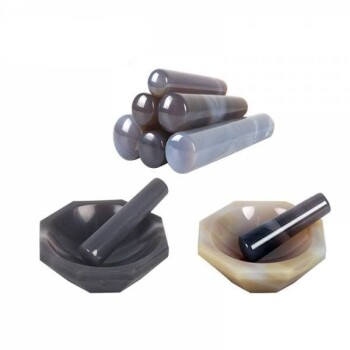
The primary function of using an agate mortar when preparing Li2-xZr1-xTaxCl6 precursors is to achieve a uniform macroscopic distribution of the raw materials (LiCl, ZrCl4, and TaCl5) before the high-energy ball milling process.
This manual pre-mixing step is essential to break up initial agglomerates and ensure that the distinct chemical components are intimately mixed. By doing so, you facilitate reaction consistency during the subsequent mechanochemical synthesis, preventing localized compositional deviations in the final solid-state electrolyte.
Core Takeaway While high-energy ball milling drives the main reaction, the agate mortar acts as a critical quality control step for homogeneity and purity. It ensures reactants are evenly distributed to prevent "dead zones" during synthesis while using a chemically inert material that minimizes the risk of introducing conductive metal impurities.
Ensuring Reaction Consistency
The Role of Macroscopic Pre-Mixing
The raw materials for halide electrolytes—specifically hygroscopic chlorides like LiCl, ZrCl4, and TaCl5—often exist as powders with varying particle sizes and tendencies to clump.
If you introduce these directly into a ball mill without pre-mixing, the milling media may isolate pockets of a single reactant. Using an agate mortar first ensures that the "starting line" for the mechanochemical reaction is uniform across the entire batch.
Facilitating Mechanochemical Synthesis
The synthesis of Li2-xZr1-xTaxCl6 relies on mechanochemistry, where mechanical force drives chemical bonding.
By manually pre-mixing in an agate mortar, you maximize the contact area between the different precursors (e.g., Lithium contacting Zirconium/Tantalum centers). This allows the ball milling process to initiate the reaction more efficiently and uniformly throughout the vessel.
Why Agate is the Material of Choice
Chemical Inertness and Purity
Solid-state electrolytes are highly sensitive to impurities, particularly transition metals that can introduce electronic conductivity (which causes short circuits).
Agate (primarily silicon dioxide) is chemically inert and non-conductive. Unlike stainless steel mixing tools, agate prevents the introduction of metallic contaminants that could degrade the electrochemical performance of the final electrolyte.
High Hardness and Low Wear
Agate is an extremely hard material. During the grinding process, it resists abrasion.
This characteristic ensures accurate stoichiometry. Because the mortar does not shed material into your mixture, the precise ratio of Li, Zr, and Ta you weighed out remains the ratio that enters the reaction. This preserves the intended formula of the Li2-xZr1-xTaxCl6 structure.
Understanding the Trade-offs
Manual Variability
Using a mortar and pestle is an inherently manual process. The quality of the mix depends on the operator's technique and duration of grinding.
Inconsistent manual grinding can lead to batch-to-batch variations. It is crucial to standardize the mixing time (e.g., "grind for 15 minutes") to maintain reproducibility.
It Is Not the Final Reaction Step
It is a common misconception that the agate mortar completes the synthesis.
For halide electrolytes like Li2-xZr1-xTaxCl6, the energy input from manual grinding is generally insufficient to fully crystallize the final phase. This step is strictly for distribution and blending; the high-energy ball milling that follows is required to drive the actual solid-state reaction.
Making the Right Choice for Your Goal
To maximize the quality of your solid-state electrolyte precursors, apply the following principles:
- If your primary focus is Electrochemical Stability: Prioritize the use of agate over metal tools to strictly eliminate the risk of metallic contamination during the pre-mix phase.
- If your primary focus is Phase Purity: Ensure thorough manual blending to eliminate localized compositional deviations, preventing the formation of secondary phases during ball milling.
Summary: The agate mortar serves as the foundational step for homogeneity, ensuring that the high-energy synthesis that follows acts upon a uniform, contaminant-free mixture.
Summary Table:
| Feature | Impact on Li2-xZr1-xTaxCl6 Synthesis |
|---|---|
| Primary Function | Macroscopic pre-mixing and de-agglomeration of raw chlorides |
| Homogeneity | Ensures uniform reactant contact before high-energy ball milling |
| Chemical Purity | Inert agate prevents metallic contamination and short circuits |
| Stoichiometry | High hardness resists wear, preserving precise Li/Zr/Ta ratios |
| Reaction Quality | Eliminates "dead zones" for consistent mechanochemical synthesis |
Elevate Your Solid-State Electrolyte Research with KINTEK
Precision is the backbone of high-performance battery synthesis. At KINTEK, we specialize in providing the high-purity laboratory equipment necessary for advanced material science. Whether you are preparing Li2-xZr1-xTaxCl6 halide electrolytes or exploring next-generation anodes, our portfolio delivers the reliability you need.
Our specialized solutions include:
- Milling & Crushing: High-energy planetary ball mills and premium agate/ceramic mortar sets for perfect homogeneity.
- Synthesis Equipment: Advanced vacuum and atmosphere furnaces, CVD systems, and high-pressure reactors.
- Battery Tools: Specialized battery research consumables, electrolytic cells, and precision hydraulic pellet presses.
- Thermal Control: High-performance cooling solutions, including ULT freezers and freeze dryers.
Ensure your precursors meet the highest standards of purity and electrochemical stability. Contact KINTEK today to discuss your lab requirements and let our experts help you achieve superior synthesis results!
Related Products
- Nature Agate Mortar and Pestle for Grinding and Mixing
- Laboratory Jar Mill with Agate Grinding Jar and Balls
People Also Ask
- Why are agate mortars and pestles used for grinding iron oxide? Ensure Sample Purity for XRD Analysis
- What is the function of an agate mortar and pestle? Ensure Purity in Halide Solid-State Electrolyte Synthesis
- What is the primary function of an agate mortar and pestle? Optimize VO2+ CaZn2(PO4)2 Nanopowder Pre-Treatment
- Why is an agate mortar and pestle required for grinding Zr3(Al1-xSix)C2? Ensure Maximum Sample Purity
- Why is an agate mortar and pestle preferred for grinding MAX phase? Ensure Sample Purity & Zero Contamination