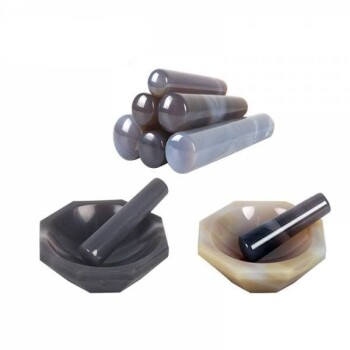
An agate mortar is the primary tool utilized for the manual comminution of solid electrolytes during the final processing stage. After high-temperature annealing, it is used to grind sintered or agglomerated material back into a fine, homogeneous powder to prepare it for final pellet pressing or slurry creation.
High-temperature annealing often causes solid electrolytes to fuse into hard agglomerates. The agate mortar provides the necessary hardness to mechanically break these structures down while ensuring the chemical inertness required to maintain high purity.
The Role of Agate in Post-Annealing Processing
Breaking Down Thermal Agglomerates
Solid electrolytes typically undergo high-temperature annealing to achieve the correct crystal structure.
This process often results in sintering, where particles fuse together into hard clumps or agglomerates.
An agate mortar is utilized to mechanically pulverize these fused chunks, returning the material to a workable powder form.
Achieving Particle Uniformity
Consistency is vital for the subsequent steps of battery fabrication.
The grinding process ensures the powder achieves a uniform particle size.
This uniformity is a prerequisite for successfully pressing dense pellets or preparing smooth, consistent slurries for coating.
Why Agate is the Material of Choice
Maintaining Chemical Purity
Solid electrolytes are highly sensitive to contamination, which can degrade electrochemical performance.
Agate is chemically inert and corrosion-resistant, preventing the introduction of impurities during the grinding process.
Unlike metal mortars, agate ensures that no conductive metal particles are abraded into the electrolyte powder.
High Hardness for Efficient Grinding
The material properties of the mortar must exceed those of the electrolyte being processed.
Agate possesses high hardness, allowing it to effectively grind hard ceramic electrolytes without wearing down significantly.
This durability ensures the tool remains effective over repeated uses without compromising the sample.
Understanding the Trade-offs
Manual Variability
Because the agate mortar relies on manual operation, the resulting particle size distribution can vary based on the operator's technique and duration of grinding.
This method lacks the automated consistency of ball milling, potentially introducing slight batch-to-batch variations.
Throughput Limitations
The use of an agate mortar is inherently a low-throughput, labor-intensive process.
While ideal for laboratory-scale synthesis and research where purity is paramount, it is generally ill-suited for large-scale industrial manufacturing.
Making the Right Choice for Your Goal
To determine if manual grinding with an agate mortar is the correct step for your process, consider your specific endpoints:
- If your primary focus is high-purity research: Rely on agate to break down agglomerates without risking the metal contamination that can short-circuit cells.
- If your primary focus is pellet densification: Use the mortar to ensure particle sizes are fine and uniform enough to minimize voids during the pressing stage.
By using an agate mortar, you ensure the physical integrity of your powder while safeguarding its chemical composition.
Summary Table:
| Feature | Benefit for Solid Electrolytes |
|---|---|
| High Hardness | Effectively grinds hard ceramic sintered agglomerates without tool wear. |
| Chemical Inertness | Prevents contamination and maintains high electrochemical performance. |
| Manual Control | Ideal for laboratory-scale synthesis and delicate sample preparation. |
| Non-Metallic | Eliminates the risk of conductive metal particle abrasion into the powder. |
Elevate Your Battery Research with KINTEK Precision Tools
High-performance solid electrolytes demand the highest purity and consistency. KINTEK specializes in providing the essential laboratory equipment and consumables needed for advanced material synthesis. Whether you are performing manual comminution with our premium agate mortars and pestles or moving toward automation with our crushing and milling systems, sieving equipment, and hydraulic pellet presses, we have the solutions to ensure your materials meet exact specifications.
From high-temperature furnaces for annealing to isostatic presses for densification, KINTEK supports your entire workflow. Contact us today to discover how our comprehensive range of lab solutions can enhance your research efficiency and material integrity.
Related Products
- Nature Agate Mortar and Pestle for Grinding and Mixing
- Laboratory Jar Mill with Agate Grinding Jar and Balls
People Also Ask
- Why are agate mortars and pestles used for grinding iron oxide? Ensure Sample Purity for XRD Analysis
- What is the function of an agate mortar and pestle? Ensure Purity in Halide Solid-State Electrolyte Synthesis
- What is the primary function of an agate mortar and pestle? Optimize VO2+ CaZn2(PO4)2 Nanopowder Pre-Treatment
- Why is an agate mortar and pestle required for grinding Zr3(Al1-xSix)C2? Ensure Maximum Sample Purity
- Why is an agate mortar and pestle preferred for grinding MAX phase? Ensure Sample Purity & Zero Contamination