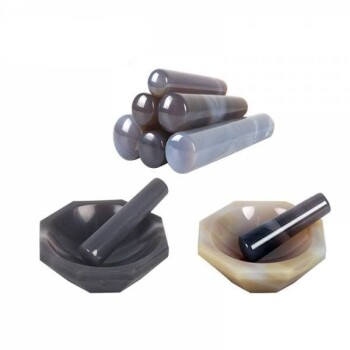
Precision in sample preparation is paramount. An agate mortar is selected for grinding silicate glass primarily due to its extreme hardness and superior chemical inertness. These physical properties prevent the grinding tool itself from degrading and shedding material into the sample, thereby eliminating the risk of cross-contamination that could compromise sensitive structural analysis.
The use of agate ensures that the resulting data reflects only the intrinsic properties of the glass matrix and radiation-induced changes, rather than artifacts introduced by the sample preparation equipment.
Preserving Sample Integrity
The Role of Extreme Hardness
Silicate glass is a hard, abrasive material. To grind it effectively without destroying the tools, the mortar must possess extreme hardness.
Agate meets this requirement, allowing it to pulverize the glass into a fine powder. Because agate is sufficiently hard, it resists the abrasive friction that would cause softer materials to chip or wear down during the grinding process.
Superior Chemical Inertness
Beyond physical durability, the grinding environment must remain chemically neutral. Agate is highly chemically inert.
This ensures that there is no chemical reaction between the mortar and the silicate glass. The composition of the glass powder remains identical to the bulk sample, preserving the validity of the experiment from the very first step.
Ensuring Accuracy in X-Ray Diffraction (XRD)
Preventing Signal Interference
The primary goal of the study is to analyze structural transformations using X-ray diffraction (XRD). This technique is highly sensitive to the presence of crystalline structures.
If material from the grinding tool were to detach and mix with the sample, it would introduce external impurities. These impurities would appear as foreign signals or "noise" in the XRD results, obscuring the true data.
Isolating Irradiation Effects
The study specifically looks for microcrystalline phases produced by irradiation. To identify these specific phases, the background signal must be clean.
By using an agate mortar, researchers ensure that any short-range ordered structure or microcrystalline phase detected is a result of the irradiation process alone. This isolation is critical for drawing accurate conclusions about how radiation affects the glass matrix.
Common Pitfalls to Avoid
The Risk of Tool Detachment
A common error in powder preparation is selecting a mortar material that is softer than the sample being ground.
If a softer material is used, the friction of grinding causes the tool's surface to degrade. This leads to material detachment, where microscopic particles of the mortar blend with the glass powder.
Compromising Structural Data
Once contamination occurs, it is often impossible to separate the tool's debris from the sample data mathematically.
This compromises the entire dataset, as researchers cannot verify if a structural anomaly is a genuine scientific discovery or simply a preparation artifact. In studies of subtle radiation-induced changes, even minor contamination can render the results inconclusive.
Making the Right Choice for Your Goal
To ensure your analytical data remains valid, consider your specific experimental objectives:
- If your primary focus is distinct phase identification: Use an agate mortar to guarantee that detected microcrystalline structures are caused solely by experimental variables like irradiation.
- If your primary focus is chemical purity: Rely on agate's extreme hardness to prevent abrasive tool wear from introducing foreign elements into your silicate matrix.
Reliable science begins with a sample that is a true representation of the material, not the tools used to make it.
Summary Table:
| Feature | Benefit for Silicate Glass Research |
|---|---|
| Extreme Hardness | Resists abrasion; prevents tool material from shedding into the sample. |
| Chemical Inertness | Prevents chemical reactions, preserving the glass matrix's original composition. |
| High Density | Enables efficient pulverization of hard glass into fine, uniform powders. |
| XRD Accuracy | Eliminates 'noise' from impurities, isolating radiation-induced structural changes. |
Elevate Your Sample Preparation with KINTEK
Precision research demands purity. KINTEK specializes in high-performance laboratory equipment, providing researchers with the tools needed to eliminate variables and ensure data integrity. Whether you require premium agate mortars, high-precision crushing and milling systems, or specialized vacuum and tube furnaces, our solutions are designed for the most demanding applications in materials science.
From high-temperature high-pressure reactors to advanced battery research tools, KINTEK is your partner in scientific excellence. Don't let equipment artifacts compromise your results—contact us today to find the perfect solution for your lab!
References
- Mussaeva Malika Anvarovna, Guzal Olimjon qiz Olimjonova. Radiation-Induced Structural Transformations in SiO₂- Based Silicate Glasses. DOI: 10.56334/sei/8.9.34
This article is also based on technical information from Kintek Solution Knowledge Base .
Related Products
- Nature Agate Mortar and Pestle for Grinding and Mixing
- Laboratory Jar Mill with Agate Grinding Jar and Balls
People Also Ask
- Why are agate mortars and pestles used for grinding iron oxide? Ensure Sample Purity for XRD Analysis
- What is the function of an agate mortar and pestle? Ensure Purity in Halide Solid-State Electrolyte Synthesis
- What is the primary function of an agate mortar and pestle? Optimize VO2+ CaZn2(PO4)2 Nanopowder Pre-Treatment
- Why is an agate mortar and pestle required for grinding Zr3(Al1-xSix)C2? Ensure Maximum Sample Purity
- Why is an agate mortar and pestle preferred for grinding MAX phase? Ensure Sample Purity & Zero Contamination